Did kids really used to say golly, gee, and gosh a lot?

I have never really heard “golly” outside of holly jolly Christmas carols (much like figgy pudding). People sometimes still use “gee”, but I use this term exceedingly rarely.

When I moved to East Coast Canada, many people used the equivalent phrase “jumpins”, which was new to me.

Swear words were taboo and shocking when I was young, and now are commonplace and accepted. Euphemisms like “shut the front door” were used. Even my parents swear occasionally, but surprisingly, I have never heard my older brother utter a curse word. He thinks them undignified. I tend to swear in French or Spanish. So classy.

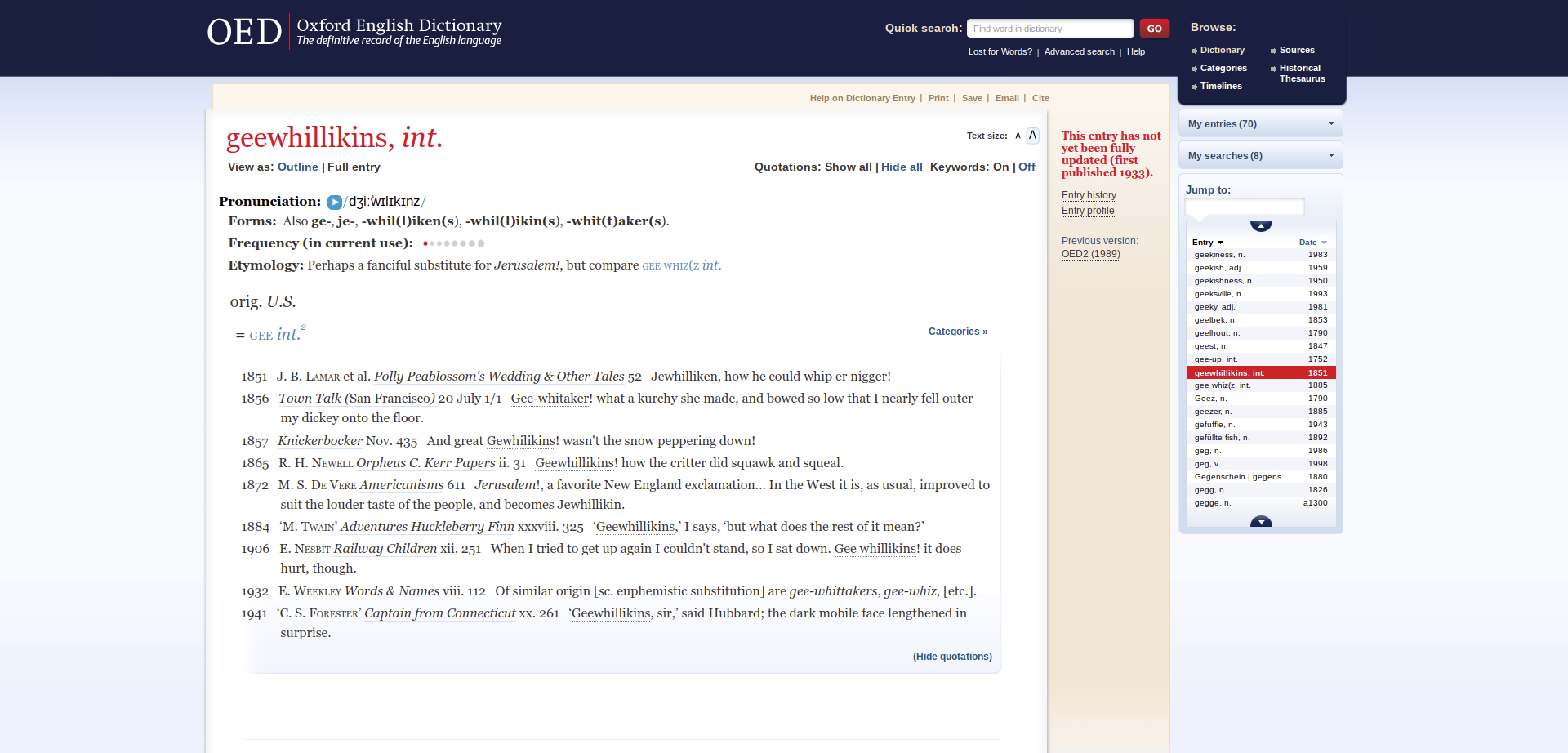
The kids in 1930s and 1940s movies, radio shows, and comic books all used gee, golly, and gosh. And it goes much farther back than that. Twain used “geewhillikins” in Huckleberry Finn.Famed English children’s writer Evelyn Nesbitt used it in 1906. The OED dates the phrase to 1851. It sure wasn’t a kids’ word then!

I don’t recall anyone saying “golly” or “gosh” when I was growing up in the 1960s, although I’ve heard “gee” all my life.

All three are “minced oaths”, and it’s not hard to see where they likely came from – “gosh” and “golly” start with the same “go-” as “god”, which kids weren’t supposed to say as an exclamation. “Gee” is a truncated “Jesus”

Similarly. you have, as substitutes for “Jesus Christ” the similar and similarly stressed “Judas Priest”, “Cheese on Rice”, and “(Great) Caesar’s ghost”. The last of these was used by Horace Bixby (according to Mark Twain in Life on the Mississippi) and by Clark Kent’s editor, Perry White. (In one comic book use, White actually has a vision of Caesar’s ghost after he says it). I suspect that Bixby’s use is a euphemism for something else. Twain said that Bixby regularly used eloquent curses, something Bixby denied to the end of his life.

I have a theory about another minced oath – “Jiminy cricket” or “Jiminy crickets”. The Disney cartoon has John Darling saying this in Peter Pan. And, of course, they use it for the name of the character in Pinocchio (in Carlo Collodi’s original book, the cricket has no name, but is simply “Cricket”. Pinocchio gets fed up with his ersatz conscience and squashes him into bug juice in the book, something they left out of the movie)

Of course, anyone looking for evidence of euphemism hasn’t got far to look – Jiminy Cricket’s initials are “J.C.”, just like a certain religious figure. But it goes deeper than that. Or possibly I have an overactive imagination. Follow me here.

Minced Oaths are nothing new. In ancient Rome women and children used them, and two of them were Edepol and Ecastor were two of these. They were, in turn, derived from Pollux/Polydeuces and Castor, the twin sons of Zeus and Leda (and Tyndareus, but it’s complicated). The words mean, literally, “By Pollux” and “By Castor”. Using the names of demigods instead of gods was apparently les serious than using the names of gods.

Collectively, they were the Gemini.

In the 18th and 19th century (and before, as well, but these are more important to my point) the classics were part of an education for the young, who frequently had to learn Latin and/or Greek to be considered “educated”. Even at lower social levels, the influence of the classics filtered down to become part of education. (Heck, I took two years of classical Latin myself). Lots of bits of Roman culture got introduced into everyday life, including expressions. But instead of getting students to use Ecastor and Edepol, they introduced the use of “Gemini”, which eroded through time into “Jiminy”

If you think this is farfetched, Etymology Online cites “By Gemini” attested to in 1802.

Jiminy(interj.)

exclamation of surprise, by Jiminy!, 1803, colloquial form of Gemini (by Gemini is attested from 1802), a disguised oath, perhaps based on Jesu Domine “Jesus Lord.”

Most people not having a classical education, this got rationalized into a euphemism for Christ. Some say it’s a worn-down form of “Jesu Domine”, which I find harder to swallow than “Gemini”. In any event, by the mid-19th century “Jiminy Christmas” and “Jiminy Cricket” had appeared, likely driven by the “J.C.” initials. And farmboy Walter Elias Disney probably heard “Jiminy Crickets” often enough growing up in the Midwest.

Since starting this thread I thought of another word all over 50s comics and TV that I wonder about the frequency of real-world use: “swell”.

A friend I’ve known since junior high (late '60s) still uses “golly” and “gosh” occasionally in emails he sends me.

I can say nothing about real-world usage, but I seem to recall a 1940s Superman radio show episode where Clark tells Jimmy Olsen (who about 14 years old) that he shouldn’t use slang after Jimmy uses “swell.” Also, of course, shows up in the 1978 movie as a shout-out to Clark’s old-fashionedness, as I recall.

Doesn’t answer your question, of course, but it makes me think of to what degree there was a movement in the first half of the 20th century among certain types of adults/educators/etc. to have children avoid slang altogether (or at least avoid it with adults or in professional environments).

“Shoot”? “Shucks”?

A shortened form of “Great jumping Jehoshaphat”?

“You can’t fool me – ‘Shoot’ is ‘Shit’ with two O’s” – George Carlin

Don’t need a cite for the obvious origin of “Shucks”

As I’ve remarked before, I doubt if “Cotton pickin’” has its origin in racist imagery. It just has the same accents and stresses as ”motherfuckin’”

Euphemism etymology is fun!

There’s also “Criminy” as a minced oath for “Christ” - presumably nothing to do with the mushroom.

I was probably in my twenties before I learned that golly, gee, and gosh were minced oaths, and I only now learned about the term minced oaths.

Don’t know how it is nowadays, but when I started Grade 1 in 1985, saying “fuck” or “shit” could definitely get you in trouble at school, IIRC, bad enough to be sent to the principal’s office and have to sit there for a while. So if some kid wanted to tattle on you in order to be spiteful to you, they might hear you swear and then would go: “Oooh–I’m TELLEEEEEEEENG!!! YOU SAID THE F-WORD!!!”

I learned this the hard way when I started school. Until then, I actually didn’t understand the concept of a swear word / oath / expletive. In my family, Serbian was spoken and my parents (certainly my mother) used some pretty typical Serbian swears, such as the standard one “E, jebem ti mater” (Ah, I’m fucking your mother!) I didn’t understand what it meant – I thought it was just an angry or shocked exclamation!

In the 80s there was an after-school cartoon called “JEM”, about an all-girl pop group and their (eventually) two rival bands. One character from one of the rival bands was an English girl called Jetta. She would sometimes use the expression “bloody”. Apparently the the producers weren’t aware that in England, that word is an expletive, and put it in a kids’ show.

I probably heard the words “gee” and “gosh” from time to time, but as I recall, the words “Jesus” and “God!” were used quite a lot where I grew up (Toronto) and no one made a big deal out of it. “Golly” – that one I only knew from the media, I can’t recall it being used in everyday speech. (I noted it as something weird when I first heard it in a cartoon, IIRC it was Clumsy Smurf, who used it in his anachronistic fake Southern US accent).

In Grade 4, my teacher, Mr. L. actually used the expression “a piece of crap” when criticizing students’ poor work. I learned it from him. The next school year, I used that expression when speaking to my Grade 5 teacher, and she was shocked at my vulgarity.

Maybe, maybe not. I found references to the term “cotton pickin(g) coon” as far back as 1900.

And, frankly, I’m a little surprised that the word “coon” as a racial slur goes back that far. I didn’t hear of it until the 1970s, and that was from some ‘city folk.’ Some things were slow to make it to the rural south, as I’d never heard it used to mean anything other than trash pandas.

There’s a whole TV Tropes page about that:

https://tvtropes.org/pmwiki/pmwiki.php/Main/DidNotDoTheBloodyResearch

Never thought of that. But probably.

The earliest use of “coon” as a racist insult was in 1837.

We were late getting the memo. And of course, there were already other colorful slurs already in use.

To a feverish degree. Slang was reviled by all self-proclaimed “good” speakers. It was associated with the lower classes, who were deemed illiterates and destroyers of the English language.

Just for fun, I did a quick search and found this from the Austin Daily Texan in 1930.

[I]t is to be wondered if the prolific use of slang is robbing us of our richest heritage, the English langauge. …

William Lyon Phelps, of Yale University, says that “slang, like profanity, is the resource of those whose vocabulary is limited.”

Most Americans paid no attention to this nonsense, but, like profanity, slang was supposed to be kept of out the public eye. One person’s offense was deemed more important than the approval of ten thousand.

Oh yeah? Keep listening until 1:25. :wink: