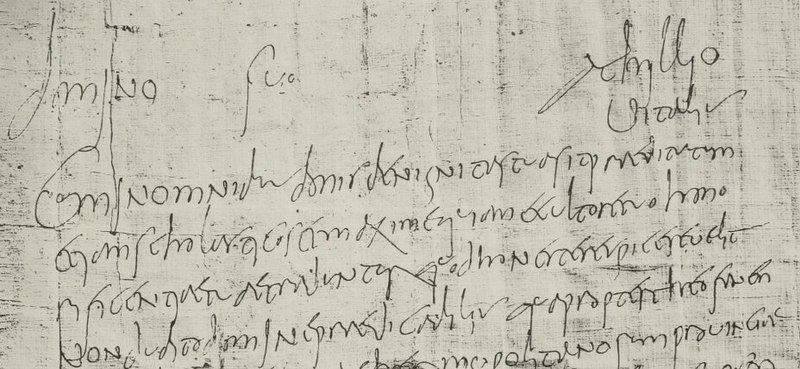
At doctorate or postdoc level you might want to do original research and read documents that someone hadn’t already transcribed and printed in a textbook for you.
Handwriting (and printing) has changed over the centuries, and as soon as you go back to the 17th century, you’re going to have to learn entirely different forms of cursive, even if you know modern cursive. But it wouldn’t be all that difficult to learn to read earlier scripts. Perhaps it would take a week or two to get comfortable with it?
Teaching cursive to children and forcing them to use it went on for decades too long out of momentum. It should have died out with fountain pens. I never took to it and stopped as soon as I was allowed.
Its nice to start with a foundation. My youngest’s History major requires doing some original transcription for some of the classes (it may end up being their Summer internship - transcribing old farm journals). Its easier to read early 20th century script if you can read late 20th century script. Its easier to read early 19th century script if you can read early 20th century…and so on. It is a skill that can be developed, but it isn’t a skill that it should be assumed people have.
And its difficult to learn a different alphabet as an adult (says anyone who has learned Russian or Greek as an adult) - which is sort of what you are doing learning to read script.
I don’t think it needs to be taught, because it is sort of a niche thing to do, but I think an awareness that it isn’t taught needs to filter into undergrad History programs. (My kid’s transcription project was a journal from 1840 - the historical society has a ton of documents that are not transcribed, and are using the University History department undergrads to slowly work through it as an assignment in research and working with original materials).
Okay, how long would it take to teach it? You have to teach the letters anyway. Though probably many kids know these long before kindergarten. Assuming no knowledge, would it really take much extra time to teach cursive after printing? (Independent of its value and lost opportunity costs).
If one is in the humanities/social sciences there’s a very high probability that one will need to use original primary sources in their research. You mention family letters. One of the collections I managed were World War II letters. An assignment (from a history professor) required her students to use a minimum of three of these letters for an assignment and more than half the class couldn’t perform.
No doubt, letters are tough and our position was, “the onus is on the researcher.” It would be impossible to transcribe (or digitize) what’s held in a repository.
As far as interns (or volunteers), yes, working with original documents is absolutely necessary. (Part of their experiential learning includes handling and preservation, so the expectation is they’ll know how to treat the items to start with.) Not to get too technical about archival processing, but if a collection comes in, it’s arranged and described, among other things. One needs to recognize what the items are and how to explain their content, sometimes on a very granular level.
Those (mostly volunteers) who read cursive contribute greatly to the transcription of records used as genealogical resources, but they’re still fraught with errors since trying to read some recent handwriting can be challenging at best. The last US census relying on hand-written forms was 2010, so it will be interesting to see how well they’re transcribed for their release in 2082.
There was/is an expectation that one comes with a skill set that will help students perform tasks required of them in a college/university setting. Cursive seems to be one of those abilities that’s been dropped from elementary school curriculum.
It’s one of the reasons we offered a six-week(!) course on how to use the library. Students had never heard of either the Dewey or Library of Congress classifications, much less, knew how to use them.
In the same vein, I had to teach classes full of students (practically born with electronic devices in their hands) how to create folders and save files in those folders on their computers. (Didn’t kids learn this as part of their computer classes?)
Was cursive dropped for reasons other than it wasn’t perceived as a necessity? Unknown. But, the ability to read it is still a useful, nay mandatory skill in certain areas of study and occupational pursuits.
I can only read about 75% of my mother-in-law’s letters which she has written in the last 20 years. But it’s not just me. Her own children really struggle. It doesn’t help that she uses pencil and seems to hav an allergy to straight lines.
Me, too. But I learned cursive a very long time ago, and I’m “fluent” in it.
I began learning Russian as an 18 yo, and it took me a couple of days to really learn the alphabet. That wasn’t the difficult part of learning Russian!
I taught myself to write cursive as an adult. Up until my early 20’s I used a block printing that looked very… childish. When my wife made a comment about my poor handwriting I decided to change it. It was fairly easy but I still today struggle with remembering certain capital letters – Q, for instance. For the most part I still use my original block printing for capitals.
On the rare occasion I come across some old paper that I wrote on 20 years ago I do not recognize my own handwriting.
My cursive is very nice if I have a decent pen (I like fountain pens) and take my time. Quick notes are just chicken scratch.
I dropped Intro to Russian after two weeks my Junior year in college in 1984 (I over-scheduled and something had to go). If I remember correctly, they had us writing letters differently than how they were printed. I don’t know if you’d call it cursive, though.
Russian script isn’t completely 100% connected as English script is. It affected my English script after I got used to the Russian style! It was like the best of both worlds.
But diclensions drove me crazy. Then, my second year teacher said a large percentage of Russians slurred their word endings in normal speech anyway. And no one would shun you on the street in Moscow if you got a diclension wrong. Good to know!
I remember standing in line outside the Troubadour one night and some guy who was going to Russia (well, it was still the Soviet Union then) the next week wanted to know how to say “woman.” I told him. But I always wondered how he got along if that was the only word he wanted to know.
I taught 3rd grade this past school year (which just ended yesterday, May 27, 2021). Our school system does not teach cursive. I am glad. First of all, it’s not something that’s assessed on any standardized test, so the district is not going to give two-sh*ts about it. Secondly, EVERY assignment we did this year (with students doing long-distance learning AND students in the classroom, we had both due to Covid) involved a computer. It would be FAR better and more useful to teach kids keyboarding (typing) skills. Not only that, but in addition to the assignments, all standardized tests were given online this year as well. Not much use for cursive there.
One school teacher taught us calligraphy. Not terribly useful, but before that my handwriting was terrible. I had to go to medical school to learn how to write badly again.
I thought this teacher was nuts when she made our class go to the local high school to learn how to type. They played these typing records which were very repetitive. But really, clearly she was a genius and years ahead of her time. We even had a computer in our classroom. It was the early 80s. It might have been the only classroom in our small city that had one.
I would call that calligraphy and I don’t think that has ever been a required subject in Elementary School. Our school system has failed to prepare us for prison.