A while back, I bought a “storm bottle” at a yard sale. I’ve been watching it for a while, and I am struck by the shape of the camphor crystals inside…they look like miniature pine trees. For those of you who don’t know, a storm bottleis a sealed glass tubem filled with a saturated solution of camphor, ammonium chloride,alcohol, and water. These dendritic crystals are beautiful…they seem to grow to about a centimeter or so, then breakoff. They look like pine or spruce trees. Is it possible that the encoded growth patterns (in conniferous trees DNA) follows the same pattern as these crystals?
The results are similar (and self-similar), but the processes are different. A tree branch “decides” when to, well, branch based on rules encoded in its DNA. Since each cell has the same DNA, they all follow the same rules. All the decisions are made locally, rather than every cell having an idea of “the whole tree”. This leads to the self-similarity in the branching pattern.
Your crystals likely are growing by “diffusion-limited aggregation”. That is, dissolved particles float around in the solute until they come near an established crystal, at which point they join onto the crystal. The result is a “brownian tree”. The branches tend to grow because a particle is more likely to hit a protrusion than get down to the “center” to fill in the gap between two branches.
Lindenmayer Systems are a simple formal grammar/automata system that seem to capture certain key elements of plant growth. Cool stuff has been generated using them. (Much better than fractal systems.) But keep in mind that a tree is fantastically complex and no simple (i.e., figured out by a human) system can be a 100% perfect model.
Pine trees tend to have their buds arranged regularly, and commence growth in these buds simultaneously. They also tend to have their buds arranged radially, which is why young pines have a “ring” of branches in more or less regularly spaced tiers. If you watch a pine beginning new growth, you’ll see the new branches (candles) grow at the same time. However, as things like disease, or drying winds, lightning, or instect attacks can alter this growth, they tend to not always be as regular as crystals.
The most regular conifers i’ve seen are Araucaria heterophylla, the Norfolk Island Pine, which has a very regular growth pattern, with regularly spaced branches spaced evenly in radial tiers. You can see it here:
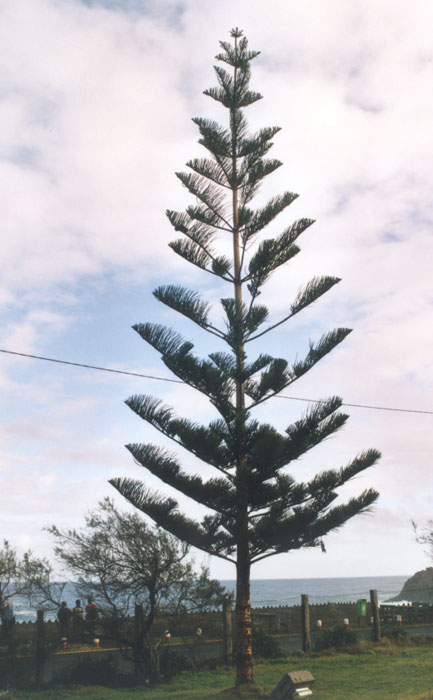
If you look towards the top you can see how regular their development is. These are also called “Star Pines” due to their tendency to have five branches per tier, which looks like a star.
Another factor in determining the shape of a tree is the production of a hormone, abscisic acid, in the terminal buds (at the ends of branches) of a plant. This hormone suppresses growth and keeps all but the terminal buds dormant under normal conditions. If a terminal bud is clipped off (pruning, as gardeners sometimes do) the other buds no longer receive absciscic acid. They begin to grow new a new branch and become terminal buds themselves. Under conditions where it is appropriate for the plant to grow new branches (high light levels, for example), abscisic acid is suppressed or its effect is overwhelmed, and the tree begins to grow new branches. That’s one non-random aspect to tree growth and shape.
That being said, fractal models of tree growth can produce startlingly realistic trees. Presumably they’re even more effective at predicting the growth of a dendritic crystal. I imagine that analogous processes on a molecular scale (branching in low-density polyethylene, for example) can also be modelled in this way.