I’m 48 and still read them, although there what brought me back was Watchmen back in 1987. I had drifted from Marvel, DC, and Golden Key comics but Watchmen was like nothing I had ever seen. Today, it’s Walking Dead, Fables, League of Extraordinary Gentlemen, I Zombie and a host of others.
I bought and read monthlies regularly until about two years ago when DC cancelled all three series I was still buying (Legion, Dial H, and Threshold). The New 52 pretty much killed my interest in most of their books, of which I bought many beforehand. I continued buying Fables in trade paperback, and now that too has ended. I’ve been comic-book-free (as far as new purchases go) for about eight months now, and it feels weird, but I’m not actively seeking new ones to get hooked on.
On the other hand, the Marvel movies provide me with something of a continuing fix.
I pretty much stopped a long time ago, except for special issues or series. Ignoring collected graphic novels, the –
I’ve bought and read:
Phil Foglio’s four-issue run of Angel and the Ape (excellent)
His limited series Stanley and his Monster (not as good, but it’s the first appearance I’ve seen of The Heterodyne Boys and a strong female inventor. It’s like watching the genesis of “Girl Genius”)
His 12-issue Buck Godot: Zap Gun for Hire (which follows his graphic novels of same)
The League of Extraordinary Gentlemen (all incaenations)
The special 12-issue series The World’s Greatest Comics Magazine, which was a Fantastic Four story done in the writing style and drawing style of Stan Lee and Jack Hirby.
The special issue Fantastic Four: The Lost Issue
The special 6-issue run a few years ago of Ambush Bug (I’ll take AB over Deadpool for self-aware comic book characters, thank you)
Wait, the Heterodyne Boys pre-existed Girl Genius? Where can one find this?
CalMeacham:
These were genius - I’d hoped that they would follow up with an Inferior Five series (with them as stars, not merely as guests).
The only problem I see with that is that eventually you change the character so much that they no longer seem to be the same character.
Your mention of Lois vs. Wonder Woman as Superman’s love interest, for example. Lois Lane was “Superman’s Girl Friend” for virtually all of the 75 years that Superman has existed (except for, that is, when she was actually Superman’s wife). Wonder Woman never became a love interest until the New 52, and I found that very disappointing; I really thought some writer who started as a fanboy was trying to fulfill an adolescent fantasy. More recently, Superman lost his powers. He was also given a new power, some sort of energy burst that stripped him of his other powers for a time after using them. My reaction to all of this has been, yeah, this is some sort of superhero story, but it’s not Superman. Superman has a defined canon; I think one needs to be very careful about how and to what extent one changes it lest he lose the essence of the character. It can be done. John Byrne did an excellent job of tweaking the Superman character in 1985. But the New 52 changes, in my opinion, have been a disaster, and have left me wondering if I even want to continue reading the series. Let’s just say I’m hanging a lot on how well the upcoming *Rebirth *reboot is handled.
It’s similar with Batman. For the umpteenth time, Bruce Wayne has either disappeared or apparently died, and someone else has become Batman for a while. This time it’s Jim Gordon, who has suddenly become young enough to take on the cowl (though they have said in the comic that he is 46, and I find it hard to imagine many 46-year-olds who are in the sort of shape to do what Batman does, even if they do have a mechanical robot suit). Again, it’s some kind of superhero story, but for me, it’s not Batman. Write the stories about a police commissioner turned caped crusader if you must, but don’t call them Batman, because that’s not who Batman is. As with Superman, there’s a defined canon out there - what’s wrong with just writing good stories within that canon? If you have a way-out idea about a character who is significantly different, either make it a different character, or, if it fits, write an “Imaginary/Elseworlds/What If” kind of story, in which you are able to explore your idea with the established character, but outside of the established canon.
Maybe I’m just old and cranky, but if I read a Superman or a Batman story, I want to recognize the character.
Good comics for adults?
Well, I see Maus is well-represented. But there are others. Here’s some of my faves:
- The Cartoon History of the Universe by Gonick is awesome. It is what it is called: a cartoon universal history.
- The Contract With God trilogy by Eisner. Some of the best comic artwork ever, by a master of the genre - sometimes called ‘the first graphic novel’. The chapter “a contract with God” , about a religious man losing his faith and giving way to despair on the death of his daughter, is absolutely heartbreaking - it may as well have been drawn in the author’s own blood. Makes sense, when you read it was a reaction to the author’s own tragic loss of a child to cancer.
- Persepolis, by Satrapi an autobiography about growing up as an Iranian girl in Iran.
-
- The Thrilling Adventures of Lovelace and Babbage: The (Mostly) True Story of the First Computer * by Padua. Awesome. Part history, part steampunk fantasy, the ultimate adult geek comic.
I’m 55. I started collecting when I was ten (1971) – mostly mainstream Marvel and DC. I continued as an adult. Didn’t stop until a financial crisis forced me to quit around 2007. I still have a whole room full of comic books, but I haven’t bought any new stuff since that time.
Not just his Cartoon History of the Universe, but also his Cartoon History of the United States, Cartoon History of the Modern World, and various Cartoon Guides (Genetics, Computers, Physics, Statistics, Sex, etc.)
Pop for this collection–
The only comic books I’ve read since the 80s is the Coheed and Cambria comics detailing the events of the Second Stage Turbine Blade era. It has unfortunately modern art and I miss the soft art of former eras, but the desire to see the story overrode this.
But in general, modern comic art hurts my eyes. So for this reason, even self-contained stories without ridiculous reboots and resurrections do not appeal to me.
Yup, all are awesome.
Hey, that looks good. I think I’ll pick it up! 
I did not read them as a kid (though I did buy a Star Wars comic before seeing the original movie – wish I hadn’t lost track of that)
I have Buffy in my pull list – mostly to support the local game / comics / misc store. We did use their game room to play board games for a while. I have bought a few games, but mostly go online for that.
Brian
I had several monthly subscriptions that I used to receive in the mail, but pretty much gave it up after graduating high school ('88). Once every few years, I’ll buy a collection or a graphic novel just to see what the fuss is about on something trending or getting good reviews and they’re enjoyable, but at the hefty price tag, just can’t imagine forking over that kind of green on a regular basis.
There’s an older appearance of the Heterodyne boys: Grimjack #40, from 1987, in the Munden’s Bar backup feature. Here’s a page. The setup, here, is that the Heterodynes come from a universe that works on the same sort of moral logic that powers, say, the Batman '66 TV show. And they wind up in a place that’s basically the Mos Eisley cantina.
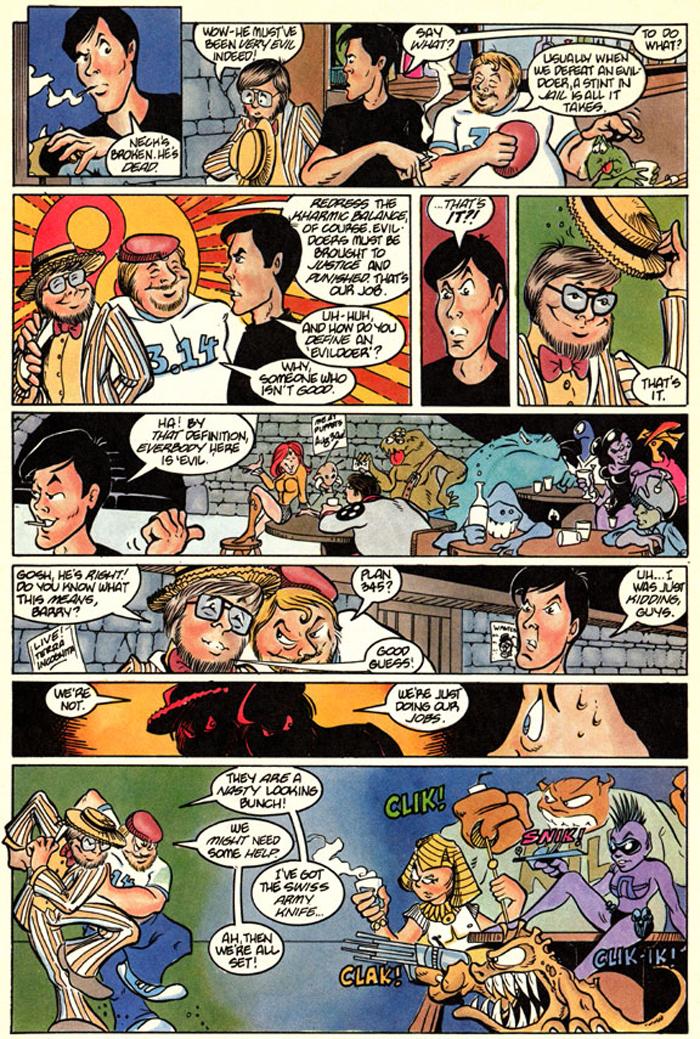
Fracas ensues.
As far as I know, this was the first ever published appearance of the Heterodyne boys.
Tongue in cheek? Wit? Not sure these are terms that make me want to read accounts of nauseatingly brutal murders of real people.
Look, it’s first class work, & shockingly well-reviewed.
And there are more in the series.
No doubt there are good reviews. I’m just having trouble imagining a “tongue in cheek” retelling of the savage murders of several sad, poor women that I would want to read.
I did find it a little disturbing, albeit well done. It prompted the thought that the bulk of depictions of crime in nonfiction (including television) are at bottom exploitative and voyeuristic. At least most (all?) of the families of the victims in Geary’s account have long since passed on.