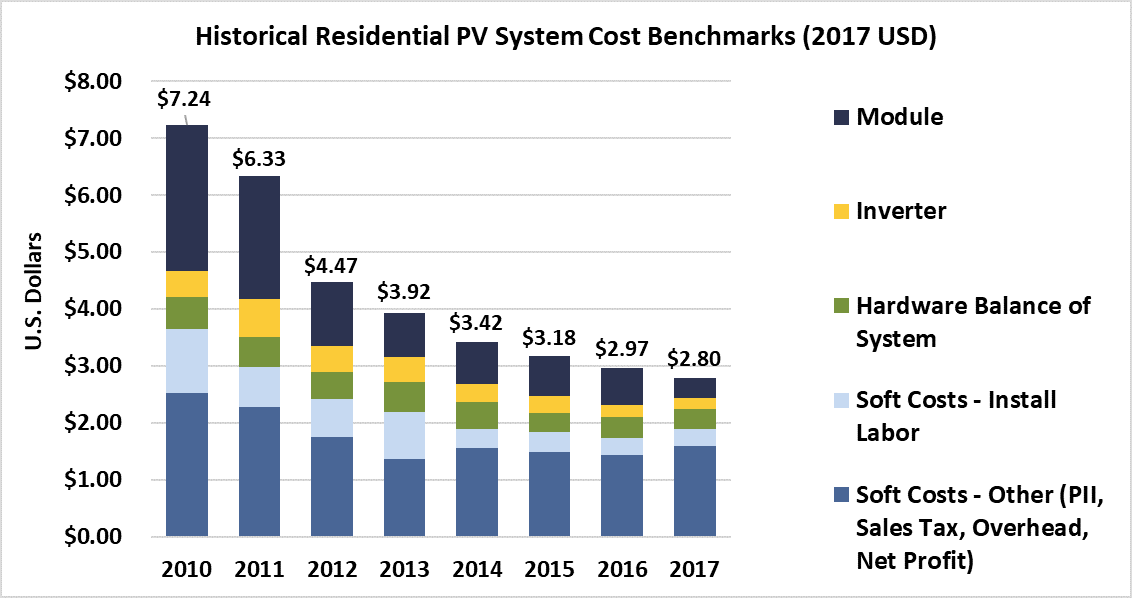
In America, solar costs have declined but that is mostly because the solar panels themselves have declined in price. Panels went from about $3-5 a watt down to around $0.50 a watt over the last 15 years.
But ‘soft costs’ haven’t budged much and are now the bottleneck.
Companies like Legion solar claim to reduce soft costs by creating easy to install panels. They seem to claim you can set it up yourself w/o permits and plug it into an outlet, which would reduce soft costs quite a bit.
Does anyone know if companies like this are legit or if this is an actual improvement over existing solar systems where the soft costs make up 2/3 of the total price?
I don’t know anything specifically about that company, but my thoughts are:
No permits and plugged into an outlet? If you’re sticking 50 Watts of panels on the ground in your backyard, maybe, and only have them plugged in when you’re powering something on that circuit.
But if you’re putting anything on your roof, or more than 100W or so of wiring, I think your municipality is really going to want you to have permits (building and electrical). There’s a decent possibility they have very specific requirements for solar panel installations (for instance a quick shut-off switch mounted outside the house). I really do not advise doing multi-kilowatt wiring, especially highly visible work, without a proper electrical permit (which will certainly not allow just plugging panels into an existing wall socket).
And there’s no way to do any kind of net metering (selling extra power back to the utility) or renewable production credits without proper permits, many or most projects will be economically unviable without permits.
Doing the physical installation yourself is probably possible for some people, just like building an addition is possible for some people, but there aren’t that many people who can do it nearly as efficiently as a pro. Depends on how you value your time.
I can’t speak to your #1 or #3. However, regarding #2, I think having a storage battery, which the video talks about and which would allow storage of excess energy for use when the sun is not available, would obviate this objection. It could allow a large reduction in electricity consumption from the grid and the concomitant dollar savings. To quote someone from some movie*, “It…Could…Work!”
*OK, I know which character and which movie. I’m just not saying as it could reduce the credibility of my argument.