I agree that film photography did slow you down a bit, in many cases. As for thoughtful endeavor, it is what you put into it. You can mindlessly take pictures with film or with digital. But, yes, it’s easier to do so because it’s less costly with digital but, on the other hand–and I feel people forget this–it’s so much easier to quickly learn photography with digital since you can freely experiment, make mistakes, and learn from them immediately. Now, yes, it means thoughtfully taking photos and making mistakes, but digital photography is, in my opinion, the greatest learning tool possible for budding photographers. Yes, it can be misused. Yes, it can develop bad habits of mindlessly clicking, but that’s the photographer, not the medium. I would have killed to have digital at my disposal when I was learning photography.
As for skillset, I honestly don’t feel I’m using much of a different skillset now than I did in my film days. I certainly have MORE of a skillset now, but the basic photography part is pretty much the same.
On another forum I frequent, there used to be a guy who was absolutely ADAMANT that the word “photography” did and must refer only to the creation of images by exposing paper treated with photosensitive chemicals to light. What you do when you point a digital camera at something and push the button is absolutely NOT photography, and the images that result are absolutely NOT photographs. No disagreement would be brooked.
I don’t believe he was a professional photographer, just a hobbyist. But boy, was he an odd duck. In many ways, not just that one.
When my battery goes dead, I lay in the sunlight and relax for 16 minutes.
Actually, old school forced learning does still influence many of my approaches to photography. Wouldn’t give up that experience for anything. On the other hand, I love using the histogram display, and pulling details out of a raw file via image manipulation programs is also a rush.
Ah, but what if you capture the image digitally, but then print it by exposing that light to photosensitive chemicals? (And, actually, I do a lot of prints that way, Lumira prints on Fuji Crystal Archive paper. It’s exposed to light onto photographic paper, goes through developer, bleach, and fixer.) Would he say that’s photography or not?
Light meter if i need one, not all of them took batteries
What are you scanning?
Prints? Negatives? Slides?
Makes a huge difference, also the scan is not the film, the scan coming out crappy does not have any real bearing on the film itself.
If you are scanning film to digital what you really want are the negatives, or even better the slides.
From the prints themselves milage may vary depending on age quality of print, quality of scanning equipment and software used for processing.
Prints also do not upsize well, imperfections are magnified, the original film itself upsizes quite well.
Digital does not seem to do well, to me, in extreme light conditions.
And a lot of B&W technique you see notable photographers using (or saw anyways)
you’d have to do in photoshop post processing, does not seem to come out right on camera.
I am very disappointed in my fellow dopesters. We’re two pages in and no one has corrected the OP. Kodachrome, the song, was from a Paul Simon solo album. Garfunkel had nothing to do with it.
I scan negs and slides. I have a dedicated slide scanner and have also had film drum scanned. I was shocked at how grainy 400ISO slide is. Swear my D750 at 6400 ISO has less noise and a better ability to resolve detail. At least that is my impression. That said, film grain looks nicer than digital noise. Remember, I am talking about 35mm film, not medium or large format.
In extreme light conditions, digital does far better than slide film (it’s not even close), but negs may have an advantage. Certainly, you’re not totally screwed if you overexposed a neg the same way you are if you blow out your channels in a digital capture. Overall dynamic range, though, is pretty damned close these days. Kodak’s own literature says 13 stops of dynamic range for most neg films. My D750, as measured by DxO labs, has 14.5 stops of range, so exposed optimally, you actually have at least as much dynamic range, if not more.
I should also say “absolute dogshit” as compared with modern imagery. The photos look fine at normal viewing distances and normal sizes, but when you hone in at fine detail level, you realize just how grainy it is. Now, granted, I work a lot in the 800ISO+ range, so it’s especially evident to me, looking through sports negs shot at 800 pushed to 1250 compared to what digital cameras will produce these days at those ISOs (and even two, three, possibly four stops faster) but it’s even quite evident at lower ISO film.
I really can’t say, since I didn’t know enough about the subject to ask him anything like that, and as he passed away some time ago, I can’t ask him now. He will forever stand out in my memory though, as perhaps the most pedantic person I ever encountered. Even more than some of the folks here at the Dope, and that’s saying something! The dude would get really, frothing at the mouth angry about it. It always stuck me as such a silly thing to be so invested in.
These days I shoot raw+jpeg on Fuji gear in order to cover these two points.
Fujifilm has some of the best in-camera film simulations available, to the point that I rarely do more than crop images in Lightroom. Their Acros B&W simulation is very nice IMHO and I use it regularly.
But if things go off the rails, there’s nothing like having the raw file available in order to rescue a little bit more of the highlights or shadows, or to provide better control over white balance. If Acros doesn’t satisfy me, I’ll use Silver Efex Pro on the raw file.
Once I’m happy with a photo shoot, any unneeded raw files go in the bit bucket. They are way too huge to keep around any longer than necessary.
I remember essentially the same argument being made against photography. Photography wasn’t art; all you did was point the camera and push the button. The camera did all the work. Painting was a form of art. That took skill and patience.
I feel people are missing the point. Art is created in the mind of the artist. Then they use some tools to produce their art. And the tools can be anything; a paint brush, a roll of film, or a computer program.
I certainly don’t miss having 10 exposures left of an ISO 400 film when I need to take ISO 1200 photos. I don’t miss the expense of having totally crap photos printed and available two or three days (if you lived in town) later. Photography was a very expensive hobby when I first started using my husband’s AE1. It can still set you back, but only by choice.
That box of photos you find in grandma’s attic can be scanned and shared with all of the cousins instead of persuading Aunt Dorothy to let go of the last phone of Granny and send it off to a processor for duplication. Copies which generally looked like crap.
Digital photography is artistic democracy. For every kid with a DSLR, a B&W setting, and delusions of grandeur, there are a lot more regular folks like me who are able to produce pretty great shots on a fairly regular basis.
Even a blind squirrel can compose a decent photo of a nut if he can snap a hundred quick ones and choose the best.
There still a wide gulf separating Joe Public and truly excellent photographers, but good riddance to the days of picking up your envelope of photos and finding out that every single one is a blurry mess.
I used to spend a lot of time in a darkroom growing up, and got to enjoy processing film and making enlargements. I don’t miss it much.
I especially don’t miss taking a bunch of pictures with a film camera* and winding up tossing most of the developed photos for one deficiency or another and having boxes of negatives gathering dust. Digital quality far surpasses what I used to get with my Nikon F and Kodachrome film.
*although some of my most cherished photos used film, including a time-lapse shot I unearthed recently, showing a total lunar eclipse sequence taken with an old twin-lens reflex camera.
I’ve had several hundred Kodachromes scanned by different pro services using equipment I can’t ever hope to afford. IOW, the scans are pretty darn good, and the original chromes were properly exposed and focused and originally produced with high end equipment.
I’ve been able to market some of these “classic” images currently, they hold up well compared to my newer work. Even at that, tho, I keep on saying to myself “I wish I had this image captured in RAW digital.” It’s often just about the small tweaks we can do now with digital files. My chromes are what they are. Which is fine, in some cases still awesome, but that’s pretty much it.
Most of my negs were damaged/destroyed in a flood during the 90s. It was mostly portrait work, tho, for color. My B&W negs, I miss those…
One important point of fact here is that people like Ansel Adams did HUGE amounts of post work with their prints. An Ansel Adams final print looks little like a straight print, or what you’d term an “out of camera” picture today. I don’t know if people forget this, or just don’t know this. For example, here is a contact print of “Moonrise.” That’s what it would be straight out of camera. And here is the print, after Adams worked with it.
Or look at Dennis Stock’s famous photo of James Dean on Times Square, and all the notes on the right with the straight print used to create the final print on the left.
Post-processing has always been a part of photography. Back then it was done in the darkroom. Now it’s done on the computer. It’s easier now (in most senses) and can be far more intricate, so I suppose there is some temptation to slack on technique and hope you can fix it in post, but that still is not the ideal way of doing it.
While I miss the darkroom and exercising the headful of esoteric knowledge about film response curves and exposure estimations and chemical dickery, on balance I am vastly more happy with the digital world.
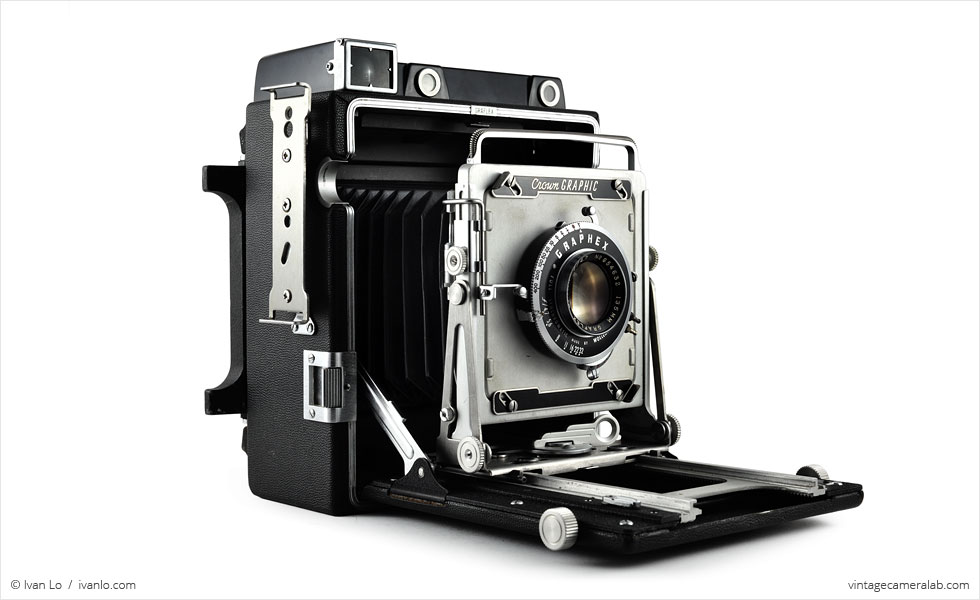
I do really miss my Crown Graphic though. It was just an excellent machine to operate. And the redundancy in the controls was as hilarious as it was comforting when you were unsure about what you were doing. Three viewfinders? Sure. Three different ways to trip the shutter? Why not?! Three different ways to focus? Fits the pattern; check. Two different shutters? The more the merrier!
And as good as digital is these days, I still don’t think I’ve seen anything quite as good as an ideally exposed 4x5 transparency on Velvia for example. I’ve got a pretty nice monitor, calibrated and everything, and I canmodel how much smaller the monitor’s color space is than a transparency. I got a fancy data sheet with this monitor showing how accurately it maps to sRGB space. Too bad sRGB is a terrible compromise to begin with!
Yes, indeed. It wasn’t unusual for me to spend most of a week in the darkroom with B&W negs I exposed in a few hours onsite.
People posting #nofilter on their social media posts often make me chuckle. Give me that file for about 10 mins or less of basic post processing, and I can pretty much improve that image, at least by a little bit. Oh well…
In the interests of expediency, the vast majority of time I don’t do post-processing beyond adjusting color, contrast, and cropping. I just don’t have that kind of time when I’m delivering a thousand photos. But for photos that I decide to concentrate on, there are very, very, very few photos I’ve worked on that didn’t benefit from some additional localized correction (dodging, burning, contrast, saturation, whatever.)
Back when we still made physical prints for our college newspaper, it was rare for me not to dodge and burn something for every picture that appeared in the paper. We quickly got so good at it that we can look at a developed neg and, knowing our darkroom equipment, know what the base exposure should be and how many seconds to dodge here, and how many seconds to burn there. I have no recollection whatsoever of making “test strips,” we just quickly learned and you could always just use your initial print as exposure reference instead of making a test strip. And, much of the time, your initial print is good enough for the paper, so no need to waste a sheet on a test strip.
Which is pretty much what I’m labeling as basic post processing.
Batch editing is useful in many situations for large numbers of files. Depends on what is being edited and what the end use is.
For certain “beauty shots” of property, person, or product, it’s not unusual for me to use 2 or 3 different programs. For my personal projects, I can get lost in time working on them. Just like in darkroom techniques, I’ve played around and found what works for me. Yeah, lots of large files. But, I have the processing power and storage space for them. I am almost as interested in computer specs now as I am in my other photographic gear.