Exactly. What did he answer? I asked him how he could distinguish a god who chooses never to do something for all of eternity and one that cannot do it. Especially if we can easily suppose a god who can.
He god seems very petulant, doesn’t he? “I won’t do it and you can’t make me!” My two-year old grandson is more mature.
An omnipotent being, qua omnipotence, has the capability of only doing good, so can choose to do so, and thus, be omnibenevolent. That is just something about the set of things they choose to do, this doesn’t lessen their capabilities at all. Hence, they’re just as omnipotent as before. No issue at all.
Exactly. And if that subset is the set of good things, that’s what makes them an omnibenevolent being. It just so happens that we have a special name for that particular subset; but we could just as well attach names to other subsets, e.g. omnimalevolent for always choosing the worst thing, an omnihilarivolent being would always choose the funniest option, an omnidocentivolent being always chooses the option that’s teaching the best possible lesson, and so on. Neither of these is lessened in their omnipotence by just choosing a particular set of actions from those available to them.
So you see, it’s simply not the case that there are things that an omnipotent being simpliciter can do that one that is also omnibenevolent can’t. It’s a question of what they choose to to, and any omnipotent being, as you note, only chooses some subset r from their possible actions, thus being omni-r-volent, with there being special names for some of these subsets.
But the maximality argument in particular pulls in the other direction that you are intending: because it is generally utilized to substantiate a god that is maximal along every direction (as non-maximality would imply a contingency, but god is considered a necessary being), hence omnipotent, omnibenevolent, omniscient, omnipresent, and so on. A ‘merely omnipotent’ being would thus not be a maximal being.
Again, whether you or anyone can distinguish something has no bearing on it being logically possible.
I have noted that this is a theological position that exists, but don’t have myself a firm opinion on the matter.
That this being is omnipotent is an assertion. Clearly an omnipotent being has the capability of doing only good. But does it also have the capability of doing only bad? Or some bad? Doing good is just a subset of its capabilities, and the only part is a limitation on its power with no justification except to make omnibenevolence work.
You still seem to be confused about any omnipotent being necessarily choosing a subset of its powers to do, versus having the capability of doing things outside that subset. I won’t repeat my examples - you seem to ignore them.
Supposedly omnipotent being A only rolls 1s. If he were indeed omnipotent, he could roll other things. Omnipotent being B rolls all possible values - on command.
How do you propose showing that A is omnipotent except by assertion. His ominpotence, in terms of dice, is a claim, not a fact.
Actually this argument asserts there is a maximal being. Since no being can be all the omnis at once, it is hard to define a maximal being - is the truly omnipotent god greater than the truly omnibenevolent one? I don’t know if you studied mathematical lattices, but the omnis seem to make up a lattice, and the maximal lattice is not possible to determine in all situations.
I agree that a merely omnipotent being is not maximal. That’s why it seems there is no maximal being - and thus no god if that is how one defines god.
It doesn’t matter if it is logically possible if you cannot show how to determine it even exists.
No, mostly it’s just “argument from authority”, constantly repeating “Platinga” like ihs name is an automatic win, or that most people here even knew who he is. Someone else had to be the one to explain what “Plantinga’s argument” even was.
But I haven’t seen any serious arguments to support it, just the assertion of it, waving away opposition and objective reality as “intuition” and the refusal to actually justify what is a rather absurd claim.
That’s the starting assumption that you’re also making, that such a thing as an omnipotent being is at least possible.
Good. Then they can actually do so. And consequently, if they do, be omnibenevolent.
Sure, they have all those capabilities. They just don’t use them. Again, that an ability is preconditioned on its utilization is just nonsensical. If I never eat bananas, it doesn’t follow that I can’t eat bananas. I just don’t like them, hence I don’t want to eat them, hence I don’t do so. That doesn’t mean I can’t. I am fully capable of banana eating.
There is no limitation of capabilities implied by just choosing a subset from all possible actions. As you note, any being, omnipotent or not, does so. It’s just that some such choices have special names.
Any omnipotent being has the capabilities to do anything at all. That isn’t changed by them just select a subset of actions to actually do—in fact, they must do so. No being does everything it can do.
The question isn’t whether one can demonstrate that an omnibenevolent being is omnipotent. The question is whether it’s logically consistent for a being to be both omnipotent and omnibenevolent. Since it’s possible for an omnipotent being to just choose actions that maximize overall goodness, that is indeed the case.
No, the omnis are completely independent of one another; there is no ordering between them. There’s, as demonstrated, no issue with an omnipotent being also being omnibenevolent, since that is just a particular way of exercising its powers.
Your argument was that there is an inconsistency between omnipotence and omnibenevolence. Since it’s possible to be both, there is no such inconsistency. Whether one can demonstrate this to your satisfaction is an entirely separate question, and if you want to move the goalposts there, it’s not something I think anybody would care about.
I’ve referred to Plantinga’s argument in order to make it clear that I’m not claiming any originality with these arguments, and have still needed to explicitly clarify this more than once.
My first post contained a link to the Wikipedia page of the argument.
I have discussed the logic of the argument in depth, explicitly in response to you, and since referred back to this multiple times; so far, all that has come in response was just naked incredulity without even so much as an attempt to grapple with the actual logic of the argument.
This is still trying to avoid the entailment of your argument, so let’s put it simply again:
If we lived in a literal hell, having our skin burned off and rehealed repeatedly, multiple crucifixions per day etc, would the observation of that massive and apparently unnecessary suffering, in itself, give us any reason to doubt that an omnimax God exists?
The answer based on your reasoning would seem to be “no”, but when asked about hell you seem to deflect on to other questions no-one asked, like whether you think there are other reasons to disbelieve. Let’s go with a clean answer to this and take it from there.
I think I’ve been completely unambiguous about that, but if you need to have it spelled out again, that’s a ‘no’, without further assumptions, this doesn’t give us reason to doubt, because we know of the consistency of evil with the existence of God, and evidence for a proposition consistent with another can’t be evidence against that other proposition.
Yeah, I think it’s an absurd position. Remember, we are not talking about proof, merely whether the existence of seemingly limitless suffering would give someone any reason whatsoever to doubt that an all-powerful and maximally loving / benevolent god exists.
You’ve bit the bullet and said “no”. Fair enough, I respect that.
I wonder whether you treat other claims this way? If X locks me in a dungeon and unleashes vicious dogs and a hail of knives at me, do I have any reason to doubt that X is a kind host? Logically speaking, X could have reasons.
Well, what other option do you think was available? The FWD tells us that merely observing evil doesn’t tell us whether we’re in the set of possible worlds that includes God. So to the extent that the FWD is sound, there really isn’t another option. If you want to make a case against God’s existence, you have to add in further premises. In hell, that’s going to be a really convincing case, since there’s an easy argument to make that there is more suffering than a tri-omni God ought to allow, so by the amount of evil, we’re very likely in a ‘superevil’ world, and God probably doesn’t exist. But you still have to add in that further supposition, that there’s some boundary to the amount, cruelty, or distribution of evil that a tri-omni God would allow, and then you have to point to evidence that this amount is exceeded. Without that, you’re not getting anywhere.
Sure, but as long as you have no reason to think there are such further reasons, X’s behavior is perfectly solid grounds to conclude that they’re a bit of a dick, probably. This doesn’t conflict in any way with what I’ve been arguing. Go back to the FWD: you have two sets of worlds, where a tri-omni God exists, and where evil exists. The FWD shows you that there is an overlap between these, hence, the mere existence of evil doesn’t suffice to tell you that you’re in a world without God—you have to bring in additional propositions, such as one limiting the amount of evil you should expect to exist. Here, now, we have two sets of worlds: one in which X is a kind host, and one in which they’re pelting you with knives. Absent an FWD-like defense, there’s no reason to think there’s any overlap; with such a defense (which is certainly possible), you have to admit that, given a prior believe in the good-host-nature of X, this belief isn’t necessarily invalidated. But evidential arguments here are easy, of course: we have a reasonable overview of the gamut of human behavior and abilities, and we know definitely that there is a set of possible worlds in which X just is a bad host, so their treatment of you makes a strong case that we’re in one of those worlds.
Again, I’m not saying that the prevalence and severity of suffering can’t give us rational grounds to disbelieve in God, I’m merely saying that further argumentation is required to make the case that a given prevalence or severity is out of line with what a tri-omni God would permit. Just pointing to the mere fact of evil, even great evil, without an argument why one should expect this to exceed what a tri-omni God could prevent, simply isn’t a sound case.
This sums up the problem. The question is not whether it is possible for this supposedly omnipotent being to choose actions which are consistent with omnibenevolence (it obviously can) but if it is possible for this being to choose actions which are not consistent with omnibenevolence. You have nowhere demonstrated it can. It is clear that an omnipotent being not bound by omnibenevolence can. So, please stop talking about choice and talking about possibility.
I guess you never studied lattices, since branches of a lattice cannot be ordered. (Probably the wrong term, but I studied them over 50 years ago.) I’m not talking about logical inconsistencies here, I’m talking about the foolishness of the notion that you can define the “greatest” example of a lattice.
You have yet to demonstrate that the omnibenevolent entity is in fact omnipotent, except by assertion. You cannot demonstrate it. You cannot show that it can do all the things a truly omnipotent being can do except by the circular argument that it can because it is omnipotent but chooses not to do things the other being can do.
It is omnipotent; so it can. That’s where we start, remember? You have an omnipotent being that chooses a certain set of actions. Done!
A lattice is a set with a partial order (where any two elements have unique meet and join). There’s no partial order between the omnis.
It starts out omnipotent. That’s the base case; the question is whether an omnipotent being can also be omnibenevolent. Then it acts, in whatever way it chooses. If it chooses only good, it’s omnibenevolent. Since it’s possible for it to choose only good, it’s possible for it to be omnibenevolent. Simply choosing to only to good things doesn’t remove its omnipotence any more than choosing any other set of actions.
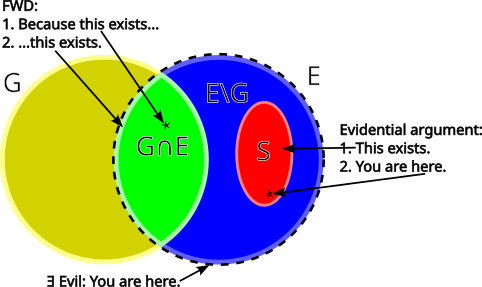
Here’s a quick visual representation of the logic involved:
G is the set of all possible worlds in which God exists, E is the set of all possible worlds in which evil exists. The FWD establishes that their intersection, G\cap E is non-empty, by exhibiting a particular element of that intersection. (Note that this doesn’t entail that the set G\setminus E is non-empty, even though I’ve drawn it that way for generality.) To show that there is no God, we have to demonstrate that the actual world is in the set of possible worlds that contain evil, but where there is no God, i.e. E\setminus G. Pointing to the existence of evil, however, merely establishes that the actual world is in the set E (highlighted with broken outline), which means that it is possibly in G\cap E.
We have, at this point, virtually no information about the set of possible worlds in which evil exists. We don’t know the magnitude or distribution of evil within them. We have to add in further information to narrow our location. This is where the evidential argument comes in. We need to constrain the ‘placement’ of the actual worlds more sharply than is possible with simply pointing to the existence of evil; but to do so, we must introduce assumptions about the nature of worlds in which evil exists, such as that there are ‘superevil’ worlds S where the amount or distribution of evil exceeds what a tri-omni God would permit, and which therefore have no overlap with G. Having done that—having put forward a characterization of the set S, of what it means for a world to be superevil—we can then check whether our actual world lies within this set. This is where evidence comes in: if we know the characteristics of a world within S, we can check whether our world seems to fulfill these. If we are in hell, for instance, such an argument seems fairly easy to make; in the actual world, there’s a bit of debate. But the crucial point is that it’s not enough to just point at the magnitude of evil: we first need an argument as to why that magnitude exceeds what a tri-omni God might permit. We need to know that there is some set S which our world could lie in. Otherwise, we simply have no sound case.
(I mean of course one can define a lattice of omnis simply by taking the powerset of the set of all omnis and ordering them by set inclusion; that lattice then would have a maximal element that’s equal to all the omnis.)
The god of the Bible is very petulant, but the version that has the power to do anything but the will to choose not to do some things is not being petulant. Just determined.
The argument he is presenting - Plantinga’s argument - is not intended to say anything about the ability or likelihood of a tri-omni god. All it is intended to do is address the singular issue of how there could be evil in a world with a tri-omni god.
The battle over whether omnipotence and omnibenevolence are in conflict is immaterial to Plantinga’s argument. Plantinga assumes the tri-omni god can exist. It is a stated premise.
If the tri-omni god is not possible on other grounds, then Plantinga’s argument is unnecessary. It is still logically sound.
The question of likelihood of a tri-omni god is also outside the scope of Plantinga’s argument. We can argue that the level of evil in the world is beyond what an omnibenevolent god would allow, or that the level of evil means that a tri-omni God doesn’t seem likely. But Plantinga isn’t about that, only that we can’t rule out a tri-omni god just because there is evil.
It seems to me that a lot of the objections to Plantinga’s argument on this thread argue in terms of what it means to be tri-omni, and whether that concept means anything. There is also a subset looking at what makes a “world” such that god made it the best he could.
My arguments have tried to focus on inconsistencies in the presentation of PA. Particularly the “world” aspect seems self-contradictory.
I will say that I come down more on the side of an omnibenevolent god is not power limited because of a choice on how to act. But I do see the reason the other position seems arguable.
Sure but remember this isn’t @Half_Man_Half_Wit 's thread, nor is the topic plantinga’s argument. It’s only been hijacked that way.
I get what you’re saying with the defence, and indeed when plantinga first got brought up I conceded that yes, technically speaking, the existence of evil doesn’t prove an omnimax God doesn’t exist.
But let’s not take the original point of the thread, and all related and interesting points, off the table, simply because one poster wants to use his plantinga hammer.
In my defense, I honestly didn’t expect this would take so much explaining. Although to be fair, that’s not all I’ve been doing, just recently I’ve also been trying to explain to @Voyager that choosing A over B doesn’t mean that one is unable to do B. Another point where I underestimated the amount of work needed to get it across.
The visual representation doesn’t display for me (maybe it’s an EU GDPR thing).
But on the ‘Set of worlds with evil, E’ thing; why are you repeating this? I already 100% agree that, technically-speaking, the existence of evil doesn’t prove that an omnimax god doesn’t exist.
The problem is, that this logic could be used for any claim about the universe.
I could use it to demonstrate that we can’t prove that clowns don’t come from the planet Venus. However, just as we can use empirical observations to doubt that claim, so I can use observation of a great deal of apparently unnecessary and randomly distributed suffering to doubt the existence of an all-powerful, perfectly-loving God.
It’s no more complex than that. And the fact that your response to the plain and simple summary I laid out in post 288, was to reintroduce predicate logic and make a point no-one disputes, I think is a tacit concession.
Honestly, I don’t believe I’ve made any claim in this thread that I would’ve expected to need more than a cursory discussion of the logic involved, and I’ve been utterly flabbergasted by the responses I’ve gotten. I’ll readily cop to some grandstanding, and I’m not trying to make excuses, I’m entirely to blame for that, but the frustration I’ve vented was completely genuine and stemmed from absolute confusion about being confronted on claims I thought pretty much self-evident. If you don’t buy anything else I’m saying, please at least believe this.
Yes, there seem to be issues with imgur in that regard, sorry. Does this work better?
Suppose somebody claims that clowns can’t come from Venus, because they have red noses. Then, somebody makes an argument that merely having red noses isn’t inconsistent with coming from Venus. After this, it’s simply no use to point to clowns’ red noses to support the idea that they’re not from Venus—even if they’re really red and prominent. The deductive logical argument shows that the empirical evidence they’re pointing to fails to support the hypothesis they wish to make a case for. Hence, you have to adduce further premises—such as that under Venusian conditions, the process by which rubber is produced doesn’t work—which then opens up an area of empirical investigation—showing that clown noses are made of rubber—to substantiate the hypothesis.
But not unless you’ve made additional assumptions about the set of evil worlds. Again, I just fail to see what’s controversial about this. Without some further structure on this set, your empirical evidence just doesn’t tell you anything. Some proposition into which the quantity or distribution of evil consistent with a tri-omni God enters is necessary before you can say that some quantity or distribution is inconsistent with it. Otherwise, you just have no grounds on which to say that the distribution you observe argues against the existence of God. In other words, if you know that God and evil are consistent, saying that God probably doesn’t exist because there’s more evil than x in the world is entirely useless without a reason that God wouldn’t allow more than x evil in the world.