Why would you think that? If you see a fence across a road with no obvious reason for its existence, do you think it’s probably unnecessary unless somebody justifies it to you? A part of your car whose function you can’t readily discern? An architectural feature whose role isn’t obvious to you? I think that, in these and similar cases, it’s the far better epistemic policy to give some benefit of the doubt—to assume that, although it’s not obvious to you, there probably is a reason for the existence of these features. More generally, I don’t see that assuming that what isn’t immediately obvious is unnecessary should in any way be a ‘default’ position—or at least, one would have to make a substantial argument to that effect.
And likewise, we have the knowledge in the God case that some unknown amount (quality, kind, pattern…) of suffering should not be surprising, and we can reasonably infer that some (and perhaps all) of that suffering will seem unnecessary to us—after all, if such a God exists, they’re in a vastly superior position to judge such matters than we are. We readily know cases where the suffering can’t judge the necessity of their suffering thanks to a discrepancy of epistemic access, e.g. the child being admonished by a parent, or the pet being taken to the vet. In neither of these cases, it seems prudent for them to conclude from the fact that their suffering seems unnecessary to them, it probably actually is unnecessary, and the parent or pet owner is being pointlessly cruel. But if there’s a God, we’re very probably in an even worse situation to accurately judge the necessity of our suffering, the gulf between the understanding of the child and the parent being minuscule in comparison to that between us and an omniscient entity.
Besides, even if we were to make the highly questionable assumption that what appears to us as unnecessary suffering probably is unnecessary suffering, that still would be an additional assumption of the type of the factual premise—in that case, it would not be our observation of apparently unnecessary suffering that allows us to lower our credence in the existence of God, but our observation plus the assumption that observing apparently unnecessary evil licenses us to conclude the existence of unnecessary evil. So this would be a valid evidential argument, just a bad one.
That doesn’t work though because the solution to the logical problem of evil works for any entity.
The solution boiled down to “God may have reasons for his actions, and be bringing about the best possible world”.
Well, Freddy Krueger might have reasons for his actions, and be trying to bring about the best possible world. In fact, it’s massively more plausible that Freddy, or any real-world serial killer, might have entirely loving reasons for their actions. Why? Because we know that humans often have limits on their knowledge and abilities that require or compel them to inflict necessary suffering; there’s only one way that can happen with an omnimax God, and that’s when it’s the best possible universe overall. It’s a much stronger claim.
Also also…you ignored the point that Freddy Krueger might be God for all we know. Just another reason why this attempted carve out for God fails.
Ah ok. Yeah that’s wrong. For example, one of the philosophers most associated with the evidential problem in modern times:
So: what I’ve consistently said. No-one needs to make a knowledge claim about whether the suffering is gratuitous, just observing that it appears so, as I have, is enough.
Do you take back your claim about “all of the literature”?
No. The logical problem of evil doesn’t even arise for any entity that isn’t omnibenevolent (so wants to eliminate all evil), omnipotent (so is able to do anything that can be done at all), and omniscient (so knows perfectly what would need to be done to achieve every possible end), and in the habit of creating worlds (so the question why they would nevertheless create a world containing evil comes up in the first place). So that’s pretty much God, exclusively. If you want to argue that Freddy has all these properties, then well, that’s just another name for God.
But we have no reason to believe so, while we do have that reason in the case of God. You seem to be thinking that anything that might be possible is equally fair game, but we’re just updating our knowledge based on what we have reason to believe; and the failure of the logical PoE gives us a positive reason to believe that, despite God’s tri-omni nature, evil is possible. We have no comparable reason to believe that Freddy, despite his apparently sadistic acts, might be perfectly kind. If there were an analogon to the PoE for Freddy, then sure, the same argumentation would hold. But there’s not, so it doesn’t.
If I had reason to believe Freddy might be God, then that would work. But without such reason, there is no justification for adding this as a hypothesis.
No. You missed the crucial bit right before what you quoted:
It then goes on to specify that from such cases, Rowe builds the argument you detail.
This is exactly what I’ve been saying: pointing at evil in the abstract doesn’t do anything, you have to make an argument that some particular evil is not to be expected given a tri-omni God, i.e. that don’t serve some particular goal like moral growth or free will or the like. We need to have some grounds to make an inference from “we cannot see a good reason” to “probably there is no good reason”, as your new cite puts it, and this is exactly what you’ve been saying requires no justification.
On this, I should probably be more precise. I’m not claiming that all the literature makes my case. I realize that my wording was ambiguous, but of course, I haven’t surveyed anywhere near ‘all of the literature’ (and if you want to read this as me walking back on the claim regarding ‘all the literature’, please do). Rather, I intended to say that the literature so far as it has been reviewed in this thread agree with me, at least as far as I can see:
There are probably articles out there that don’t. But that still doesn’t explain away the explicit disagreement with the stance that ‘all evil is evidence against God’ that’s pervasive throughout the cites presented here, including the two largest reference works on philosophy available on the internet. My question was how you reconcile your stance with this widespread disagreement: does it move the needle of your certainty at all?
There may be a misunderstanding on this point. I thought you compared Freddy Kruger appearing to act sadistically with God allowing suffering. Freddy Kruger appearing to act sadistically is analogous with God appearing to allow gratuitous suffering (i.e. appearing to act less than omnibenevolently).
You have repeatedly asserted, as a general rule, that suffering is apparently unnecessary until we know otherwise. I think I acknowledged that assertion, as a special pleading, when I wrote: “I might be persuaded to agree with this statement personally, but it is neither trivial or self-evident.” This kind of claim demands an argument because it shifts the burden of proof on the basis of ignorance. Your newest formulation, that “something is apparently unnecessary until we have outside knowledge that might provide a reason,” is much less defensible. I think Half_Man_Half_Wit was unfair in construing “something” to mean anything other than ‘suffering’, and “might” to mean anything less than ‘probably’.
If I understand your bucket metaphor correctly, the observation is the unsorted token and you have to determine which bucket to put the token in by examining the token and comparing it to the labels on the buckets. I agree that a pattern of behavior can lead you to re-evaluate prior observations. If you see one token with a strange symbol, that might not be problematic. If you see multiple such tokens, maybe they belong in a different bucket.
Since you asserted all appearances are always evidence, I assumed by “apparently gratuitous suffering” &etc. you were making a defeasible epistemic claim. Such claims increase the probability that actual gratuitous suffering exists, and therefore count as evidence. If you are looking at a mirage and assert you observe an “apparently” distant lake, that is a phenomenal claim. You are really saying that you see what looks like a distant lake, as opposed to what appears to actually be a distant lake. There’s a slight difference, although most of the time an “appearance” is both: normally, we are justified in generalizing that sight is accurate, or making some other inductive argument. But the observation of what looks like a distant lake does not necessarily increase the probability that a distant lake actually exists; if you know you are observing a mirage, your observation is not evidence of the lake’s existence. You don’t leave the token in the evidence-for bucket, you remove it and replace it in the bucket for irrelevant evidence.
You cannot escape the fact that a determination must be made before you may classify evidence in favor of a hypothesis, even a defeasible first impression. This determination is always based on prior knowledge and a threshold–not of weight but of relevance–to filter out noise that has no relation to the proposition.
No worries. I was just clarifying on this point because earlier you were saying your position is the same as @Half_Man_Half_Wit 's, and it actually isn’t on this point.
HMHW has bitten the bullet and suggested that even if we were in a horror movie; even if God was crucifying us daily, we would have no reason to doubt that he was perfectly loving.
I’m glad that you haven’t gone over that particular cliff, and you agree with me that apparent sadistic acts should indeed make us doubt his omnibenevolence, the same as it would for any other entity.
I will say though, that I place the bar of sadism very low for an omnimax God. e.g. for a child getting bone cancer, God has much greater control of that child’s physiology, their DNA, their pain receptors, the cancer’s physiology etc than I have over my pinky finger. And indeed he could fix it all with less effort than it would take me to wiggle said finger. So to me, seeing a child dying of that cancer is just like watching a man kicking a puppy to death, and in fact it is more plausible that the latter would have good reasons for performing that actions for the reason given in the last post.
I think you’re still seeing this as some kind of determination though, when I am saying that this is a “don’t know” category. That is to say, instead of the phrase “apparently unnecessary suffering” we could say “no known higher purpose suffering”. It makes clear that I am not making any claim, and I don’t think it affects the evidential problem of evil.
When it comes to empirical claims, we almost always have to say based only on what we know now. Based only on what we know now, there’s no reason for God kicking puppies (cancering kids), and until that picture is updated, we have reason to think he’s not omnibenevolent.
On reading back, I realized that these two lines might seem contradictory.
So to clarify: I am not talking about having a different standard for God. I am judging all entities to the same standard. The difference is in what events an entity has under their control.
As humans, we’re used to things like cancer “just happening”, and there’s a temptation to therefore describe God’s relationship to such events in quite a passive way too. But, for an omnimax God, any suffering at all is actually more under his control than me picking up a fork and stabbing someone in the face with it.
Imagine we were in heaven; a place of no suffering at all, and then one day someone contracts cancer and is in horrible pain. Does omnimax god get to just shrug?
That was what I was trying to say with those two lines.
My point was just that I don’t think this is a reasonable general principle (since there are instances where it seems obviously erroneous), and hence, that its applicability in this specific setting is, at the very least, in need of argument. Beyond that, I think it’s unlikely that such an argument could be very convincing, as this link between appearance and reality is exactly what Skeptical Theism denies, so there’s at least some contingent of people who think this is a sensible position. So that we can just take appearances for even probabilistic evidence of realities, without further argument, seems rather dubious to me.
Anyhow, I think that it might be useful if we were to take stock of our respective positions, chart where we may have common ground, and where there’s areas of disagreement. So to that extent, I’ve attempted to draw up a little taxonomy of attitudes towards evil and its problems for a tri-omni God. I’m not gonna claim that this is necessarily an exhaustive list, but I do think it’s fairly representative of the positions taken in this thread so far. So my hope would be that if anybody finds some errors or omissions with the following, they’d offer up corrections, and otherwise, indicate which of the offered positions best represent their stance.
So to me, these seem to be the possible positions as so far articulated here:
All evil / suffering is evidence against God. I don’t think anybody here that accepts the failure of the logical PoE seriously defends this view anymore; the failure of the logical PoE directly entails that God may exist, yet so does evil. Moreover, it gives us a positive reason to believe that despite God’s omnibenevolence (and other properties), evil or suffering may not be avoidable. The probability of seeing evil is nonzero, and so is the expected amount of evil, but more can’t be said; in particular, this tells us nothing about amount, kind, quality, or pattern of evil we should expect. But we can say that there should be a nonzero amount: if it is possible for God to instantiate a world with evil E, it can’t be also possible for them to instantiate a world with evil E’ < E, since then, by omnibenevolence, it wouldn’t actually have been possible to instantiate the first world, because all evil exceeding E’ would necessarily be gratuitous.
The sheer amount of evil / suffering is evidence against God. This is the ‘hell world’-proposal: while pointing to some particular evil may not yield evidence against God, the sum total of all evil eventually may tip the balance. The logical PoE’s failure gives us grounds to expect some evil, but there is some threshold such that the total amount of evil, exceeding this, will make the existence of God increasingly unlikely. The problem with this is that we have no idea where that threshold may be: what the minimum amount of necessary evil is that God would have to accept. Thus, this would need further argumentation to establish such a threshold.
Only gratuitous evil / suffering is evidence against God, but all evil / suffering appears gratuitous, and that appearance is sufficient to yield evidence against God. Near as I can tell, this is @Mijin’s current position. This would take the lesson of the failure of the logical PoE on board, yet still entail that all evil / suffering we observe yields effective evidence against God. I think this is obviously problematic, because in fact, not all evil / suffering appears gratuitous. The suffering of me burning my hand so that I can retract it and keep myself from greater injury (a ‘natural evil’ in the same sense, if not to the same extent, as a fawn perishing in a forest fire) seems very sensible; the evil of lying to a murderous mob about the location of their intended victim seems more than offset by their survival. There is lots of apparently necessary evil in the world, and if the inference from apparently unnecessary evil to actually unnecessary evil is warranted, as this position holds, then so is the one from apparently necessary evil to actually necessary evil. (Although this inference itself is highly dubious, see the next point.)
Only gratuitous evil / suffering is evidence against God, some evil / suffering appears gratuitous, and that appearance is sufficient to yield evidence against God. On this position, not all evil provides evidence against God. Rather, there is evil that apparently is necessary, and as a result, probably actually is, provided one grants the inferential link here, and hence, can’t form evidence against God. But of course the inference from apparently unnecessary suffering to actually unnecessary suffering is a rather weak one: just as with a pet being driven to the vet, or a child receiving a scolding from a better-informed parent, there is a huge discrepancy in the sufferer’s ability to discern the necessity of their suffering as compared to the one inflicting or allowing it. At the very least, it would require a substantive argument to establish, and can’t be just taken for granted, as it is clearly false in many analogous scenarios (apparently unnecessary car parts should not be taken to be actually unnecessary car parts; their necessity would be immediately obvious to those with a better epistemic access to the facts at hand, e.g. mechanics). Besides, if we were to allow this inference to stand, we’d necessarily get wrong results at least sometimes: if we were in the best possible world, and God did exist, then still, there would probably be lots of suffering that appears gratuitous to us. If we allow that to inform our judgments, we would probabilify the wrong conclusion; but then, this just means that we ought not expect evidential reasoning to yield even probabilistically trustworthy results, and the evidential problem pulls the rug out from under itself. Rather, we should recognize that, because of the epistemic discrepancy between us and God, if they were to exist, there would probably be lots of (at first blush) unnecessary suffering; hence, the presence of apparently unnecessary suffering is not in and of itself in tension with the hypothesis of the existence of God.
Only gratuitous evil / suffering is evidence against God, some evil / suffering appears gratuitous, and we have to make an inductive case for some particular evil / suffering to be gratuitous in order to yield evidence against God. This is, to the best of my understanding, the position of the classical evidential PoE. We propose a case that, upon careful examination, does seem highly unlikely to constitute suffering such that it is offset by some equal or greater benefit, or which if permitted to occur prevents another instance of equal or greater suffering, and seems both within God’s ability and interest to prevent. These are cases like Rowe’s Bambi or Sue. Such suffering, if it exists, certainly is in tension with the hypothesis of God’s existence, and thus, yields valid evidence against it. Given that our argument towards the gratuitous nature of that suffering are inductively valid, we have inductive reason to lower our credence in God’s existence.
All evil / suffering fails to be evidence against God’s existence. This is the position of Skeptical Theism, which I think has only been tangentially discussed in this thread so far. Its basic point is, as I understand it, that the inference from ‘some evil appears unnecessary’ to ‘some evil is unnecessary’ is simply never warranted, the discrepancy between our finite and God’s infinite point of view just being too great to bridge. It would appear to be a consistent stance, but I find it singularly unappealing: not only does it leave us epistemically stranded, helpless amid the tides of forces we can’t hope to understand, it also carries the moral hazard that we may excuse any and all evil as happening for a reason we just can’t begin to fathom. But of course, these are only aesthetic objections, which unfortunately carry little weight as far as influencing the actual facts of the matter go. A committed theist might well seek refuge to such a position, but thank God I’m not among that number.
To me, 1.-4. seem obvious non-starters, for the reasons indicated, and only 5. is a version of the evidential argument that could have any hope of having real bite. I think that this is born out by the fact that, at least as reviewed in the thread so far, all real-world evidential arguments broadly take the approach of 5.: first, a premise is argued for that has some inductive justification, and thus yields at least a probabilistic judgment that there may be gratuitous evil; to the extent that this justification is sound, we have thus evidential warrant to lower credence in the existence of God. But evidently, others disagree, so I hope that the above list might at least serve to throw such points of disagreement as there are into sharper relief.
Of course, I don’t see myself as having bitten any particular bullet. If all you know of a quantity is that you ought to expect it to be nonzero, then you don’t have any good reason to expect it to be below a certain threshold; doing so would just be assuming facts not in evidence. Also, I’ll just note that this position, too, has been defended, see e.g. this article. This comes from the point of view of Skeptical Theism, which as noted I’d be reluctant to advocate, but it also argues against a view that starts from an evidential argument that starts with a specific evil. Against a position that only starts from generic evil, such as yours, one need not endorse the commitments of Skeptical Theism.
The point is, if I were to claim that Bob is omnibenevolent, and you were to disagree, and you were to point out that Bob kicked a puppy earlier, then I can invoke Plantinga’s solution to the logical problem of evil: Bob might have reasons for kicking a puppy, so it is not incompatible with him being omnibenevolent.
Indeed I could ask you: How do you know humans are not omnibenevolent? Because if you believe the logical problem is defeated by Plantinga, and that said defeat also means we can handwave unlimited observations of apparent evil…how can you possibly lose confidence that humans are perfectly good?
False. Firstly the idea that God is trying to bring about the best possible world is merely a claim, and it’s even arguable to what extent scripture agrees with it, let alone having any evidence. Meanwhile we are aware that humans frequently attempt to improve the world, and we very often do things that cause some degree of harm for what we think is the greater good. There are millions of examples of this.
So I think the latter claim is on the much stronger footing, but I’ll settle for same footing.
You don’t know though. A lot of reasoning concerns making judgements without full knowledge. I don’t know Freddy Krueger isn’t God and even if God exists I wouldn’t know that he’s omnimax.
Your current position that God has infinite carve outs but we can judge and make inferences of other entities’ actions is inconsistent, and requires us to engage in some kind of compartmentalized reasoning.
How do you think that changes anything? Firstly Rowe is agreeing with me that we don’t need to make a knowledge claim about gratuitous evil. Secondly the examples he gave here are curiously familiar, given that I have used the exact same examples within this thread.
I think you misunderstand Plantinga’s argument. The point is not that ‘God might have reasons’, it’s that there may not be logically consistent worlds in which there both is zero evil and moral goodness. This isn’t just an arbitrary get-out-of-jail-free card, it’s something that works for the very specific setting where a creator with a certain set of attributes sets out to create worlds, and what worlds they are able to create. There may be more moral value to a world in which there is significant freedom, even if there also is evil; that’s why God acts according to omnibenevolence in creating such a world. It’s not just that ‘God might have reasons’.
Hence, you’d have to make an argument why Bob, in accordance with omnibenevolence, sometimes can’t avoid puppy kicking; then it would trivially follow that Bob sometimes kicking puppies does not conflict with omnibenevolence. However, it seems trivial for Bob to avoid puppy kicking, by just not, you know, doing it.
Because I don’t have reason to believe that despite their omnibenevolence, humans might necessarily have to act shittily some amount of the time. If you gave such a reason, then again, their acting shittily would not conflict with their claimed omnibenevolence. The basic epistemological principle here is that you shouldn’t believe X unless you have a reason to believe X; Plantinga’s argument gives a reason to believe that God, acting in accordance with tri-omnihood, would nevertheless instantiate a world with non-zero evil. But that same argument doesn’t work for humans, and I can’t see any way to formulate a similar one. In a sense, this is because we have greater background knowledge: because we know that humans can and do act differently across similar situations, we have grounds to believe, in any given situation where they do a shitty thing, that they could have (that it was logically possible) done a different, non-shitty thing.
Analogously, if we had grounds to believe that it was possible for God to instantiate a world in which a given evil is absent, then that evil’s presence is evidence against the existence of God (or their tri-omni nature). That’s after all exactly what the evidential argument seeks to establish: that for some evil E, there is a world such that it was within God’s ability to instantiate that world, and that did not incur any offsetting effect (i.e. a compensating equal or greater evil or loss in moral value), and in which E is absent. But for humans, we don’t have to rely on hypotheticals: we have lots of actual cases where they refrained from doing the shitty thing.
Not knowing whether X is neither having reason to believe that X nor having reason to believe that not X. So we don’t know whether Freddy is God, which hence has no effect on our judgments; but we do have reason to believe that if God exists, so does evil, and hence, this absolutely should affect our judgments.
There are no carve outs for God. It’s just rational updating based on whether the evidence supports the hypothesis, or fails to. The hypothesis that tri-omni God exists entails, thanks to Plantinga’s argument, that one ought to expect a certain amount of (‘necessary’) evil; hence, that one finds a certain amount of evil is not surprising on the hypothesis that God exists. The hypothesis that Freddy is an all-round swell dude does not entail that he acts sadistically; hence, that he does is surprising given the hypothesis that he is an all-round swell dude. So he probably isn’t.
Rowe argues that for certain concrete cases of evil, there does not seem to be a justification that a tri-omni God should allow them. Hence, such a God probably would not allow them, and thus, that they exist is evidence against that God. Again, this is best captured in the IEP quote (bolding mine):
That is, we make an argument that E, some concrete instance of evil, should not be expected given the hypothesis of a tri-omni God.
You, on the other hand, are proposing that one could just abstractly point to any evil at all to make that case. I think the easiest way to see that this can’t possibly be right is to (counterfactually) imagine that you are, in fact, living in the best possible world, and God does exist, and there is evil. Following your logic, then, the fact of the existence of this evil would probabilify the wrong conclusion that God does not, in fact, exist. Hence, your argument is one where we can use the all available evidence, reason perfectly, and yet, support a wrong conclusion. Consequently, your form of arguing is unreliable: there is no reason for us to expect that the conclusion it arrives at has a good chance of being true. A theist, confronted with this argument, could validly just dismiss it out of hand merely by noting that there’s no reason they should expect it to be trustworthy, and for the conclusion it supports to actually be true. It also can only ever arrive at one conclusion, so in fact, the evidence doesn’t even matter: it is basically a kind of show trial.
Contrast that with a Rowe-style argument. Either it is true that there are cases where there’s no justification for God to allow a particular suffering to exist, and we’re not living in a world created by such a God; or there are in fact no such cases, and we may do so. In the latter case, whenever we believe of a certain evil that it is gratuitous, then we’re just wrong, and either, we’re mistaken in our reasoning, or we haven’t taken into account all relevant evidence. In either case, for this argument, given all relevant evidence and making no errors of judgment, it won’t be the case that we increase our confidence in a wrong conclusion. So we have good reason to trust this argument.
(Indeed, in the formalized setting you still seem reluctant to consider, it’s a theorem that, provided one hasn’t excluded the truth from the beginning, using consistent reasoning the evidence can only lead to the truth, so something like systematically increasing confidence in the wrong conclusion is just impossible.)
As I say: special pleading.
The “set of universes” argument previously was just discussing what actions were compatible with what set of universes; when I point out that this reasoning could apply to any entity, now it’s restricted to true scotsmen universe creators only.
A couple of responses to that:
While most popular depictions of God posit that he created the universe, strictly-speaking, omnimax does not entail creating the universe. It could be that the universe predates God and God now changing any aspect of its original properties might be logically inconsistent, like a “square circle” or whatever. It makes no difference to how I am evaluating God’s actions, but if this is the new thing you’re hanging Plantinga on to, it’s inherently shaky from the start.
God’s omnis, including omnibenevolence, is the thing being doubted. What you’re doing is like handwaving all the observations of meat suspiciously close to being eaten in Bob’s vicinity because Bob is a vegetarian (I need to pick another men’s name; Bob’s done a lot in this thread). But we are doubting Bob’s vegetarianism on the basis of those observations; asserting it doesn’t help. I only have my observations, there is no magic way to know for sure that Bob is vegetarian or that God is omnimax.
And I have no reason to believe God has such a reason either. The assertion that it is possible that he has, can be applied to any entity.
I’m not going to engage further on the thing of whether my position is the same as Rowe’s. It was a squirrel in the first place – we were talking about specifics and then you challenged me to answer the question of why allegedly “all the literature” disagreed with me.
And when I gave the counter-example of Rowe, now supposedly when he invoked the trapped deer as an example of why he believes it gives us reason to doubt that God is omnibenevolent it’s different from when I invoked the trapped deer as an example of why I believe it gives us reason to doubt that God is omnibenevolent…sure, if you say so. Back to the topic.
Quite the opposite, of course: I’m merely pointing out that if you want your case to be analogous, you have to make an analogous case.
Jesus Christ, will you stop it! There is no “set of universes” argument. What there is is a Venn-diagram-like visualization of the possibilities after Plantinga’s defense. I don’t know why you’ve got such a problem with that, but as I said, if this doesn’t work for you, just ignore it entirely, it doesn’t matter.
The point is that Plantinga’s argument has the following structure:
If <condition C> then <restriction R>
Hence, possibly <restriction R>
In the case of God creating universes, C is that a universe with moral value may necessitate free action, and that given free action, every creature eventually commits at least one evil act in every possible setting. The R that follows then is that God, despite their tri-omni nature, can’t bring it about that a universe with moral value contains zero evil. This gives us reason to believe that despite tri-omnihood, evil can exist, which hence entails that the existence of evil is not per se incompatible with tri-omnihood.
The case of Bob has no premise of the form 1. Best as I can tell, you seem to be saying that ‘something unknown might do we don’t know what’ to make it such that Bob, despite being omnibenevolent, could not avoid occasionally kicking puppies. And that’s possible, of course, but it gives us no reason to believe that Bob’s omnibenevolence entails his kicking puppies: after all, we know that we can just refrain from kicking puppies, and that’s it. On the other hand, in the case of God, we have no knowledge that one could just create worlds with zero evil in them. Again, that’s where the (Rowe-style) evidential problem steps in: to make it plausible that one could create a world such that a given evil is not part of it, and that world has no lesser moral value. We don’t need that in the Bob case: we know that we can avoid kicking puppies by not doing it.
To make the cases analogous, you’d have to supply a condition C’ such that if that condition held, Bob would be restricted in the exercise of his omnibenevolence such as to occasionally being forced to kick puppies. Then, it would once again follow that the fact that Bob occasionally kicks puppies is not in tension with his omnibenevolence. But just hand-waving that some such reason might exist, while true, does not accomplish this. A reason might exist that the moon is made of green cheese, but that possibility does not give anybody a reason to believe it does. Only once you actually produce such a reason do we have epistemic license to make that leap.
I think theological tradition would dispute this, because the omnimax nature of God is generally thought to result from their nature as necessary being, which entails that they can’t have contingent attributes; and since every finite amount of power, or knowledge, would introduce a contingency (why that amount?), the only non-arbitrary choice is the maximal one. The universe, on the other hand, is contingent, and hence, might not have existed; therefore, God is logically prior to the universe.
But this is a rather different matter. For present purposes, it’s clear that God can only be an omnimax creator, since only for such an entity does the problem of evil arise in the first place (if God hadn’t created the universe, they could hardly be responsible for the evil it contains).
No. The existence of a tri-omni God is the hypothesis being tested. We start out with that hypothesis, and check if the evidence lines up with it; if it doesn’t, we reduce our credence in it.
That reason is exactly what the free will defense yields.
The point of disagreement between your stance and that of the argument from evil in the literature is that you start from abstract evil—claiming that any evil at all is evidence against God—while Rowe and others start from concrete instances of evil—arguing that this particular instance of evil is unlikely to be compatible with the hypothesis of the existence of a tri-omni God. These are exact opposites: you claim that ‘all evil is evidence against God’, the claim there is ‘not all evil is evidence against God’. See again the SEP:
You’re making the abstract version of the argument from evil; Rowe is focusing on evils that are argued to be gratuitous. (Of course, I might be misconstruing your view; but since you’ve neglected to indicate whether your stance is accurately characterized in my attempted overview, I can only go by my best guess.)
And again, your kind of ‘argument from evil’ can be immediately discarded: as noted, it won’t generally probabilify the right conclusion, because even in the case of God’s existence it would support the conclusion of their nonexistence. So the argument only supports the right conclusion in the case where God actually does not exist; thus, you have grounds of accepting the argument only to the extent that you have to accept that conclusion in the first place. Hence, it can’t do anything to move the needle of anybody’s belief: if you consider yourself to have reason to believe in God’s existence, you have equal reason to reject this blanket-style argument. Nobody should, therefore, accept an argument of that sort, as it doesn’t do anything to uncover the ground truth. I can’t imagine you’d be on board with that sort of argument in any other case, but your continued refusal to engage with this point seems to suggest that on this topic, you’re fine with it.
It is analogous.
You’ve agreed – as anyone would – that if we see an entity doing things which appear sadistic, then we have reason to think the entity is a sadist. Or causing seemingly unnecessary harm, we have reason to think they are an entity that causes unnecessary harm. We don’t need to make a knowledge claim about the entity because we are not making a knowledge claim about their actions either – only updating our probability guesses about the world, based on observation.
…Oh, but not for God though. No logic at all can be applied to God and we should ignore all observations.
One of my guilty pleasures is sometimes listening to the atheist call-in shows, where a theist caller will be happy to say that, say, baby murder is wrong but then suddenly start pretzelling when shown that, according to the Bible, God commanded exactly that.
And that’s all this thread is. You are better read than the average philbro, I’ll give you that, but the arguments are no less ad-hoc and special pleading.
Maybe take it up with this guy:
Note that the above works for any entity. Seeing Freddy Krueger rip kids apart just means we are in the set of universes where that happened, however the compatibility of that with the hypothetical possibility that Freddy is doing it for benevolent reasons means we should handwave that observation.
Well let’s focus on that then. If you are going from an abstract “there might be reasons” to “the free will defence actually works”, then let’s go. How does free will explain kids getting leukemia? Or a deer getting trapped by a tree and slowly starving to death?
Absent further information. But the free will defense gives us further information, which amounts to the fact that despite the existence of evil, God may be tri-omni, hence, the existence of evil fails to disagree with God being tri-omni. In none of your cases have you supplied similar information.
Observations, as noted, are evidence against a hypothesis only once they disagree with that hypothesis. We know that we should expect an unknown quantity of evil if God is tri-omni. Hence, actually finding some quantity of evil is not in tension with that hypothesis.
That is, once again, just a way to visualize the possibilities we’re left with after Plantinga’s argument. It’s not a separate argument in any way. It tells us that it’s possible that God exists, and so does evil, and hence, abstractly pointing to evil can’t provide an argument against God. There’s nothing difficult about this.
No, because we don’t have a Plantinga-style argument for any entity. We know it’s possible for God to be tri-omni and evil to exist. We don’t know it’s possible for Bob to be omnibenevolent and kick puppies, or Freddy to be a swell guy and kill kids.
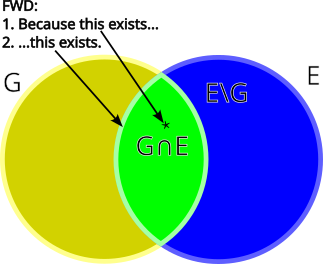
You know what, let’s get back to drawing pictures. The logic of Plantinga’s argument is, as noted, to first show a case where a certain condition C is fulfilled, such that there is a restriction R on the action of an entity—God, in this case.
That is step 1 in the above image: there is an element (marked by the star) of the intersection G\cap E. Hence, that set isn’t empty; but beyond that, nothing can be said. Because that set is not empty, it’s possible that evil exists, and so does God.
To make an analogous case, you’d have to first argue that there is a case such that Bob can’t avoid kicking puppies despite being omnibenevolent. You haven’t done so; but then, we have no grounds to expect that the intersection of cases where Bob is omnibenevolent and cases were he kicks puppies is non-empty. Hence, we have no reason to believe that the act of kicking puppies is compatible with his omnibenevolence. You’ve given no reason to believe that the intersection of the two is non-empty, hence, we can’t validly assume it is in our determinations. Plantinga’s argument, on the other hand, gives us reason to believe that there are cases where God is omnibenevolent and evil exists, hence, taking account of that fact in our argumentation is the only correct way of reasoning.
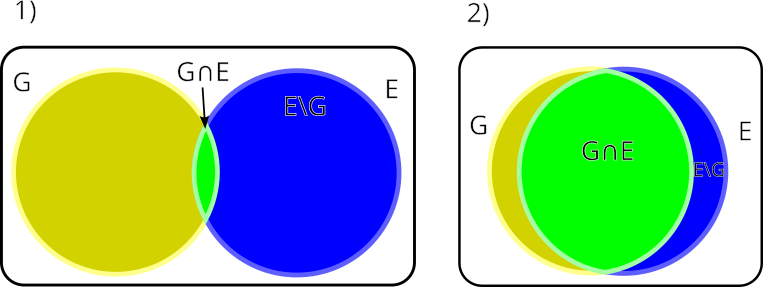
Now take the following two cases:
They have the same logical structure as the first image, but they are now intended to represent quantitative relations, as well (really, just conditional probabilities). Plantinga’s argument doesn’t settle whether case 1) or case 2) obtains. Now suppose you add the datum that there is evil to either case. In case 1), there are many more cases where there is evil, but no God, than cases where there is evil, and God exists. If case 1) obtains, there being evil is thus evidence against the existence of God.
On the other hand, in case 2), there are many more cases where, if evil exists, so does God; consequently, saying that evil exists does not allow us to conclude that hence, God’s existence is less likely. But again, both cases are identical regarding the logical relations, and it is only those that Plantinga’s argument fixes: it tells us that the intersection is non-empty, but not how big it is, so to speak. Both case 1) and case 2) remain possible (of course, there are also other cases, such as G\subset E, but these don’t matter for present purposes). Hence, we don’t know whether pointing abstractly to evil should count against the hypothesis of God’s existence. We’d need further information on the relative prevalence of cases where God and evil coexist, or (as the evidential argument according to Rowe has it) need to argue that there is probably some evils that are not contained in the set G, and that the actual situation is an element of that set.
That is why your argument can’t work: it assumes knowledge we don’t have. That’s why, in the case where God actually exists, it would still (probabilistically) support the false conclusion that they don’t, which is, of course, a reductio (in the formal sense) of your position. Which is why you’ll again ignore this point so you can pretend like you’re making a cogent argument.
Again, this misunderstands the free will defense. The reason in question is one that despite their tri-omni nature, God might have to permit evil (an unknown kind, quantity, pattern, whatever thereof). That is provided by showing a case in which God in fact has to permit evil, namely, the case where free will is necessary for genuine moral value, and transworld depravity obtains.
Let’s look at a case that actually is a little more analogous. Suppose you’re introduced to Frank, who, upon the first handshake, promptly calls you an asshole, or something worse, a slur or something. Do you now have grounds to doubt that he’s a perfectly polite person? Well, certainly—if that’s all the knowledge you have. But if course, you also know that there’s a thing called Tourette syndrome, where sufferers may sometimes have an irresistible compulsion to curse, among other things. Thus, you know that it’s possible to randomly curse people out, and still be a perfectly polite person. If Frank has Tourette’s, his verbal transgression is not evidence against him being a perfectly polite person.
But of course, in this case, you know more still: you know that Tourette’s is very rare in the general population. Thus, you know that we’re in case 1) above, rather than case 2). Therefore, absent other knowledge, it’s more likely that Frank is not a perfectly polite person, because he probably won’t suffer from Tourette’s. The evidence, given that we are in case 1), is in tension with the hypothesis of perfect politeness.
On the other hand, if Tourette’s were common, and we were in case 2), then probably, in doubting Frank’s perfect politeness, you’d just be making a mistake. That perfectly polite persons sometimes cuss people out randomly is what you should expect.
Consequently, in cases where we don’t know whether 1) or 2) obtains, as in the tri-omni God question, we can’t just proceed ‘as if’ case 1) obtained, and thus, all evil yields evidence against that hypothesis. We have no logical justification for doing so, and doing so regardless amounts to assuming facts not in evidence.
Ah, shame. I honestly think we’ve got some opportunities for genuine progress here. With the distinction of gratuitous and necessary evil, you’re halfway there, all that’s left is the recognition that you need grounds to believe that some evil is gratuitous in order to have commensurate grounds to reduce belief in God. But I understand if it’s too much for you.
But this goes slightly further than saying we don’t know God’s reasons now. Does your position assert that if God has an excuse, we would (likely) know it?