[QUOTE=Swallowed My Cellphone]
The overall message of Beauty and the Beast has always bugged me. She fell in love with the “monstrous dude” and the reward is that he turns into a hottie? Way to totally defeate the entire movie! If she’s in love with the guy, she sould love him exactly as-is. That’s the whole point. She should be able to live happily ever after with the hairy fanged guy because she wants to.
On the other hand, that idea has also probably encouraged a ton of stalkers throughout the year, filling their heads with the idea: “If she just gets to know the real me she’ll love me. Warts and all.”
[/QUOTE]
That’s how I’ve always felt about Shrek, which is essentially* Beauty and the Beast* with more pop-culture references and fart jokes.
In Beauty and the Beast, what saves it for me is her pulling away when Michael Bolton-Beast descends. She *rejects *him, just for a moment, until she looks into his eyes (which are the same in his Beast and Bolton faces) and sees that he’s still, internally, The Beast. He’s the man she’s come to love, EVEN THOUGH he’s now handsome. She even says, “Yes, it IS you!” before she takes his hand.
Being handsome again is HIS reward, for learning to love and be loved. It has nothing to do with her, really.
[QUOTE=acsenray]
Okay, let me modify that then. It’s the whole point of letting someone else see what you’ve created. An artist who thinks he can dictate to the world what everyone must think about his or her art is delusional.
[/QUOTE]
I think the artist is trying to express something within themself.
The viewer sees things within themself.
Sometimes, they are the same thing.
At all times, even when they disagree, both the artist and the viewer are 100% correct about the art.
I never said the artist can dictate what their art will mean to everyone. But the way one interperts a work of art, tells us about the viewer, not about the artist.
For instance, some people have said that in Sesame Street, when the chef pronounces ‘Six Bannana Splits!’ and then falls down the stairs, they feel sadness, or horror or frustration. I think the artists never intended those feelings and never had those thoughts about their work. They thought it was funny. The fact that people see that, in that bit of art, only tells us about those viewers, it tells us nothing about the artist or the art in question.
[QUOTE=Sockmunkey]
The saber-tooth in Ice Age only became a good guy when he rebelled against his fellow pack-members who were, naturally, cast as the villans.
[/QUOTE]
And by changing species and title you can do this to Shark Tale as well.
[QUOTE=Koxinga]
So Dumbledore is not necessarily gay?
[/QUOTE]
Correct. Samuel Beckett was once asked to explain Waiting for Godot, and responded: “If I could have said it any better, I would have.” If a work of art requires further commentary from the author, then it is a failure.
[QUOTE=WhyNot]
Being handsome again is HIS reward, for learning to love and be loved. It has nothing to do with her, really.
[/QUOTE]
Yeah, but I still would like the guy to be happy enough as-is and not need the reward. The whole feeling comfortable in your own skin thing. Wasn’t his torment about bing seen as a monster? She loves him anyway, sohe can stop beating himself up about looking like a monster.
The Disney version definitely did a better job of it, having her recoil from handsome dude until she recognized him. But I’d sooner just see them living happily ever after just as they are.
[QUOTE=Swallowed My Cellphone]
Yeah, but I still would like the guy to be happy enough as-is and not need the reward. The whole feeling comfortable in your own skin thing. Wasn’t his torment about bing seen as a monster?
[/QUOTE]
His torment was that he was unlovable because he was a pompous ass. The witch in the prologue wanted a place to stay and he turned her away because she was hideous. So she made his outside match his inside, and in doing so, made him what he most reviled - ugly.* Only by changing himself on the inside - first by learning to control his temper, then by being a good host, then by being generous, and somewhere along the line falling in love and, most importantly, becoming lovable, does he REVERT to his former appearance. The spell is lifted, it goes away and things go back to normal.
Yes, but don’t forget there are still all those other people he dragged down with him that want to be human again. They can’t be until the spell is lifted. Of course, it’s magic, so you can make that whatever you want, but there’s no symmetry if they revert and he doesn’t.
*I suppose if Belle had been similarly afflicted, she might have become illiterate, since books were so important in her life. We all have something we fear losing, for pre-Beast-prince it was his handsome face and beautiful castle and servants.
[QUOTE=WhyNot]
His torment was that he was unlovable because he was a pompous ass. The witch in the prologue wanted a place to stay and he turned her away because she was hideous.
[/QUOTE]
Sorry, I wasn’t referring to specifically the Disney version. I’ve seen other versions groing up (theatrical performances, TV adaptations and whatnot) in which the curse was never specified as a punishment of any kind. It was purely based on nothing but the witch’s malice. So it always bugged me.
The version I saw when I was about 9, I thought breaking the curse cheapened the poignancy of the rest of the show. I mean, in real life if I was in an accident and permanently maimed or disfigured, I probably wouldn’t get that second chance. I always figured it was nicer that she loved him no matter what.
(And in the other versions I’ve seen, no one else shared his fate. So you didn’t have a canldestick turn back into a person.)
[QUOTE=Otto]
“The Wizard of Oz” sends the message that it’s beeter to live in crushing poverty on a dirt farm in Kansas where some evil bitch is trying to kill your dog instead of in a fabulous magical realm where you’re a national heroine and in with the ruling cabal. That’s fucked up right there.
[/QUOTE]
In the book, the Scarecrow points out that Oz seems to be a much nicer place than Kansas and can’t understand why Dorothy should be so anxious to get back there. Dorothy tells him that’s because he doesn’t have a brain. The Scarecrow admits that’s true, and says it’s lucky not everyone is as brainless as he or Kansas would be completely unpopulated.
I imagine L. Frank Baum sitting in the Hotel Del Coronado, looking out at the ocean, and smiling as he thought of all the smart people back in the mid-west.
[QUOTE=Swallowed My Cellphone]
Sorry, I wasn’t referring to specifically the Disney version. I’ve seen other versions groing up (theatrical performances, TV adaptations and whatnot) in which the curse was never specified as a punishment of any kind. It was purely based on nothing but the witch’s malice. So it always bugged me.
[/QUOTE]
Ah, I see. In that case, then yes, I agree with you. (See my previous comments re: Shrek.) There are lots of horrendous B&B versions out there. I’m a big defender of the Disney version because I think not only is it the best B&B story I’ve seen/read (perhaps barring Robin McKinley’s Rose Daughter) but because I think it’s the best of the Disney Masterpieces, for reasons of story and song and art and character and theme.
As for my nomination for WTF “kid’s” movies, I nominate Watership Down. Quick synopsis: Fiver gets a hallucinatory vision about the end of the world, spurring Hazel and company to rebel against society and fight the cops in order to escape Armageddon. Shortly afterwards Violet falls victim to death from the sky. Our heroes find shelter with a cult practicing death worship and flee only to be captured and tortured by a foreign army. They escape from prison with the aid of a mysterious white flying creature from an altogether other world and eventually find paradise.
[/QUOTE]
I’ve never thought of Watership Down (either the book or the movie) as being for kids. We have an unfortunate attitude that if something involves talking animals or animation then it’s necessarily for kids.
[QUOTE=Poysyn]
I think * Iron Giant * qualifies in this thread - although my daghter loves it.
[/QUOTE]
I love it, too, and its message, which isn’t disturbing in the slightest:
“You are who you choose to be.”
The government is in the middle, in this movie. They respond with fear, but restrain themselves once the true nature of the Giant becomes apparent.
Mansley chooses to be fearful and destructive, even when given ample opportunity to be otherwise.
The giant chooses to be “Superman” rather than “A Gun,” and sacrifices himself to save even those people who had attacked him.
What could you possibly find disturbing about this movie?
[QUOTE=Swallowed My Cellphone]
. . . The Disney version definitely did a better job of it, having her recoil from handsome dude until she recognized him. But I’d sooner just see them living happily ever after just as they are.
[/QUOTE]
Well, if you go by peripheral products, he does stay a beast. Get the action figures, get the bedspread (do they have a towel?), get the lunch box, and you get the beast. You also get the smiling teapots and candlesticks.
Of course, if you get the princess products, the beast may be absent entirely, but that’s another topic.
[QUOTE=Argent Towers]
I’d think that a Jewish director would prefer the Jewish character to survive, just out of feeling more of a personal connection with that character if nothing else.
[/QUOTE]
But didn’t that movie practically require Matt Damon to be the last man standing? Although I suppose they could have made Pvt. Ryan Jewish.
ETA: And the guy is a fictitious character, there’s no real “personal connection” anymore than I would have a personal connection to Kevin Bacon as a bike courier in Quicksilver. “He rides a bike… I ride a bike… He’s my brother!” Granted that’s over-simplifying things.
[QUOTE=RMutt]
I’ve never thought of Watership Down (either the book or the movie) as being for kids. We have an unfortunate attitude that if something involves talking animals or animation then it’s necessarily for kids.
[/QUOTE]
I never did either, which is why I put “kids” in quotes. I read it as a kid and loved it, but I was a little odd that way (I read Animal Farm and Steven King when I was eleven so Watership Down didn’t faze me). But unfailingly, if you ever look for the movie (a very faithful adaptation of the book) it’s going to be in the "kids " section.
Check out its listing on Yahoo Kids. If that description was all a parent knew…
Come to think of it, I’ve seen the animated version of Animal Farm in the kids section of Blockbuster Video, too.
[QUOTE=WhyNot]
I have appropriated Skald the Rhymers’ signature for the purposes of this thread:
I think that says a lot about it. Disturbing messages are in movies and books and fairy tales and music because they are in us. Hopefully, the movie, book, fairy tale or music will also contain a bit of Hope, Truth or Justice (if not the American Way), or at the very least a parent will provide the context for the disturbing bits.
[/QUOTE]
Which instantly reminded me of Bruno Bettelheim’s The Uses of Enchantment: The Meaning and Importance of Fairy Tales.
[QUOTE=Koxinga]
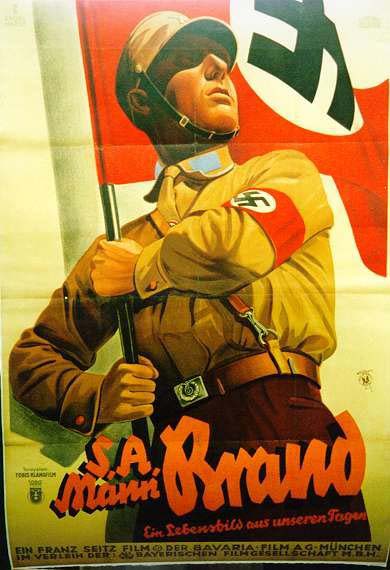
… And if you’ll take another look at the poster from the movie I mean to indicate that there could be undertones of fascism, …
[/QUOTE]
My first reaction was soviet propaganda art, so I Googled that and on page 2 was this,
but the Nazi’s used very similar imagery. At this point it’s really just become a classic retro style.
[QUOTE=WhyNot]
… Generally people don’t realize what a manipulative asshole Gandalf is until they get older and read the extended works.
[/QUOTE]
IIRC there is the whole “Gandalf puts the invisible rune on Bilbo’s door so the dwarves can find him” in The Hobbit. It’s not until LOR that we find out Gandalf’s grander manipulation of the whole thing.
[QUOTE=WhyNot]
Yep, one of my favorite books. Chesterton’s quote is just so much…pithier, don’t you think? Essentially comes to the same conclusion, though.
[/QUOTE]
Absolutely, plus Chesterton doesn’t come with the baggage that Bettelheim does these days! I was trying to find a reveiw of TUoE:TMaIoFT (just in case anyone wasn’t familiar with it) but there wasn’t one that bring it all up.
[QUOTE=Argent Towers]
Yeah of course, that’s my point. Those were mostly civilians who were defenseless. Spielberg created a Jewish character who was a well-armed and trained soldier, and even he got killed. I’d think that a Jewish director would prefer the Jewish character to survive, just out of feeling more of a personal connection with that character if nothing else.
[/QUOTE]
No, that’s the surface. The major plot is that the German soldier was spared through common humanity and fate by Cpt. Miller. He came back and killed one of the people that wanted to summarily execute him in the cow pasture. Cpl. Upham witnessed his inhumanity, was spared by him, but ultimately slew him… justly. It made the innocents killers.
IMHO the whole “genius bad guy” meme (AKA the mad scientist) is just the modern interpretation of the fairy-tale “evil wizard” character.
I think the average person would rather be “super” than a genius because the genius is usually only powerful when pre-emptive. People don’t want to have to spend time planning and worrying about trouble, they just want to be inherently able to handle trouble when it comes. After all, it’s impossible to anticipate evey eventuallity.
On another note, remember the Road Runner cartoon? Those always bugged the hell out of me because it seemed like the message was: It doesn’t matter how smart you are, how well you plan, or how hard you try because the talented and/or lucky SOB will always win.