[QUOTE=bobsled]
Two words: Jury Nullification. And by thy peers thou shall be vindicated.
[/QUOTE]
As a lawyer I can tell you that almost never happens, and I have never heard of it happening in a tax-evasion case.
[QUOTE=bobsled]
Two words: Jury Nullification. And by thy peers thou shall be vindicated.
[/QUOTE]
As a lawyer I can tell you that almost never happens, and I have never heard of it happening in a tax-evasion case.
[QUOTE=bobsled]
Income tax is stealing. If I have an agreement to work for a company for $10 an hour and I work 10 hours, if I take home anything less than $100, that means I’ve been robbed. Doesn’t matter if it was John Doe or the Feds, my property has been taken from me.
[/QUOTE]
How is income tax any different, in that regard, from sales tax, real property tax, or tarrifs?
Government – any government worth the name – has the authority to take your property from you. It’s called taxation and it is one of the essential incidents of sovereignty.
[QUOTE=BrainGlutton]
As a lawyer I can tell you that almost never happens, and I have never heard of it happening in a tax-evasion case.
[/QUOTE]
Just curious – did you or do you practice criminal law?
I’ve never heard of it in a tax-evasion case either, but I have had any number of not-guilty verdicts which I believe were the result of leniency, and which I suppose might technically qualify as nullification. I think there’s a distinction between believing the overall law is unjust and acquitting (true nullification) and believing the individual defendant is deserving of leniency even though guilty in fact. Of the latter, I’ve seen plenty.
If you want to make the argument that taxation is stealing, go ahead. But why is income tax a worse crime against nature than sales tax or property tax?
[QUOTE=Bricker]
Just curious – did you or do you practice criminal law?
[/quote]
I’ve handled some criminal cases in the past, but never before a jury; some bench trials, some appeals. What I said about jury nullification is simply well known in the profession.
[QUOTE=Bricker]
I’ve never heard of it in a tax-evasion case either, but I have had any number of not-guilty verdicts which I believe were the result of leniency, and which I suppose might technically qualify as nullification. I think there’s a distinction between believing the overall law is unjust and acquitting (true nullification) and believing the individual defendant is deserving of leniency even though guilty in fact. Of the latter, I’ve seen plenty.
[/QUOTE]
I was referring to the former. And no way is Ed Brown going to benefit from the latter.
[QUOTE=BrainGlutton]
I was referring to the former. And no way is Ed Brown going to benefit from the latter.
[/QUOTE]
Gotcha.
And, I agree completely.
[QUOTE=BrainGlutton]
I was referring to the former. And no way is Ed Brown going to benefit from the latter.
[/QUOTE]
Brown’s not going to benefit from either. He’s already been convicted and sentenced.
Willie Nelson might find a sympathetic jury to cut him a tiny amount of slack. I don’t think Ed Brown could do the same.
[QUOTE=askeptic]
This is what I don’t get about tax protesters. You go to work on a road paid for by income tax. You went to school that was most likely subsidized with federal tax dollars. You live in a country that is protected by a military that is funded by income tax. You take advantage of the numerous benefits that only exist because of a government that is funded by income tax. Do you suggest that all the things the government provides will magically appear absent being funded by us?
[/QUOTE]
Many tax protesters will counter that we can fund the country through customs and tariffs. Might as well rely on proceeds from the tooth fairy.
[QUOTE=D_Odds]
Many tax protesters will counter that we can fund the country through customs and tariffs. Might as well rely on proceeds from the tooth fairy.
[/QUOTE]
And since the cost of a tariff is passed along to the ultimate consumer of the goods in question, it constitutes an indirect sales tax. How is that any less immoral and/or unwise than an income tax?
[QUOTE=BrainGlutton]
How is that any less immoral and/or unwise than an income tax?
[/QUOTE]
Don’t ask me. It is as foolish and stupid an idea as is declaring income tax illegal.
[QUOTE=D_Odds]
Many tax protesters will counter that we can fund the country through customs and tariffs. Might as well rely on proceeds from the tooth fairy.
[/QUOTE]
Oh thats better then. I mean who wants to pay 20%± of his earnings as income tax when he can pay 30%± of his earnings in higher prices that would result from higher “customs and tarriffs” not to mention the damage we would do to ourselves in the arena of foreign relations.
I also think the same people screaming about income tax now would be screaming about “customs and tarriffs” if this turned into bizarro world and they managed to abolish the evil income tax.
Hmmmm…what’s another word for “tariff”?
ETA: I just had to put a rather large check in the mail to the IRS for my quarterlies today. Maybe there is something to this income tax is illegal stuff.
[QUOTE=bobsled]
I think it’s too vague. The context is open to interpretation, you are just telling me how it’s historically been interpreted, that’s not to say it couldn’t be interpreted differently in the future.
[/QUOTE]
Only in the sense that the word “cabbage” could, in the future, be interpeted to mean a law of physics or a literary concept or a breed of goat.
[QUOTE=askeptic]
Hmmmm…what’s another word for “tariff”?
[/QUOTE]
Duty, impost, customs, import tax.
[QUOTE=BrainGlutton]
Duty, impost, customs, import tax.
[/QUOTE]
One of us needs to work on our sarcasm, I suspect its me.
Um, first of all, you folks do realize that the original poster has long since accepted that his original position cannot be justified? He has since fallen back on asserting that the income tax is amoral. You cannot win that argument, since morality is not able to be debated rationally (as it includes personal belief).
You will not convince the OP that his beliefs are wrong.
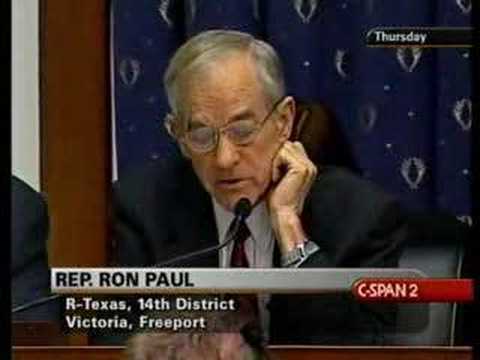
[emphasis mine]
“Congress, in essence has ceded total control of the value of our money to a secretive central bank. Congress created the federal[sic] reserve, yet it had no Constitutional authority to do so. We forget that those powers not explicitly granted to the Congress by the Constitution, are inherently denied to the Congress. Thus, the authority to establish a central bank was never given. Of course Jefferson and Hamilton had that debate early on, and the debate was seemingly settled in 1913. Transparency and oversight are something else, and they are worth considering. Congress, although not by law, has essentially given up all its oversight abilities over the fed, there are no true audits, Congress knows nothing of the conservations, the plans, and the actions taken in concert with other central banks. We get less and less information about the money supply every year, especially now that we don’t even have access to M3 statistics.”
Ah. Ron Paul. Who wants us to go back to the gold standard. Riiiiiiiiiight…
[QUOTE=bobsled]
I don’t have to defend my idea anymore than to say that’s how I interpret the Constitution, and that I’m following a historical tradition of this interpretation. I’m a Jeffersonian strict constructionist, not a federalist Hamilitonian. This was an debate even in the earliest days of the Republic. From the Wikipedia article on Necessary-and-proper clause:
[/QUOTE]
How you define the constitution is irrelevent when the Supreme Court has a different opinion and only whackos think that this is not well settled law. I guess I could probably create some tortured interpretation of the constitution combined with local statutes that would make it legal for me to take all your stuff but it would probably be a bad interpretation.
[QUOTE=bobsled]
You didn’t read what I said. The income tax could be interpreted to be violating the 16th. The last part of the clause is open to interpretation, “without regard to any census or enumeration.” I could argue that since the tax is graduated based on income, it is indeed enumerated based on income.
But who decides the value of Lemur currency? If you define the value to be 1/1000th of the value of the dollar, your taxable income could be much less, which is why the gov’t doesn’t allow people to create their own currencies. But that is totally irrelevant to my argument. The issue that I have with the taxation of bartering is how and who determines the fair market value of the goods being trading. That certainly seems open to interpretation and abuse.
[/QUOTE]
Considering the amendment was specifically passed to empower congress to impose an income tax your best argument seems to be “they didn’t use clear enough language”