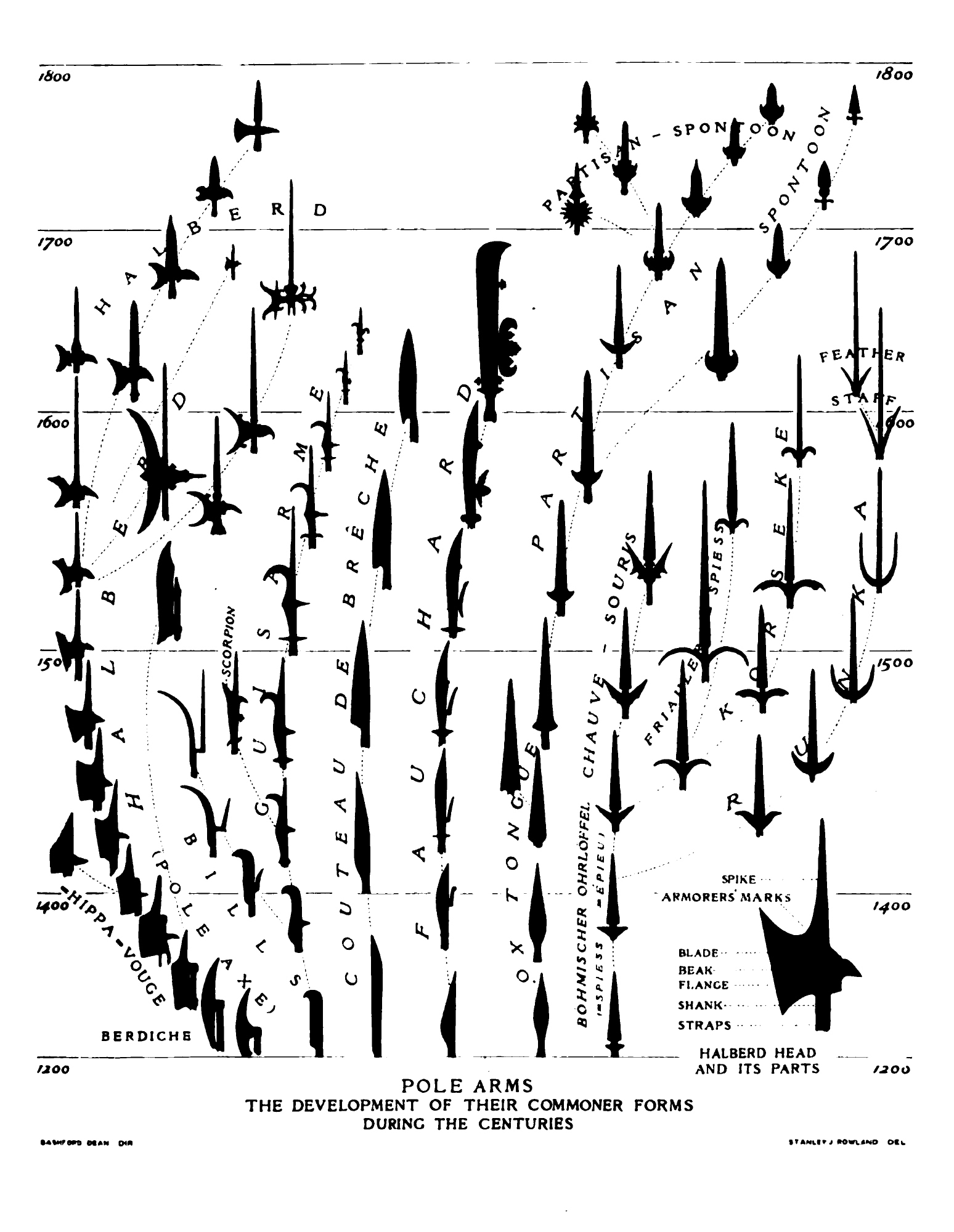
Consider the fauchard, for example. Around 1300, you have your basic convex blade, while by 1400 a useful hook had been added. But is a c. 1600 fauchard that much more deadly/higher-tech/better than a 1400 fauchard? Or the 1800 halberd compared to the 1500 halberd? Etc.
Some of it is clearly fashion, and cultural preferences - for instance, the English always preferred bills over halberds. But a lot of it has to do with the changing nature of battle during the period and the polearm’s role in it.
Consider - who is using the weapon? Untrained, lightly armored infantry? Trained infantry in mass-produced breastplates and helmets? Dismounted knights?
And who are they using it against? Light infantry? Heavy infantry? Men with pikes, men with polearms or men with shields? Mounted heavily armored cavalry?
And what’s its role in the battlefield? Is it used on the front line of battle? Is it intended to support the pikemen? Support the archers? Support the arquebusiers and musketeers? Used by an elite corps of guards? Used in open fields? Used in urban and castle warfare?
No weapon is the best at everything, so the design of these weapons was constantly tweaked to best fit whatever role people thought they’d be used for. Over 300 years, that would lead to a lot of variations.
Among other things you’ll note a general trend towards longer and thinner blades. That’s probably a result of improved metallurgy so that less material is still adequately strong.
The especially pointy ones are optimized for poking through armor of whatever material. If we see those points getting finer over time that’s a sign of both better metal / metalworking enabling finer points, and also better armor needing to be defeated by increasing the impact pressure per unit area.
Yep, the evolution of most weapons tracks with the evolution of most armor. Consider the time frame of this graph, it also covers the eras in which wood, leather and cloth-based armor evolved into chainmail, and eventually plate mail. As the weapon side got better, people started to die more, so the armor side had to improve. And as fewer people died, we upped the weapons game to kill more people.
Mobs and pitchforks go waaay back. A farmer may not be able to afford an armory, but he can sure afford the necessary tools of his trade. Those also attract fewer questions from the local Lord’s goons.
Probably more common is that the local lord recruited the farmer and the farmer only had agricultural implements. Good steel was quite expensive and equiping a good-sized troop with halberds was beyond the resources of most local lords.
The “illegal weapons” story is one I’ve heard many times when doing various martial arts classes when I was a kid. The story goes that nunchucks, kamas, bos (quarter staves), and similar weapons were adopted by the people of Okinawa after Japan conquered the island and banned all weapons - because there are agricultural implements.
That said, my understanding is that this is mostly a myth.
True. But it makes for good stories! My favourite was for the European quarterstaff. The saying was, “You can’t deny a man a stick when he lives in a forest.”
Right: In actual use, polearms might just be “Hey, you, peasants over there. You’re conscripted. Grab whatever you can use as a weapon and come with us”. In which case their form might be entirely determined by their agricultural use.
What part of it is a myth? Because those are agricultural tools. A kama is a sickle, a nunchuck is a threshing flail, and a bo is, well, a stick.
That the Japanese confiscated all weapons when they occupied what today is Okinawa and this is why the tools were adopted as weapons. It seems more likely that metal was relatively rare at the time so agricultural implements were the best weapons they had, rather than a widespread and intentional confiscation of dedicated weapons.
But that’s just from a very cursory reading on the topic a while ago.
Maybe, but polearms grew popular (and exploded in variety) around the time that European militaries started employing paid, professional infantrymen, either as mercenaries, household troops or regular armies. I suspects that while peasant levies may have managed with improvised weapons, spears and bows, the polearm was by and large the weapon of the trained soldier.
When I first read this part, I raised an eyebrow, and was about to point out that the spear was the melee weapon of choice of militaries for nearly as long as militaries have existed, and that this was true of drafted and professional militaries alike, with professional militaries able to field more complex spears, like sarissas, in more specialized formations.
But then I finished your post, and saw this:
So clearly you don’t consider the spear to be a polearm. But I have to ask, why not? A spear is a very simple polearm, but it’s still a polearm, IMHO.
Yeah, spears are sort of the ultimate militia weapon. Easy to make, comparatively easy to use. One of my oft-quoted favorite old sayings - ‘Swords or daggers of famous warriors ought not to be coveted. A sword worth ten thousand pieces can be overcome by one hundred spears worth only one hundred pieces.’ - Asakura Toshikage, 15th century. When playing Total War: Shogun 2 always bulk up on lots of yari ashigaru and limit the number of pricey samurai units .
I am not a historian (or SCAer ) but I’d guess it was the shift from primarily being a protection against armored knights (in the medieval period), to being used primarily against other pikemen (in the early modern period).
A way I’ve seen it put in the past is that a sword is a warrior’s weapon, a spear is a soldier’s weapon.
A sword is a better generalist weapon, being handier in closer quarters and capable of parrying attacks. A highly skilled swordsman fighting alone is likely to be better off than a lone spearman. It’s also a lot easier to carry around everywhere. Also being more expensive it’s more useful as a status symbol.
Spears however are not only cheaper and effective with less training, but unlike swords their effectiveness increases with numbers. A spearman doesn’t need to parry a sword when he’s part of a spear wall and the swordsman can’t get close enough to hit him.
I dunno. To me, the definition of a polearm is a weapon on a long stick that isn’t a spear. I think it’s because spears are so much more widely used and ubiquitous - throughout history there have been at least 100 spearmen for every soldier armed with a non-spear polearm - that if we included them in the discussion, we wouldn’t be talking about anything other than spears.
Besides, a spear is so cheap and so common and so familiar to everyone, it’s worth discussing what kind of soldier would use a weapon with something more complex at the end of their stick, don’t you think? The spear is the rule; the non-spear polearm is the exception. This thread is about the exception.
And I’d always splurge on naginata troops, because polearms are cool.
 .
.