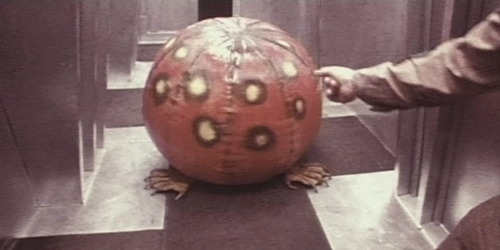
Another one that continues to amaze me is the make-up work in The Adventures of Baron Munchausen. A majority of the characters were shown at different ages spanning something like 40 years, and while some of them were slightly characterised rather than full-on realistic, the make-up and latex work looks like part of their face, and they really do look older and younger. I’ve never seen any movie which equalled it, even ones where such a feat was the whole point of the film (for instance, Mrs. Doubtfire.)
I always feel it a shame that the techniques used in the movie seem to have not been passed on to Hollywood.
trenuously disagree. I thought Gort’s construction looked impressive and different from any other robot depiction of the time. The way his knees bent instead of pivoting (a la the robot from Metropolis, or C3PO) was a cute touch, implying some sort of flexible metal (the costume was, I believe, made of leather – not fabric – painted over, which is why it moved the way it did).
The disappearance effects were straightforward – but nobody else did it that way that I can recall. It was elegantly portrayed, and didn’t look “cheap”
The ship had a spare and classic appearance, and the way it opened – with a wedge of the ship seeming to appear and open, with no clear seam (an effect they DID work to achieve) was amazingly cool. “Looked like a plywood mockup”? What do you want – if it was made of metal, it would look the same. That it wasn’t festooned with extraneous tubes, pipes, and gizmos was an aesthetic decision. It implied intelligence of design and control.
But the best thing by far is Gort’s “laser visor”. The way the visor slowly tilted open, to reveal the shimmering light source within, was VERY impressive for the time and is still as impressive today. Infinitely better than, say, having a little ball turret covered with tubes, hoses, and gewgaws.
Being surprised by how good a SFX or technical design in an old movie isn’t to say that they’re equal with what is possible today. There are a few scenes in Gone with the Wind that use matte paintings to great affect but I think we can accomplish better scenes today. Likewise 2001 still looks pretty good and the ships move realistically but they look like models to me. They did a great job but I don’t think the effects in 2001 hold up today.
[QUOTE=CalMeacham]
The way his knees bent instead of pivoting (a la the robot from Metropolis, or C3PO) was a cute touch, implying some sort of flexible metal.
[/QUOTE]
Maybe, but the result was not “hey, that’s a cool robot!”, but “Hey, that’s a guy in a fabric suit!”. (Granted, it was a big guy in a fabric suit.)
I guess what I’m saying is that when Gort turns and I see the fabric in the knees flexing and bunching up, it took me right out of the movie. Where the spirit of the OP is more, the SFX are so good that you suspend all disbelief.
Bending the concept of “old movies” a bit (but it’s okay, the OP called Goonies old!): I’d point to the brilliant CGI work in Tron. CGI at that time was in its infancy, barely ready for primetime… but Tron’s universe pretty much requires the basic, non-realistic look that could be achieved at that time. There has been talk for the last few years of revisiting Tron in a second movie, and one of the biggest fears of Tron fans everywhere is that CGI is too good now-- it’s going to be difficult to recreate such a primal, electric world when every animator’s going to tack on as many flashy effects that they can.
It doesn’t “bunch up” – it’s leather. It does bend in a weird way, though.
(The Tin Man’s body, by the way, was made of leather painted silver for the 1939 Wizard of Oz.)
The climactic scene in The Monster that Challenged the World, where Tim Holt is battling a giant snail that got hatched in his lab, is damned effective. The monster is stiffish, but the actors are doing a heckuva job of looking convincingly terrified. Holt, in particular, has the perfect “scared spitless but doing what has to be done” demeanor.
And Rhedosaurus-at-Coney Island scene in The Beast from 20,000 Fathoms is very very nice, indeed.
The transformation in the old Dr Jekyll and Mr. Hyde is really awesome - what they do is, since it’s black and white, they shoot it with, say, a green light. And they paint the “monster” effects in green makeup. When Dr. Jekyll transforms, they gradually shift to red light, making the green effects show up. It was explained much better in a previous thread - the effect is awesome. You can tell it’s a really obvious makeup effect, but you can’t tell where they do it - it’s obviously not cut. Cool.
Also, in the original Godzilla, or Gojira, or what have you, the melting telephone wires are really cool. Made of wax.
At first I didn’t think that Escape From New York would qualify as an “old” movie, but I see that it was released in 1981…27 years ago!
A futuristic touch early in the movie was landing a helicopter on top of a building in the middle of NYC. The command center was monitoring the landing and it was shown on their computer screens…pretty mundane stuff for we of the future. But consider how this effect was done (from IMDB of course):
“The wire-frame computer graphics on the display screens in the glider were not actually computer graphics. (Computers capable of 3D wire-frame imaging were way too expensive when this was made.) To generate the “wire-frame” images, they built a model of the city, painted it black, attached bright white tape to the model buildings in an orderly grid, and moved a camera through the model city!”
It’s not noticeable unless you know to look for it.
If I’m not mistaken, they did much the same thing in the movie Megaforce (a wonderfully awful film). At one point they’re looking at an apparently computer-generated contour map, which is really a superimposed plywood model painted black with colored reflective tape on the edges of the “steps”
The “computer graphics” from the BBC TV version of “Hitchhiker’s Guide to the Galaxy” were also all done through conventional animation. Real computer graphics would have been too expensive. And those graphics look like they could have been whipped up on my old Apple //e.
[QUOTE=Otto]
Here’s a working clip from the 1910 Frankenstein. It about 13 minutes long and I haven’t watched it all yet to see if the creation scene is in it but since part of the url is “frankenstein_creation” I’m guessing yes.
ETA: yes it is, about 2:30 in.
[/QUOTE]
That’s not a “clip”.
IT’S THE WHOLE FREAKIN’ MOVIE!!!
THANK YOU!
I’ve been a Monster Fan since I was a wee friar & always wanted to see this!
Two come to mind that impress me for the time made. The bits of the aliens we get to see in 1953’s War of the Worlds.
And the makeup job/fingers on 1922’s Nosferatu. Man, some people must have shit a brick in 1922. Hey Nosferatu is on youtube - http://www.youtube.com/watch?v=MEOsb6CRvNU
[QUOTE=Lemur866]
The “computer graphics” from the BBC TV version of “Hitchhiker’s Guide to the Galaxy” were also all done through conventional animation. Real computer graphics would have been too expensive. And those graphics look like they could have been whipped up on my old Apple //e.
[/QUOTE]
The “how they did it” on the DVD was pretty interesting. The animators used drawn line animation for the graphics and exposed each letter a shot at a time for the “scrolling” text: ind it fooled many computer experts at the time, who wanted to know what kind of system they’d used. I assume that a similar technique was used for the “computer” graphics in Monty Python’s Meaning Of Life.
The bit that gets me, though, is how they got the moving “computer display” on the prop Guides that the characters were holding in some shots. We take it for granted now that there are hand-held devices with video screens - or that similar video effects could be simply green-screened in - but back then the technology simply didn’t exist, and they had to manually project the “computer animation” through a screen within the handheld prop - using a camera and a lot of guys shuffling about on the floor out of shot - so that it would appear as it the Guide itself had a video screen. The effect is almost flawless, so much that you don’t even notice that what it was depicting was effectively impossible over 25 years ago.