Exactly what I was going to say. I like to think I’d go with the evidence. But human beings are all subject to confirmation bias, and we all tend to reject evidence that contradicts what we already believe.
Trust me, research psychologists have evidence to back this up.
It just sounds like not much different than transactional analysis, or even Jungian archetypes, to me? Facets of personality that work under the hood. Not the same as disassociation, albeit my wife and daughter do discuss how disassociation may be more of a continuum, and that degrees of it may be actually more normal than not.
Anyway. Yes trauma work has enough study to consider what is evidence based at this point.
Soon, I am going to create a Bullshit Therapy thread and we can talk all about it. We will have a plethora of options to discuss.
One of my existing models is that people are enormously bad at accurately perceiving themselves. We’re also terrible at making predictions. We see patterns where none exist. Really, we shouldn’t be trusted at all!
I’d like to think that the evidence trumps the model, but in some or many cases the evidence is inconclusive or misleading.
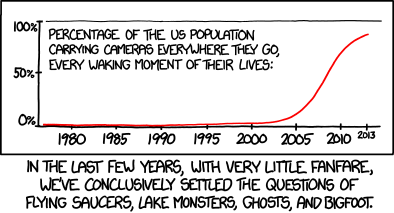
Since 1947 there has been nearly eighty years of accumulated ‘evidence’ concerning UFOs, flying saucers, UAPs and so on; however all of this evidence has to be examined critically and alternate explanations for that evidence must be considered. There is not just one explanation for the UFO phenomenon evidence - instead there are a multitude of different factors and effects that could cause the same observations, and sometimes these effects and factors are obvious, while other times less so.
You can’t just assume that a large database of evidence is conclusive proof - in the case of UFOs, ghosts and ESP (for examples) the opposite appears to be true.
Models are only as good as the evidence used to construct them.
I was listening to the If Books Could Kill takedown of Sapiens yesterday. I enjoy reading books like that, but those Big Idea non-fiction books are the textbook definition of cherry-picking data. You have no idea what’s being left out because by definition every citation is going to support the author’s thesis. It’s true whether the book is about habit formation, nutrition, or major historical developments in human civilization. For all I know, I’m being presented with 5% of the evidence and the other 95% contradicts the author.
Anyway, Sapiens apparently contains a lot of bullshit. It claims, among other things, that humanity suddenly and mysteriously became cognitively advanced 70,000 years ago in the span of a very short time. It also claims that the lives of hunter-gatherers were easier than the lives of farmers. And me, knowing nothing whatever about the subject, thought, “Huh, I never knew that.” But apparently it’s all bullshit.
I’m not claiming there’s more bullshit than there used to be. But it’s very frustrating to me how elusive the truth seems these days.
I’m mindful that we don’t understand how some drugs work (e.g., some anesthetics), but they do. That nuance means to me that we don’t have enough knowledge to understand the mechanism of action or justify the correlation (X mg/kg of propofol has Y effect) the way that we understand how beta-lactam antibiotics work against gram-positive bacteria. Unfortunately, that nuance is poorly understood and sometimes abused, as when people claim that leukovorin cures autism. It’s a fine line to walk.
Evidence is what matters, even if adjusting my paradigm can be difficult. And I’ve been told I’m a bit stubborn (no, really??) but I am educated in engineering and science, so I’m not going to cling to an unreality simply because I think I know better.
Career long lawyer - I don’t understand what you are saying. Trying to think of what legal situations depend on 'an existing model" independent of evidence.
Evidence. I may not like what the evidence says, and I may gripe about it, but if it’s irrefutable, it’s irrefutable and eventually I’ll come around. I may pout, though.
So for example, an pretend you’re an administrative law judge handling a disability claim. Claimant (“CL”) is 49 yo male factory worker, who has only done heavy manual labor, high school education, well documented chronic back pain, moderately limiting depression, difficulty standing for more than a short period, lifting, concentrating, 2 MDs applying evidence-based medicine say “light work only.” There is substantial evidence that CL has been looking for jobs but employers are unwilling to accommodate him without formal disability status.
There is a legal model/process for determining disability which you must follow. So you determine CL is not working at substantial gainful levels, is severely impaired, but when you go to look at the regulatory requirements for musculoskeletal disability… chronic back pain doesn’t qualify without other findings that aren’t present here. Okay, so you look at the mental disorder regulations, but depression doesn’t qualify unless extremely limiting. So you look at CL’s past work, but he’s only done heavy labor and can’t keep doing that. At this point you look at the medical-vocational “grid” rules, 404 CFR App. 2 part C, where under Rule 202.21 a “younger individual” restricted to light work with a high school education and no transferable skills is defined as “not disabled.”
If CL was just one year older, he would be “closely approaching advanced age” and thus “disabled.” Rule 202.12.
The model comes first, and the evidence has to work around it.
I used to be hyperfixated on the idea that I might be wrong. There was nothing worse, in my mind. But with time I’ve come to see being wrong as an essential part of the learning process. If you care at all about finding the truth, you must be constantly testing what you think is true and adapting accordingly. You must be constantly coming upon the limits of your own knowledge. That’s why sometimes I say things here that I’m not 100% sure about, because it’s the best way I know to test any idea. If I’m wrong, I have no doubt someone on the Dope will tell me!
I think part of it is, you can’t become too attached to your own models.
The more I think of your post, the more I disagree with it. While most legal arguments and decisions ought to be made with an awareness of the existing legal framework, how the evidence is weighed and interpreted within that framework most often determines the outcome.
Not that I have any expertise WRT your example, but I think you have described a situation in which the decision-maker’s assessment of the evidence is paramount. Yes, that assessment has to be done within the existing legal framework. But I would imagine it is an infrequent case in which an ALJ has ZERO discretion as to how they apply the facts to the law. One such situation might be if an individual is very clearly significantly impaired, yet they are struggling to work at a level that exceeds substantial gainful activity. No matter how sympathetic that individual might be, I’m not sure how an ALJ could find them disabled so long as they continued working. While I imagine that situation occurs, I suspect it is somewhat infrequent.
In your example, I imagine that ALJ COULD apply SSR 96-8p and conclude that the claimant was unable to sustain ongoing competitive work without excessive breaks and absences.
I also observe that Rule 202.12 does not apply to the situation you describe, and that 202.13 would still direct “not disabled” at age 50. I presume you mean 201.12. If the claimant were 49 and 6 months, the ALJ SHOULD find it a borderline case and could apply the rules for the next age category.
I’ll also suggest a modification of one portion of your scenario. Instead of
I imagine many/most cases include well documented ALLEGATIONS OF pain, depression, etc… Both subjective allegations and medical opinions must be weighed. Subjective allegations lacking sufficient support are insufficient to support a finding of disability. And medical opinions must be assessed for both consistency and supportability WRT the record as a whole.
In most disability cases, I imagine that a determination of how the evidence fits within that framework is paramount. I imagine that many people who are disappointed at receiving unfavorable decisions may just not present enough evidence, or they present the wrong sort of evidence. At least how that particular decision-maker interprets the applicable law.
Yeah, sorry about the rule numbers. The guidelines are mandatory and inflexible if the claimant meets all the listed criteria. The ALJ has more wiggle room if the claimant doesn’t fit anywhere on the grid.
But that’s my point; the model comes first, and evidence has to work within the model, even if the model is wrong. I imagine this happens in a lot of fields where the model is policy-driven rather than scientific. Like in the mundane case where boss says do X in an inefficient manner.
I get you. I had not appreciated what you were saying, as I thought most others were discussing something other than artificial and arguably arbitrary rules imposed by an authority that had enforcement power.
My misunderstanding of your post likely resulted from my understanding that the discussion concerned matters of “belief.” A thought bolstered by the first substantive sentence of the OP.
I think that if the evidence doesn’t fit the model, you need to do more research.
There are a few old drugs whose mechanism isn’t well understood, and they mostly have a lot of unpleasant side effects. There are also whole families of drugs with mechanisms that are understood, and they are regularly improved.
But you can’t just trust data, unless it’s been tested and found to be predictive. Because in the real world, data is lumpy and dirty. Lumpy refers to the fact that sometimes, with a fair die, you will roll a 6 ten times in a row. Dirty refers to the fact that the guy you hired to write down the results of each die roll made some mistakes. And speaking as a data professional, real world data is very dirty.
Also, in the real world, people lie, and some of the “data” was faked.
So data that fits your model is much more persuasive than data that doesn’t fit your model, or worse, contradicts a model that has been predictive in the past. Of course, if enough data contradicts your model, you need to abandon the model. But there’s a reason people are reluctant to do that, and it’s a good reason, that serves us well, not just some cognitive glitch in how humans process. It’s why we can enjoy stage magic, and not run to the stage to rescue the lady about to be cut in half.
Yup, i voted “model”. But of course the data matters, too.
And people make mistakes. Anecdotal evidence is evidence, but it can be unreliable, even if the people giving the evidence are honest.
Nullius in verba. It is more complex than that, since often anecdotal or eyewitness evidence is correct, but it can’t be the only reason to reject established wisdom.
But when data contradicts your a priori model, it’s worth checking the data. For example, my model of auto insurance claims is that most claims are reported fairly quickly after the incident occurs. (Unlike, for example, products liability claims, where someone might file a claim years after an incident, for instance when they read a news story about other people filing claims.) But i once saw an auto claim that was reported 20 years after it happened. We did not blindly trust the data. We read the claim description (hit by truck, broke leg) and thought it was unlikely that such a claim would be reported so late. Further investigation showed it was a typo in entering the report date.
But every large body of data I’ve looked at contained some errors. It’s just the nature of the world that records of data are imperfect.