The tsunami gods. The nuclear plants got through the earthquake just fine, it was the tsunami that cause the catastrophic breakdown.
Broomstick, I think maybe you and me cross-posted and you missed my follow-up(s). Refer especially to this post where I quote at length from the TEPCO official who indeed suspects a pressure vessel breach. Fuel escaping is rather my own inference which I clarified in the post #17.
Here’s reporting from NHK (Japan public broadcast)
If the melting fuel created a hole in the bottom of the pressure vessel, it seems pretty reasonable to assume that some molten fuel likely escaped the vessel.
[QUOTE=gonzomax]
Paul Gunter is on TV explaining that building 1 had a core meltdown and is exuding through the floor.
[/QUOTE]
And his evidence for this is…? Thanks to your helpful link, we see that Paul has been an ardent anti-nuclear activist for ‘over 30 years’…doesn’t this lend weight to his seemingly unsupported assertions in your mind?
Do you have a cite for this? Which part of ‘Building 4’ is ‘leaning badly’? The secondary containment structure? The pressure vessel? Something else? Did you just make it all up? My guess is (assuming number 3 isn’t the answer) they are talking about the secondary containment structure…which actually doesn’t hold ‘over 100 tons of nuclear waste’ in it, but simply is a structure over that waste.
[QUOTE=SherwoodAnderson]
To me sounds like a convoluted way of saying that they suspect that the fuel pellets were gathered at the bottom of the pressure vessel and subsequently melted out of the vessel.
[/QUOTE]
It’s possible that’s what he meant (it’s hard to say), but I have my doubts. The bottom part of the primary containment vessel is specifically designed to contain a partial meltdown…or, at least to fail after some period of time, giving the emergency workers time to work on mitigation. IIRC, there is actually a sub-structure that, assuming there is a melt through of the PCV allows the melted core to fall into. From what I recall of this, the temperatures never got high enough to allow a burn through of the core.
Um…you do realize that the secondary containment building exploded when it filled with hydrogen gas, right? My own Occam’s Razor points to that as being the most likely cause of the leak, since, again, I’ve seen on evidence that the temps were ever high enough for the core to burn through. Think about the temperatures it would take to melt through a structure designed to contain just such an event. We aren’t talking a couple hundred degrees C here, but thousands, sustained over hours or days.
The tops of the fuel rods were exposed to the air (in the containment vessel) because the power finally went out on the tertiary backup power (the primary backup power having been flooded out in the tsunami). That’s most likely what caused the hydrogen gas that blew up the secondary containment structure. When that happened, and when they poured sea water on those exposed rods they became brittle and broke up (they also probably started to or had melted down at that point)…but none of that indicates that they subsequently burned through the floor of the primary containment vessel and escaped.
I think what this guy is saying (badly) is simply that they have confirmed that there was at least a partial meltdown (which is something they pretty much suspected since March), that all of that junk is at the bottom of the PCV (and in the water), and that there are leaks in the vessel (most likely due to the explosions mentioned earlier). All stuff that’s been known for a while now. None of this stuff changes anything, really…the situation is as serious as it was last week, and they are slowly bringing it under control…as they were doing last week. It’s going to be months before they finally get everything under full control and they can do a full shutdown and entombment of the reactors…IIRC, their plan is to have it at that point in 8 months, but that might slip a bit (or, who knows, they might get it done before that).
-XT
Like I wrote in #17, it was a mistake to use the term “meltdown” since there’s no consensus on what it means. E.g. does it mean:
a. fuel melting
b. fuel melting and falling to the bottom of pressure vessel
c. fuel melting through the bottom of the pressure vessel
d. molten fuel escaping all containment into the environment
Those are incident scenarios in order of increasing severity.
I meant pretty much the last two scenarios - (c) & (d). Three Mile Island never got further than (a), AFAIK.
I interpret Matsumoto as saying they pretty much suspect (c) in Fukushima Daischi Reactor #1. Since I don’t think they have had the means to have a look at what things look like directly below the pressure vessel I’d suggest we have no idea about the likelyhood of (d) right now, and neither does TEPCO.
http://www.ens-newswire.com/ens/may2011/2011-05-13-01.html
In this article Banri Kaeida says water injected into unit 1 has in fact leaked out through the holes created by the meltdown. All is well in XT land, not so good in Japan though.
[QUOTE=gonzomax]
In this article Banri Kaeida says water injected into unit 1 has in fact leaked out through the holes created by the meltdown. All is well in XT land, not so good in Japan though.
[/QUOTE]
Interesting. What it actually says is this:
So…what this seems to indicate is that what might have melted is some of the pipes in the vessel, and that’s what’s causing the leak. Now THAT I would believe…it makes sense.
-XT
I’m pretty much an amateur at nuclear power plants so are we using the same terminology here? By pressure vessel I’m talking about the yellow thingie in this picture (number 8). Then there’s a structure that only functions as a containment chamber, grey bottle shape in the pic (20). My understanding, no expert.
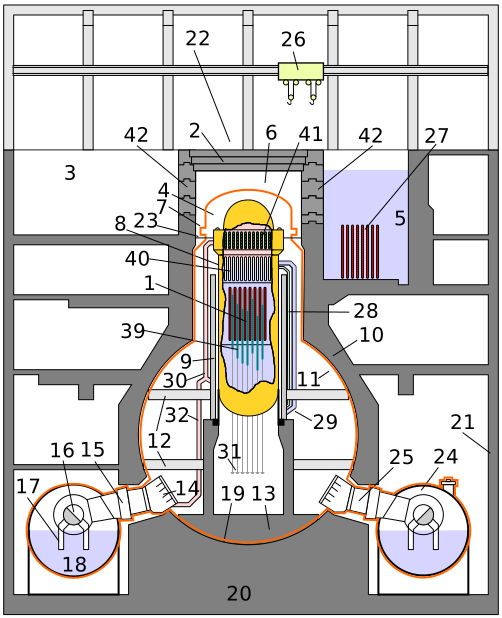
My reading of Matsumoto is that they suspect at least breech of yellow thingie caused in one way or another by fuel melting and falling to the bottom of the yellow thingie. Of note is that NHK (Japanese public broadcast) seems to make the exact same interpretation, since they write that TEPCO suspects that the “meltdown” created “a hole or holes” at the bottom of the pressure vessel.
Well nothing stopped Matsumoto from saying they suspected the hydrogen blast, but he specifically said they suspect damage from fuel.
About the temperature readings: Maybe I’m mis-remembering here, but were not temperature readings offline for one or two weeks in the wake of the tsunami? Take note of the fact that Matsumoto suspects this (possible) criticality took place pretty much directly after the tsunami disaster.
I’m not saying it’s in any way impossible - in fact it sounds like a perfectly plausible scenario. But it’s 100% inconsistent with what Matsumoto said himself.
He specifically said they suspect falling (molten) fuel damaged the bottom of the pressure vessel. NHK is reporting exactly the same - i.e. meltdown / molten fuel causing a hole or holes in the bottom of the pressure vessel. I’m not saying your scenario isn’t what happened, but it’s not what’s coming out of TEPCO at the moment…
Why does that make all the difference to you? Because it sounds more benign?
Note that with no additional information it is not obviously preferable to have critical, molten fuel escaping by melting through a pipe, over having it melt through the vessels bottom proper.
The end result is still molten fuel escaping the pressure vessel.
I would like to point out that at Chernobyl the core liquified and did burn through the bottom of the reactor room, into lower levels. It still did not escape the plant. Here is a picture. It was apparently pretty viscous stuff. Here is another picture of Chernobyl “lava” or “corium”. It’s not the universal solvent, and it doesn’t destroy everything it touches. You sure as heck wouldn’t want to stand near it, but it’s not going anywhere in the foreseeable future.


Even if the reactor containment vessel has been breached, which is serious, there is every reason to believe the fuel remains in the building and hasn’t “eaten” down into the earth. It would make for a messier clean up, and potentially more hazard for workers at the plant, but it’s not some evil monster that will sneak out in the middle of the night to consume Tokyo or anything.
[QUOTE=SherwoodAnderson]
Why does that make all the difference to you? Because it sounds more benign?
[/QUOTE]
Because it actually makes some sense and sounds more plausible. And it IS more benign. A leaking pipe is more benign than a hole in the bottom of the containment vessel with radioactive material eating it’s way through…right?
Again, there is no indication that there is ‘molten fuel escaping’ whether through a melting pipe or any other way. That’s YOUR assertion, and it has no factual basis. What we KNOW is that contaminated WATER is leaking out.
Do you have anything even remotely resembling facts to back this statement up? I’ve seen zero indication that molten fuel is escaping the pressure vessel. Just your unsubstantiated assertion that it’s so.
-XT
There’s no-one running around screaming that the world is about to end. Note, that I am not a nuclear power opponent - neither before, nor after Fukushima.
But I think the reporting suggests (reading in between the lines) that TEPCO suspects a meltdown and leak, and the extent of the breech or where the fuel is now is undetermined by TEPCO - otherwise they’d let us know. I expect us to hear more about this from TEPCO in the weeks to come.
Well, let no one say you’re not consistent in your levels of factual content.
They’ve been thinking “meltdown” since they detected radioactive iodine around the plant, and that was shortly after the tsunami.
Right now they’re ascertaining the extent of the damage. Is anyone really surprised at what they’ve found?
The article mentions that they are pumping “190 tons” of water a day for coolant. Now, unless I’m missing something obvious, doesn’t that mean that 190 tons of water a day are being replaced because it has more or less gone missing?
Which means its going where, exactly?
This highlights the difference between Japanese passivity and American free-market know how! If Haliburton were in charge, they would capture that water! And bottle it!
There are Americans who spend five dollars every day for energy drinks, dissolve a couple of No-Doz in each bottle, squirt some artificial vitamin C, red dye #3, yellow dye #6, and there you have it! Fuku, the energy drink that shows the world you aren’t one of those silly radiation hysterics! Fuku, for that healthy glow of radiant energy!
Electrolytes? Fuggin’ forget electrolytes!
But seriously, folks, where is all that water going? 190 tons, 380,000 pounds of water, that’s what…more than 600 gallons! No, wait…
Possibly. Or rather, I’ll grant you that assuming a whole lot of things that we in fact don’t know right now, fuel melting through a pipe is probably more benign than a full breach of the bottom where all the fuel escaped.
This is the relevant part of gonzomax link:
“A leaking pipe” is probably not the best way to describe the situation. Once again it is reported that the problem is molten fuel that has created a breach of the pressure vessel that allowed water to escape. If the water escaped, it stands to reason that fuel likely escaped through that same hole.
I’ll still grant you that the hole being in the piping rather than only in the strict bottom of the vessel may indicate a smaller problem or leakage than had that been the case. But in fact TEPCO hasn’t shared anything of their thoughts of how much or little fuel may have escaped, which indicates that they don’t know yet.
Yes it is my inference as I wrote in post #17. It is based on the factual observation - reported many times by now - that cooling water has leaked through holes which were created by molten fuel. It is absolutely reasonable to assume that if fissile material burns through a solid body (such as a pressure vessel bottom or pipes leading into a pressure vessel) so that a hole is created in that body, then the (liquid) fuel can escape through said hole.
See above.
Here’s an experiment for you: Take some aluminum and heat it until it melts, then try to burn a hole in a cooking pan of your choice with the liquid aluminum but dont let any aluminum escape the pan..
Maybe not. But as noted in #24 “meltdown” is a term that is poorly defined that may mean anything from scenarios that can be quite benign: (a) Three Mile Island, through (d) Chernobyl. I think it is noteable that there seems to be strong likelyhood of (c).
But we don’t know exactly how severe right now, and neither does TEPCO imho.
But any engineer should be able to imagine a situation where you’ve pumped many tons of water into a containment with critical fissile fuel, and you find out that molten fuel has caused leak, and that many tons of water escaped through those - that you are worried.
Here’s another link from NHK which goes directly to elucidators question about the missing water. TEPCO are looking for it.
Hey, all we have to do is ask the Congress to pass a law making it illegal for a tsunami to follow any earthquake. We will all then be as safe as Americans protected by the thought of waterboarding dark skinned men.
[QUOTE=SherwoodAnderson]
Possibly. Or rather, I’ll grant you that assuming a whole lot of things that we in fact don’t know right now, fuel melting through a pipe is probably more benign than a full breach of the bottom where all the fuel escaped.
[/QUOTE]
Since there is no evidence that the molten fuel rods have escaped the plant either through pipes, through the floor or via magic pony, there is, well, no evidence. When there is evidence then feel free to post it. Until then it’s pure speculation any way you look at it.
Again…what we KNOW is that contaminated water is leaking. That’s about it.
And once again, that’s YOUR assumption based on a few sentences in a news report that might or might actually mean anything. I’ve yet to see any actual evidence, however. Your cite in post 17, while possibly interesting, does not constitute evidence.
A lot of things COULD happen or be happening. That doesn’t mean that they ARE happening, however. It’s not absolutely reasonable for you to assume that fissile material is leaking through a pipe or out a hole burned in the bottom of the containment vessel or the pressure vessel, since you have zero special knowledge (as you admitted) about the workings of nuclear reactors in general or this case specifically. So, your assertions boil down to a few lines in a news report that haven’t been confirmed, afaik, by any credible sources indicating that a hole was burned through by the meltdown, or that any radioactive material from the core is escaping. Again, for the 2nd or 3rd time, what we KNOW is that contaminated water is leaking out…which is a good indication that there is a hole or breach somewhere. If you want to make THAT assumption I’m all for it…feel free. Anything else, based on the evidence so far cited, is pure speculation based on minimal evidence.
It’s really simple…we have but to wait for more actual evidence. If there IS a burn through that’s causing radioactive material to escape the plant, we’ll find out about it in more than one or two vague news reports, because it will be huge news. As opposed to what’s been presented so far, which is pretty much old news that anyone following the story knew last week…and the week before that…and the week before that. In March they thought there might have been a meltdown, and they have known that there were leaks for at least 3 weeks now, if not longer.
What is your thought experiment supposed to prove, exactly? Here’s a thought experiment for you…wait for additional information to come out, and THEN, if it really does show that radioactive materials are escaping the plant, feel free to post it. It will be big news.
Now, having thought about that, do you see what would happen?
-XT
I didn’t say there was proof / an observation of fuel outside the pressure vessel - since that hasn’t been reported. Accordingly I didn’t ask you to agree that anything was proven, only to consider if something was plausible, likely or unlikely.
If you generally don’t like considering scenarios where there’s only circumstancial and inconclusive evidence, fine. You seem to be arguing here that a proposition can only either be proven, disproven, or else “pure” speculation - which seems to be a somewhat limiting way of looking at the world.
I also think it would be useful for us to make a distinction between fuel escaping the pressure vessel and escaping “the plant”. Those are obviously not the same thing, even if the former is a necessary precondition for the latter.
That fuel has created holes through which water is escaping from the pressure vessel is reported as either the assessment by TEPCO (Reuters) or simply reported without attribution (NHK and ENS). NHK and Matsumoto talks about holes in the vessel and ENS about holes in piping.
The rest is absolutely speculation, but calling it “pure” speculation or “assuming” seems a bit much. It is reported that there is a way out of the pressure vessel caused by molten fuel and that increases the likelyhood that fuel escaped, from what it would have been otherwise - agreed?
But “likely” was maybe going to far. I think it’s warranted going only by the information in the NHK piece (molten fuel caused a hole or many holes in the bottom of the pressure vessel). But on second thought maybe you’re right about being the implications of the ENS piece. E.g., Maybe fuel burned through piping inside the pressure vessel on it’s way to the bottom.
As I pointed out: the only special knowledge I need, to know that a liquid metal is likely to escape through a hole it melts in the bottom of the metal container it resides in, is a basic knowledge of gravity. Do you think the pressure vessel is made from some magical super alloy where the laws of physics stop working?
But that’s assuming of course that the fuel did burn through the bottom of the vessel, and as you pointed out, ENS is not reporting that, but fuel burning through pipes. And considering it again, those pipes could very well be inside the vessel, but exiting through the side of the vessel, where water could escape if the space is flooded but not necessarily the molten core.
So “likely” was not warranted, based on the ENS piece.
Only having the information in the NHK piece, or considering the possibility that NHK is right and ENS is wrong i’d still say it’s warranted. But the reporting is obviously contradictory at this point, so I’ll walk it back.
Hold on here, there are credible news sources saying that TEPCO suspects a hole was burned through the bottom of the vessel (NHK, in other words Japans PBS). That source is actually much more “credible” imho than “Environmental News Service” who I know nothing about, and judging from the website layout probably has fewer and lesser well payed journalists than NHK (who have very posh and expensive office space in Shibyua if I recall correctly).
There are indeed no sources reporting fuel escaping, but that was never claimed, so it is of no relevance to us.
Whether it’s worthwhile to speculate on developing news events with limited or contradictory information when one could wait a few weeks for confirmation, well everyone has to decide for themselves.
Yeah that, and that TEPCOs assessment (their rather more acceptable speculation then, them being professionals) is that there is indeed a hole or breach and that it was caused by molten fuel.
After that, it’s pure simpleton (moi) speculation about the implications if the fuel melting a hole in the bottom of the vessel on the one hand, or in a pipe inside the vessel on the other hand - since NHK, Reuters and ENS don’t agree on that crucial detail.
Yes - once again - if we want to know we have to wait for conclusive evidence. In case you hadn’t noticed you’re flogging a dead horse here. I’m pretty sure I never implied that we could prove anything in this manner. You pretending the otherwise is really you knocking down the same strawman over and over. It’s slightly annoying by this point.
What one can do though is look at what is being reported at the moment and assuming that, make some informed speculation about the implications, until further information is available.
I’m sure you do that at times with subjects outside the area of nuclear safety? Or maybe not…
That the liquid aluminum would end up on your floor or your foot or something - in analogy to liquid fissile fuel melting through the bottom of a nuclear reactor pressure vessel and ending up in a dry well or something.
An update from the english language version of the Asahi Shimbun japanese daily.
[QUOTE=Asahi Shimbun]
Accurate data shattered the overly optimistic assessment of Tokyo Electric Power Co. concerning the crippled Fukushima No. 1 nuclear power plant and raised doubts about the company’s game plan for ending the crisis.
[…]
TEPCO officials admitted on May 12 that a “meltdown” had occurred in the No. 1 reactor. Fuel rods had melted, and the molten fuel accumulated and caused small cracks at the bottom of the reactor pressure container, they said.
[…]
From immediately after the quake, the measurements from the water gauge at the No. 1 reactor showed very little change, casting doubt on the reliability of the instruments.
After workers entered the No. 1 reactor building and adjusted the water gauge, the data obtained showed water levels so low that the gauge was unable to measure it.
[…]
TEPCO’s latest measurements found the temperature of the pressure container was about 100 degrees. If the fuel rods had been exposed because of the low water level, the temperature should have been much higher. The only explanation is that the fuel rods melted, accumulated at the bottom of the pressure container and the melted fuel was cooled by the small volume of water at the bottom.
[…]
TEPCO officials have also not denied the possibility that melted fuel has leaked out of the pressure container. That would mean the volume of contaminated water will likely increase, making work in the reactor buildings much more difficult.
[/QUOTE]
Here again there’s talk of breaches - or “cracks” - in the “bottom” of the pressure vessel, caused by molten fuel accumulating there. Environmental News Service are the only ones at this point talking specifically about damage to “pipes” rather than to the pressure vessel in general.
In my view, it’s also quite clear that the nature of the damage is only inferred by TEPCO at this point; that they don’t really know the full extent. I’m basing that belief on these reported facts:
-
ENS reports that the basement area of the reactor is not accessible to TEPCO at the moment. TEPCO suspects missing water has accumulated there, but they don’t know because they have no visuals because of the high levels of radiation making the area hard to access.
-
The scenario with fuel having melted and accumulated at the bottom of the vessel is reported (Asahi) as being infered by TEPCO from the water level and temperature level readings. That indicates to me that they do not have visuals inside the pressure vessel either.
My inferrence: they don’t know what the vessel looks like on the inside, only that water seems to be escaping it; they don’t know what the vessel looks like from underneath, but suspect the leaked water has accumulated there. Hence, IMHO, they likely don’t know whether there are “cracks” or “holes” or “damaged pipes”; it’s an educated guess based on the rate of water leakage and other secondary readings.
The Asahi piece also reports that TEPCO aren’t denying the possibility of fuel having escaped, which to me indicates that they don’t know but find it plausible that it could have.