I doubt it. Her description of Johnston’s defending the railroad obviously interested me, though.
Johnston did about as much as one could expect against a superior foe headed by one of the more capable generals of the war.
In Grants autobiography he discusses the railroad problem. The South constantly tore up the rails as they ran. The North fixed them. Then the South started wrapping the rails around trees and bending them like pretzels, Grant decried how much more work it was to straighten them out. Then they started shipping rails along with the provisions.
His wikipedia article says Johnston was the President of a railroad company in Arkansas. The maps linked to above show virtually no railroads in Arkansas.
Strangely enough, Mitchell describes Union forces heating rails and wrapping them around trees. 
How did they bend the rails in 1864? Aren’t they pretty thick pieces of steel?
With enough time and men, it was possible to make a Sherman’s necktie: http://en.wikipedia.org/wiki/Sherman%27s_neckties
Here is a recreation:

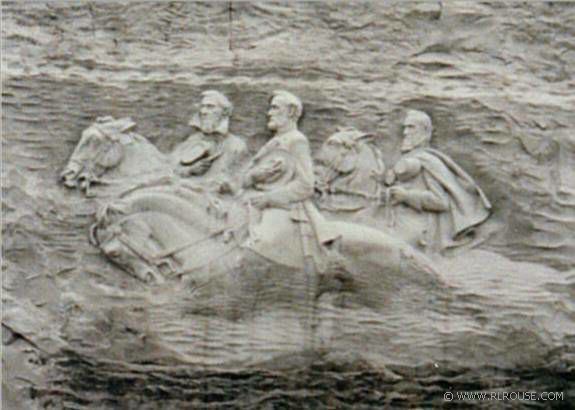
I’d rather it be him (or even N.B. Forrest, who disavowed his ties to the Klan) up there with Lee and Jackson on Stone Mountain than Jefferson Davis, but what are you going to do?
Statue in Kentucky of native sons Lincoln & Davis I’d love to caption that pedestal.

So steel can bend when superheated…interesting…

I was betting that someone was going to say that that was impossible.
But how many truthers from 9/11 1864 are left? 
Seriously, it does seem pretty amazing that they lit the ties on fire and draped the rails over the fire in order to heat them up enough to bend them. I wouldn’t have thought that a railroad-tie fire would have been hot enough to get the steel heated enough to bend the rails.
Indeed. One wonders about the quality of 19th century steel.
What? It’s a classic sabotage trick. Very famously done by the french partisans during WWII.
Superheated? This is SIMPLY heated.
Not usually great, but quality has little to do with the point where it softens.
FTR: 9/11 truthers are full of shit.
Gone With the Wind spends only a few pages on one isolated part of Southern culture before the Civil War: plantation life. Most of the book’s 1300 plus pages are set during the War and Reconstruction.
Margaret Mitchell would have been aware that Chattanooga was not in the Deep South nor was Atlanta. Deep South is the Southern most regions of the Southern coastal states. Think “live oaks” and Spanish moss.
You can argue that Chattanooga was the gateway to Atlanta which was the gateway to Savannah which is Deep South. But then, something else was the gateway to Chattanooga. You know?
I’ve mentioned before that Civil War history is all around me. I pass the intersection of Franklin Road and Battery Lane almost every day. I could walk there from here, but before I would reach it, there is now a bridge that crosses the interstate and a sign for those moving on to Alabama.
I really wish it weren’t everywhere around me all the time.
Johnston was absolutely no coward: he was probably wounded in the field more times than any other general. He was definitely cautious, perhaps overly so, but I think this came much from his realization that he could not count on reenforcements and thus simply couldn’t take the same risks as Sherman and Grant. The Union had a near inexhaustible supply of men and this was an advantage Grant and Sherman seized on right away- the Union had something like 50,000 casualties the first month Grant took control and Sherman was Grant’s acolyte- but the rebels at Atlanta were doing great to replace 1 for every 2 casualties.
Johnston had also been wounded several times by Atlanta, pretty seriously a couple of times, which may have taken some fight out of him. Like (his classmate) Lee he was a strong believer in spending a long time preparing fortifications and trenchworks and outlasting the enemy, while Davis wanted a “go get 'em” general which he wasn’t.
I also blame the demoralization of the army after Chattanooga for Johnston’s lack of success. After years of Bragg and a particularly cold winter the army just wasn’t in best shape. (One of the first things Johnston did was have several cavalry horses shot and butchered because they were not just unfit for service but in misery and hopeless and the men needed the meat; it endeared him to them somewhat.)
Johnston also knew he wasn’t a Robert E. Lee; he said something to the effect of the bullet that wounded him which led to Lee taking over was (his words) “the most propitious” of the war. (Personally I’d say the most propitious missile of the war in terms of helping the Confederacy was the one that took out Leonidas Polk at Kennesaw, but it came too late to be of real help; his arrest was the one thing Bragg did right after Chickamauga.)