So which is it, folks?
In armour and firepower, French tanks were generally not inferior to their German counterparts. In one incident, a single Char B1 “Eure” was able to destroy thirteen German tanks within a few minutes in Stonne on 16 May 1940, all of them Panzer III and Panzer IV tanks. The 37mm and 20mm guns the Germans used were ineffective at penetrating the thick armour of the B1, which was able to return safely despite being hit a large number of times.[2] Even German General Rommel was surprised at how the French tanks withstood the German tank shells and had to resort to using the German 88 artillery as antitank guns against the French tanks to knock them out. Setbacks the French military suffered were more related to strategy, tactics and organisation than technology and design.
Both, actually. French tanks were designed for a slow-moving, defensive role. When hit by a fast-moving enemy, they were over-matched. More a failure of command rather than a failure of materiel.
Germany lost almost all its armaments - tanks, planes, artillery - after Versailles. This meant that when re-arming, they did not have to worry about how to integrate new technology with the old. They could just go all out with the newer technology. The victorious allies from 1918 had to keep parts, supplies, tactics, training, manufacturing etc all in concert with keeping the old armaments relevant.
It also provided a different mindset. While the Allies were thinking - ‘We won WW1 - now how can we use these new tanks etc to win like we won last time’. (Maginot line being the classic example).
The Germans thought - ‘We lost WW1. How can we use these new tanks etc to reverse that - ie - can we fight in a new way?’.
In hindsight though, one problem with big military buildups in the 1930s is that tank and aircraft technology advanced so rapidly during WW2 that what was perfectly serviceable in 1939 was hopelessly obsolete by 1945. This led both Germany and Japan to overestimate their strength relative to their opponents. Both relied on building up a big reserve of war machinery that was expected to carry them through a coming war, when in fact victory went to the countries that could develop and build new designs during the war itself.
French tanks were better than German tanks in terms of armor and firepower, but the french tank doctrine was much worse. French plans had tanks being used in a prearranged manner set by the generals. German plans were for the tanks to be used dynamically to exploit breakthroughs and respond to a changing battlefields. 80% of french tanks did not have a radio so there was no way to quickly get them all coordinated, German tanks all had radios so they could change battle plans on a moment’s notice.
French tank doctrine was particularly bad, even by the standards of the day. French doctrine dispersed the tanks within infantry units to act in a supporting role, while the Germans, and to a somewhat lesser extent, the US, British and Russians concentrated their tanks and mobile units in mobile, tank-heavy formations that were able to engage in blitzkrieg and maneuver warfare.
So even though the French had better tanks and more of them, they were basically distributed evenly through the army, and were unable to engage in the sort of maneuver warfare that countering blitzkrieg would have taken.
As to why the British and French didn’t build up earlier; I’m not sure, but I suspect they were both hampered financially and by a desire to find a diplomatic solution. Munich 1938 was a good example of the lengths they were willing to go to to avoid war.
The US actually started building up before Pearl Harbor- between 1940 and 1941, the US military almost quintupled in size, then double again by 1942, and doubled again by 1943, and while it increased through the end of the war, it never doubled again after 1943.
Regardless of “who had the better tanks”, it doesn’t mean that much when one side (the French) switches from a gung-ho offensive spirit in WWI to a hunker-down-behind-the-Maginot-line defensive philosophy.
As far as why other countries didn’t take the German military build-up seriously, some people took it too seriously. For example you had Lindbergh (who traveled to Germany to be “briefed” on the German air force and shared his findings with U.S. analysts) fooled into thinking that the Germans already had a massive advantage in air power so accomodation was the best policy (which also fit in with his underlying sympathies with Reich aims). There was also overconfidence. The British didn’t fear U-boat warfare because they not only had convoys, but ASDIC (sonar) which supposedly would detect subs before they could do damage. They overlooked the possibility that night surface attacks could render ASDIC useless and be lethal.
Overwhelmingly though the West was exhausted by arms spending through WWI, the need to fix damage caused by that war and the subsequent Depression. Contrast their fatigue and division with the enthusiasm of the Nazis, who had the will (perverted as it was) to construct a strong military.
France had the best tanks in the world to fight WWI. Germany had the best tanks in the world to fight WWII.
Didn’t know that, thanks. If your tactical victory turns into a big enough operational victory which turns into a strategic victory, you can end up not just rushing the opponent’s base but nicking his stuff too which you can then reuse.
Wouldn’t that have been sufficient for most cases? If you’re going up against infantry and casemates, the opportunity cost of upgunning your tanks might not be worth it if it means you’ll have fewer tanks. I’m really not sure how that trade-off worked out in practice though. It’s the opposite of the WunderWaffen design philosophy.
I get the impression that, at least at first, tanks weren’t supposed to spend much time fighting each other. It would have been a lot like cavalry fights in the past: Lots of clanging noises but few casualties.
It sounds like they were relying on PaKs to take out armor which would be the equivalent of pike infantry.
Maybe someone more knowledgeable can enlighten me, but from my reading over the years:
-Germany was disarmed by the Versailles treaty. So when Hitler came along, he was starting from a pretty low point -whereas the other countries had existing armies and weapons, so no incentive to begin a sudden giant push. Hitler could, for example, start building the more modern fighter plans that he thought he needed, and aircraft tech was increasing at a rapid pace back then.
-France did spend a fortune (AFAIK) on the Maginot line, so yes they were getting ready just in case. However, they couldn’t build it on the Belgian border with Germany, and apparently they felt that reinforcing the border against Belgium would be a double insult - we don’t trust Germany, we don’t trust Belgium to hold out, and also we are leaving Belgium to its sad fate in the next war. So, Maginot was a dud.
The initial push by Germany was to reunite its many disparate pieces of ethnic germinacity (?) . They annexed German-speaking Austria. Sudetenland was taken from pre-WWI Germany and given to the Czechs despite Germanic inhabitants. the next noise about Poland was due to chunks of Poland being former chunks of Germany. France was well aware that in that category also were Alsace and Lorraine. At first, everyone took Germany’s expansion for Hitler’s “reunite the vaderland” push. Hence the willingness to give him Sudetenland and it’s Germanic inhabitants if that would shut him up - except he then took the whole of Czechoslovakia which was not part of the deal. Hence the Allied determination not to give in on Poland - Give Germany back Danzig and the corridor, and the greedy bugger would probably take a lot more of Poland… then he’d want Alsace. Which he did, turns out the easy way to do that and eliminate the threat that France would want it back - take out France.
Others have discussed his economic tricks.
The point Keynes made, back then, was that governments could spend during bad times to revive the economy, and do the payback in the good times. Politicians ever since have taken to heart only the first lesson.
More info towards the OP: Germany was very sneaky in rebuilding it’s military between the wars. For example, the Versailles treaty forbid Germany from developing new machine guns. However, a Swiss company called Solothurn, which was majority owned by the Germany firm Rheinmetall, which was majority owned by the German government, was free to develop the MG 15 and MG 17. The Versailles treaty kept Germany from having a general staff so they renamed it the “Troop Office”. There were all sorts of shenanigans with German “contractors” and “observers” involved in the Soviet Union’s tank development and importing Soviet “tractors”.
This is not quite correct. North-western France is home to most of that country’s industry and the Maginot Line was built to protect *that *from a German advance. France’s plan for the next war with Germany was to fight a long, grinding, defensive struggle on Belgian soil. Again, see The Chieftain’s video on “Development of French Armored Doctrine”.
The ‘Spirit of Locarno’ was one of the great shibboleths of the era - a feeling that Germany did not want war, and would abide by its word pledged in international treaties.
Very interesting information.
I did poke around online and found this post on another message board about the numbers of tanks used in the invasion of France. They are broken down by the German divisions.
Pz I 554
Pz II 920
Pz III 349
Pz IV 280
Pz 35 118
Pz 38 207
Pz Bef 154
Sum 2582
According to these numbers, there were more Pz III (349) than combined Pz 35 and Pz 38 (325). The Pz Bef were the command tanks, and I believe many of them were the Pz III, so that would have increased that total. Although the Pz 35 and 38 didn’t outnumber the Pz III, they certainly were a valuable contribution to German armor.
For those having trouble picturing this in action, the French tanks were (intentionally) spread out along the front line with the intention of “stiffening” the infantry’s ability to resist. Thus only a few tanks were in any one area, spread along a long line. French doctrine emphasized maintaining a continuous line of defense, and the idea was that no matter where the Germans attacked, there would be some French tanks to help the French infantry.
The problem was that German doctrine (at least partly cribbed from British theorists before the war) massed all the tanks together and struck at a single point in the line (schwerpunkt, meaning roughly focus point in German). This had the dual effect of ensuring that at the schwerpunkt, German tanks would massively outnumber the few French tanks in that locality – and also that all the other French tanks were essentially useless, being nowhere near the actual fighting.
It seems dumb in hindsight (and to some degree it was), but the previous war had been won by a continuous unbroken line of entrenchments, and it’s always hard to envision the future.
Two points:
-
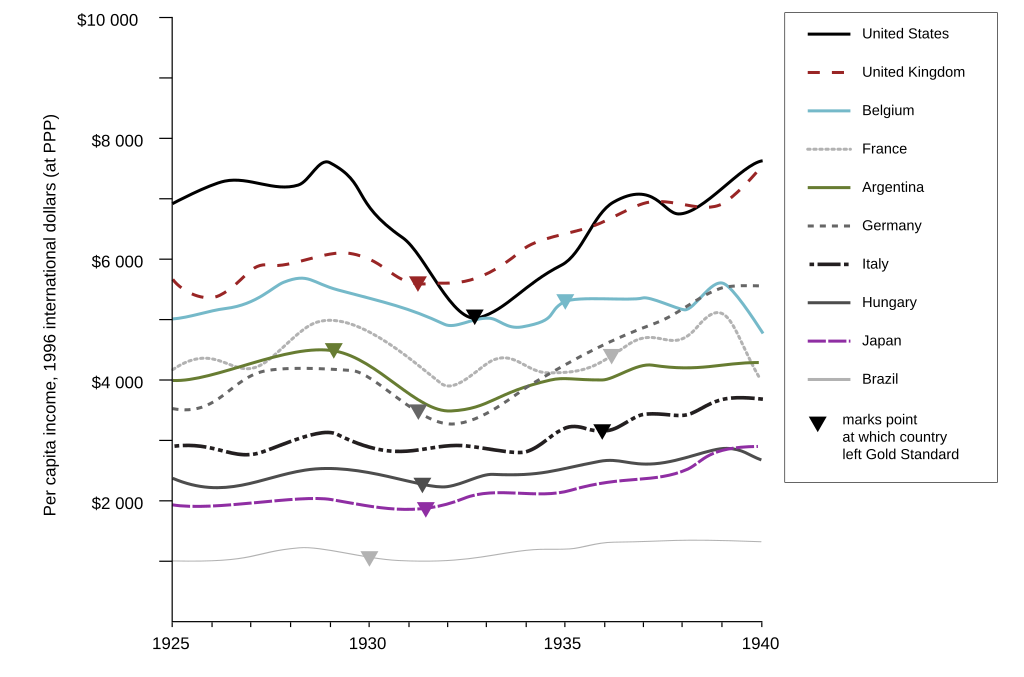
The Great Depression was significantly deeper in the US than Europe. It wasn’t as much of a reason for government austerity, or expansionary fiscal policy. Although as that juxtaposition suggests, it’s not clear whether a deep depression at that time would cause a country to cut back military spending or increase it as a stimulus.
https://upload.wikimedia.org/wikipedia/commons/thumb/b/b5/Graph_charting_income_per_capita_throughout_the_Great_Depression.svg/1024px-Graph_charting_income_per_capita_throughout_the_Great_Depression.svg.png -
The bigger point discussed above using the example of tanks and armor doctrine is that the Germans proved generally superior to their opponents in land/air forces for a given combat power on paper. So, despite a theoretical deficit in economic warmaking potential v combined Britain, France and lesser neutrals (Benelux, Scandinavia) they didn’t need materially superior forces to quickly and completely defeat the neutrals and France, plus what Britain could/would bring to bear in France in 1940, though failed to defeat Britain outright. This reliance on superior military efficiency ran out of room in the USSR with a still only partially war-mobilized German economy, then went down the drain completely once Germany lined up a list of opponents of overwhelmingly superior industrial war making potential including the US. Also, German opponents eventually closed at least part of the gap in land warfare effectiveness per unit of combat power, and at least in the West Allied fighter units were eventually better than German.
Also, the French army was hamstrung by France’s conscription law - it had conscripts in service for only a short time, very limited time for reservists to train, and didn’t leave enough men in service to maintain institutional knowledge. Without major changes to conscription, recruiting, and retention practices, the Army simply couldn’t maintain the level of training needed to engage in maneuver warfare, and without hindsight they didn’t expect static warfare to be as much of a disadvantage, and for the war to finish quickly enough that they would not have time to remain on the defensive while improving the training levels of the army.
That’s interesting.
Does this mean that Hitler’s invasion of the USSR might have succeeded if the German economy had been revved up sufficiently by the spring 1941 (or whenever they might finally have invaded)? By having sufficient production to be able to keep shipping tanks, artillery, and everything east no matter how many troops the Soviets were willing to sacrifice?
But it was only after the invasion that Germany would change to a total war footing. Could that have even been done before attacking the Soviets? Even in Nazi Germany would the Volke have committed to a total war economy/effort without facing the existential threat of losing to the Bolsheviks (no matter how hard Hitler ordered them to work and sacrifice)? Would they even have had enough slave labour before invading USSR?
That really wasn’t the German approach. I’ll get to a couple quotes from Guderian’s Achtung Panzer but there’s some background that helps set it in context. Guderian’s involvement in mechanization/motorization started in 1922 with a variety of related assignments and personal involvement between then and publishing in 1937. The writing and publication was at the request of General der Panzertruppen Lutz, who also wrote the foreword. It wasn’t new thought so much as a book to argue against the institutional forces that disagreed or were trying to siphon off some of the limited industrial capacity to other projects than the new Panzer divisions. Some of those included the infantry wanting assault guns as supporting weapons and the old horse cavalry senior officers supporting the light divisions. What Guderian laid out in 1937 was more an internal argument than innovation. The establishment of the first three panzer divisions in 1935 under Lutz proceeded under the notions that Guderian put on paper in 1937. Achtung Panzer was a collected argument against diverting from that plan and focus. It wasn’t new ideas…at least inside Germany. They were pretty radical when compared to the doctrines most of Germany’s opponents had crafted up to that point
So some quotes I pulled out:
Those driving the creation of the Panzertruppen embraced tank versus tank combat. It was, in their minds, necessary for victory. It was a revolutionary idea at the time. While it wasn’t only Germans to advocate for the idea. Not all German military minds agreed. Still it was the Germans who most fully embraced it in the design of their force structure and doctrine in preparation for WWII.
Nice cite. T(h)anks. ; ) It’s been something I looked at before and there’s seems to be a number of varying estimates…so I didn’t even look when I was postingfor totals. One nice part of the cite was the breakdown by each of the 10 panzer divisions. It answered a different question. I’d looked briefly when I was writing the post you referenced because I very vaguely remembered three or so tank divisions being supplied with Czechoslovakian tanks. It’s three by your cite. I’m not entirely senile yet or brain damaged from all the blows to the head inside a turret.
There’s an interesting other break down available because of that divisional breakdown that I remembered frustrating me before. Army Group B was the effort through Belgium. It was largely a shaping effort to divert some of the best French and British forces to flex north to oppose them. Army Group A was the main effort and had the other seven panzer divisions to effect the breakthrough. Army Group B’s panzer divisions were the 4th, 5th, and 9th. (German order of battle for the Battle of France) Those were all Pz III formations ignoring the tanks that were ineffective for tank vs tank combat - 133 Pz III in total. Subtracting Pz III totals, the main effort of the German attack had 216 Pz III and all 325 of the Czechoslokian built tanks. Germany built about 40% of the anti-tank capable tanks for the force that conducted the breakthrough and exploited to shatter the French defense.
That might be the number I was remembering. Tanks for the shaping effort were important too so thanks for digging further.
Here is an 11-minute lecture on the Wehrmacht build-up from 1933 to 1939. Same guy with a much longer treatment on what the Versailles Treaty limitations on Germany were, and how they were snuck around. This one as graphics.
From the comments on the blog I cited:
It’s an interesting article, and well worth reading.
The author goes on the place the blame squarely on bad generals.
This echoes everything I’ve heard.