That is reasonable, if we assume that the starkiller beam travels faster than c. If a beam (or anything else) travels at superluminal speeds, it is almost inevitable that the beam will also travel backwards in time, at least in some frames of reference. Neither Star Wars nor Star Trek takes much account of this effect, even though Star Trek does include quite extensive time travel.
Thanks for all these great examples. I’m taking notes.
I don’t think that it stated that the Reaver ship was on a reciprocal course. It may have been going the same direction as Serenity but slightly slower.
Also, the setting for Firefly is a single star system, with a very large number of inhabited planets and moons (the system was originally chosen for colonization partly for that reason, and terraforming further increased the numbers). So any two worlds they visit could, in the absence of more information than the show usually gave, be nearly arbitrarily close together.
Yes, if your spaceship flew through our asteroid belt, you might see one or two as points of light. Maybe there is more “dust” there, perhaps. But you will not have to dodge asteroids- at least not more than once. Space is BIG.
I am not sure, I think the “Kirk” marooned on Delta Vega (they used that name several times for widely different planets), was after Vulcan going blooie, and that Delta Vega was in the Vulcan system.
But that film was so horrible, i am only working from a Wikipedia article, etc.
Another Twilight Zone episode, “On Thursday We Leave For Home”, a human colony was stuck on a planet in another solar system - two billion miles from Earth. “Third From The Sun” has a few people leave a planet on the brink of nuclear war (spoiler alert) and head for earth - 11 million miles away.
“Abbott & Costello Meet Frankenstein” has Lon Chaney Jr. turning into the Wolfman at least four nights in a row, due to the full moon appearing four nights in a row.
You can also see Dracula in a dresser mirror. He’s quite handsome. As he’s tearing out a woman’s throat.
A scene in “Interview With The Vampire” features vampires being exposed to the sun while at the bottom of a deep well. However, the sun does not rise high enough over Paris to shine directly overhead.
Yeah, even speeding up interstellar travel to 18th century sailing times is apparently too slow; it’s got to be airliner type speed or people don’t get it.
I would say the idea that an asteroid belt means some densely packed crazy kinetic maze of tumbling rocks and boulders that require split-second heroic piloting to navigate is a pretty glaring mistake (or deliberately overlooked).
In reality, most of the rocks in the asteroid belt can’t even be seen from each other. Even though in astronomical terms they’re very close, in spaceship terms they’re absurdly far apart.
Another is the way they just hand-wave orbital mechanics away in most sci-fi shows.
Well, the difference between the first night of a waning (or waxing) gibbous is hardly different than a full moon. ( I love that term “Waxing gibbous” sounds like some sort of bird or ape).
Reminds me of this scene in Nosferatu (1979), German version. Watch closely.
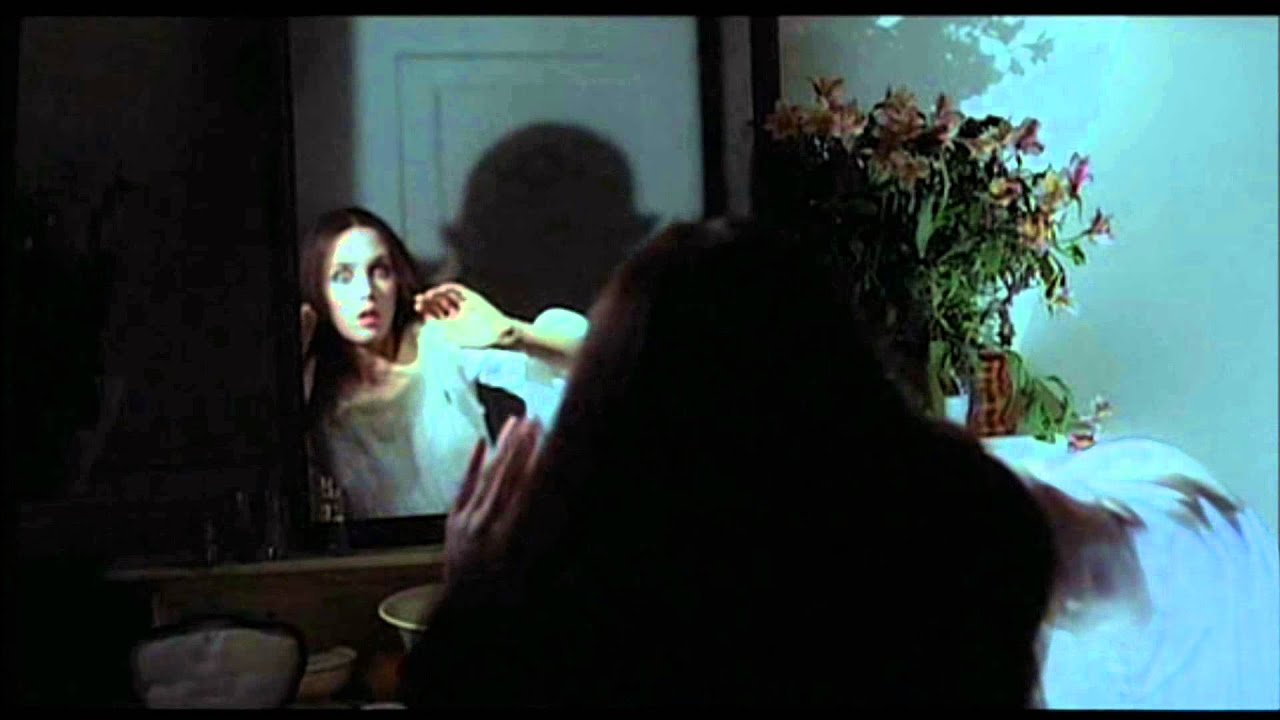
I don’t remember that. That’s really cool.
Wait a minute, I had to think a second: his shadow is casting a reflection in the mirror while he isn’t. I’ve never heard of that in any vampire lore; I love it!
A couple of Star Trek classics
In the second pilot, the Enterprise tries to fly through the energy barrier at the edge of the galaxy, but incurs a lot of damage. Also, in By Any Other Name, they successfully fly through the barrier. Apparently you cannot leave the galaxy without flying through this barrier, but it is a cloudy band only about the thickness of possibly a few billion miles at most, so if it did indeed exist, it would be all but child’s play to go around it (over or under). Of course, there is no such structure, the galaxy just gets sparser and sparser as you go outward.
There was an episode of Voyager in which the crew had the opportunity to witness a supernova. Then, about a minute later, the ship is hit by the shockwave. To begin with, the reasonable distance for watching a genuine supernova would probably be around the orbit of Neptune or so (stars that can go supernova tend to be really big), so the shockwave would be hours/days later, not seconds.
Beyond that, though, there really is no way for a shockwave to be felt in a ship at a reasonable distance, or even a bit closer. Space just does not propagate these kinds of effects. The worst impact from a nearby supernova would probably be the intense gamma ray burst, which any galaxy traveling ship would already have sufficient shielding to handle, and it would not cause any kind of shaking. And if you could see the supernova, it happened hours ago and the gamma ray burst would be synchronized with the view of the explosion.
Well, if you are gonna be pedantic, the worst impact would probably be the Neutrinos, which would kill everyone on the ship. Unless shields can stop Neutrinos, which would be quite a trick.
Not that Star Trek ever did, or intended to, have much to do with astronomy, but
It is a spherical halo of dark matter that makes up 95% of the Milky Way. How can you go around it?
I seem to remember that they occasionally had to worry about not flying too close to some things because of the radiation? Also, don’t forget that a Romulan nuke caused some casualties due to radiation.
Eh, not 30 AU out? If you were around Saturn, sure.
I’ve seen many scenes (although I can’t name a specific one offhand) that show an asteroid impact with the Earth. We see a shot that shows all or most of the Earth’s globe, and then an asteroid zooms in and crashes into the planet, crossing the planet’s diameter in a matter of a few seconds or less. Most asteroids would be traveling around 40,000 miles per hour when they impact the Earth, so would take more than 10 minutes to travel a distance equal to the Earth’s diameter. In a shot that includes a view of the whole planet, you would not even be able to see that the asteroid is moving.
IF I remember correctly, a full moon is twice as bright as it was the night before, and as it will be the night after. But I think if I were a werewolf I’d go ahead and let my hair down all three nights.
And if I’m not remembering correctly, I apologize while bowing, scraping, and backing away nervously.
Bowing and backing away are okay, but scraping can damage the carpet
In the Buffyverse it is canonical that werewolves become wolves on three consecutive nights centered on the full moon
What if the werewolf is on Mars?