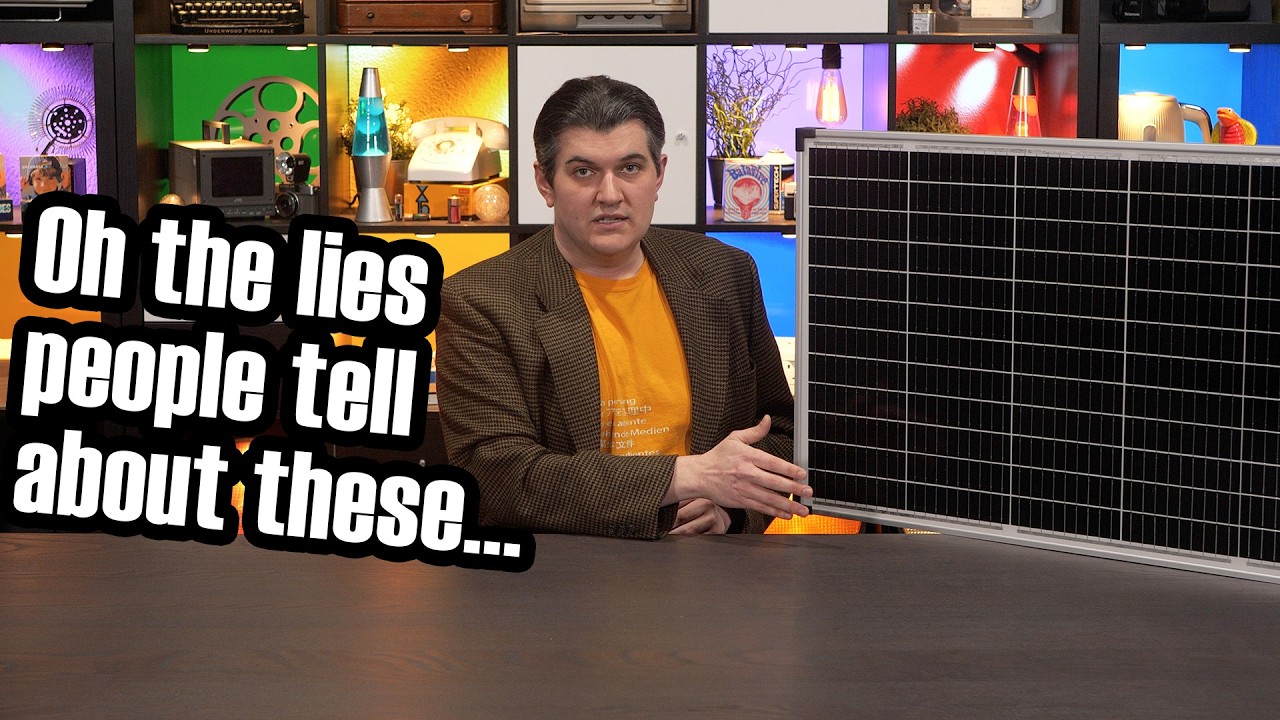
I have been a fan of YouTuber Alec at Technology Connections for quite some time now, and I expect more than a few of you have been, too. For those who don’t know him, he’s a 30-something who looks at aspects of technology he finds interesting, ranging from how pinball machines work to why heat pumps are the most efficient way to heat and cool our homes.
He has made 227 videos over the last ten years, and has more than three million subscribers.
He just posted a video about photovoltaic solar panels, pointing out that they are now the least expensive way to generate power. His main point is that the country and the world should be moving rapidly to an entirely solar- and wind-based energy system and addresses the mostly disingenuous arguments against that.
For instance, the claim that solar farms take up too much land. If all of the land currently required by law to be used to raise corn for ethanol to be added to gasoline was converted to solar farms, it would generate almost twice the electricity needed by the whole country! He makes very good points countering other common objections.
This is all covered in the first hour of the video. The last half hour contains a brilliant political rant that I posted about in P&E.
I was listening to a program on (American) public radio the other day that said that in Germany, solar panels are cheaper than wooden privacy fencing, so if you need to put up a fence, you might just use solar panels for it so it’s generating power while providing privacy.
I am one of Alec’s subscribers, and that video appeared in my YouTube feed recently. It’s just that it’s an hour and a half long, and I haven’t found the time to watch it yet. I do intend to watch it eventually, but I need to find a time when I have a large block of time free.
When I saw the video go up I was extremely worried. I just installed solar, and I was afraid that he was going to explain why that was a bad idea, and be right about it. Other than the capex, I can’t think of any negatives for solar, which is why I was concerned. What might I have missed when making the decision?
I wish I’d seen his video on heat pumps two years earlier…
Anyway, no worries, solar is about as close to the “free energy” dream as we’ll ever get.
What’s sad is that we were this close to seeing widespread EV + solar + storage adoption, maybe even with reshored battery production. Then overnight that dream died, and it’s back to fracking we go!
Oh well, at least China is still plowing ahead. The world moves on without us.
I don’t understand heat pumps. I hope you don’t mind if I ask this question.
I’m puzzled by this statement in the Wikipedia article on heat pumps:
In winter, a heat pump can move heat from the cool outdoors to warm a house; in summer, it may also be designed to move heat from the house to the warmer outdoors.
Not directly, not without adding extra energy from some other source. But even cold air has some heat, and so with the right setup, you can move some of that heat indoors, in addition to the energy you’re adding (which also ends up as heat). So you get more heat added to the inside than the energy that you’re spending. Possibly three times as much, or so, under good conditions.
That said, the benefit of a heat pump decreases when the temperature difference gets too great. When it’s really cold outside, you’d get nearly as much efficiency, and a lot more simplicity, from a pure resistive heater.
Both air conditioners and heat pumps “move heat” from one place to another. There are basically three different “pools” of heat:
How much heat is in Area A (say, inside your house)
How much heat is in Area B (say, outside your house)
How much heat a refrigerant can “hold” before it boils into a gas, under a certain pressure — this pressure is what gets manipulated by the system to move the heat around
Those refrigerants, like R-410A - Wikipedia and newer options, have a “normal” boiling point way below room temperature (far below freezing, actually, at -55°C).
So as long as an area is above -55°C, the refrigerant can still absorb some heat from it, especially once its pressure and boiling point are lowered through the use an expansion valve. This low-pressure mixture of liquid & gas is even colder than the ambient temperature. It flows through an evaporator coil, where it absorbs heat from its surroundings, turns completely into a gas, and moves to the other end of the system. At the other end, a compressor raises the pressure again, forcing the refrigerant to condense back into a liquid and releasing its latent heat.
An air conditioner does this in one direction, moving heat from inside your house to the outside. It can do this even if your house feels cold already, because even a cold-feeling house still has some heat — far above absolute zero, and also above the boiling point of the refrigerant.
A heat pump does the same thing in reverse, moving heat from outside to inside. Though it does take more work because typically the outside is far colder than what an air conditioner would cool the inside of your house to.
Like Chronos said:
It’s a bit worse than that, actually. On some older heat pumps (like older than 10 years old or so), their lowest operating temperature can be above freezing, like 35-40°F or thereabouts, which means when it cold enough, they stop working altogether and you’ll freeze without an additional source of heat. We had one like that at my old apartment and we had to leave the premises when it got that cold because we had no other heat source. Newer models are much better, thankfully, and can usually operate well below freezing, but not infinitely so — they still will not work in extremely cold conditions. Ice can build up on the evaporator coils, for example, and have to be heated in reverse to melt it to get the system working well again.
There are combo systems that can act as both air conditioner in the summer and heat pump the summer (reversing the flow of heat as necessary). And they will often also have a supplemental resistive heating unit inside to complement the heat pump part.
Generally heat pumps are more efficient (units of heat per dollar) in operation, but have a higher upfront cost (may take several years to pay back). For any given area, though, you’ll have to run it through a calculator of some sort to see what your likely savings would be.
I don’t know your specific conditions, but heat pumps can vary a lot from unit to unit. He may be right, or he may only have had experience with the worse, older units. If you’re considering a HVAC upgrade in the near future anyway, it may be worth a second opinion (maybe from a heat pump specialist dealer, if there are any in your area) and/or the use of an online calculator as a sanity check, e.g. https://heatpumpshooray.com/
You can also consider using a heat pump when it’s not too cold out, and switching to another heat source when it is extremely cold. It just depends on the specifics.
I am not an expert in this, but AFAIK that may be too cold. They apparently go down to -15F or so. -30F may be too cold.
If those two weeks were a freak occurrence and it’s normally warmer, it might still be worth considering. If -30 is normal there, it’s probably too cold.
shivers Why even live there at that point? You might as well step outside and cryogenically freeze yourself until they come up with something better..
Others have explained it, but the easiest example to experience is your freezer. It’s probably set at something close to 0F/-17C, and when it is running there is going to be hot air coming off the back of it. Some of that is waste heat produced by the compressor, but some of it also comes from the cold air inside the freezer.
Again, not an expert, but that seems like a temperature range where heat pumps may sometimes work, but not very efficiently. And you’ll definitely need supplemental heat for the days when they won’t work at all.
If I were in your shoes, I wouldn’t rush out to buy one. There are some climates where they are no-brainers and will pay themselves back quickly. In yours, it seems questionable whether it’ll ever be worth it.
I dunno your overall situation, but doing something like an energy audit (where an auditor comes to your home with a thermal camera, draft detectors, etc.) can help you see if there are any other opportunities for improving the thermal management in your house. Usually it’s more cost-effective to add insulation and prevent leaks (e.g. from windows and doors) than to keep adding heat, anyway.
That’s been my approach. It’s an old house. Replaced all the old wooden sash single panes / storm windows combos with modern double paned. Reduced drafts a lot.