Here's a Proposed Way Forward on USA Healthcare

It’s also because debt is really, really cheap. A lot of people say that they want government run like a business. But you take any business at all, and tell them that they can borrow money at a less than 1% interest rate, and they’re going to immediately borrow as much as they can, and then figure out what they can do with all that newfound cash, because pretty much everything you can possibly imagine spending that money on will give better than 1% annual returns.

Ironically, it’s usually the same people who say “run the government like a business” who also rail against deficit spending.

It goes beyond that. The profit motive is part of every atom of the system, from the company that produces the paper you sit on during an exam, to the distributor of the cotton swabs, the maker of the gel for your sonogram, the subcontractor for the labs, all the way up to the companies making all the high-tech equipment used in your MRI and robotic surgery. Everything in the system needs to make someone a profit.

It doesn’t though. Private for profit is just one way to operate. You can have private non-profits, or non-profit public sector services.

The US spends about 5.7 trillion a year on health care. I can’t find how much of that is net profits though. I’m seeing figures ranging from 200 billion up to 800 billion. But I have no idea how much of that 5.7 trillion goes to net profits, much of which likely ends up being spent as dividends and stock buybacks.

Also the profits aren’t evenly distributed. I think pharma and PCMs make up a big chunk of the profits.

According to this, shareholder payouts in the health care system made up 170 billion in 2020, so its probably closer to 200 billion now.

Fixing the US health care system to make it more affordable will involve an endless mix of things like

Eliminating the fee for service system
Streamlining administration
Reducing the profit margins
streamlining treatment protocols
Fewer scans and procedures that do not lead to better outcomes
Allowing public sector negotiations

etc, etc

Keep in mind that a non-profit organization can, and will, make a profit. It’s just that they do not distribute that profit to shareholders like a publicly-traded company, and must re-invest that profit into their own organization and spend it on their own expenses, which can take many forms. Just because they are labeled “non-profit” does not mean the profit motive is absent - they are businesses like any other and are not operating out of the goodness of their hearts.

Seize the means of production, you say?

Krugman doesn’t go into any details on the Public Option, and in fact says the details for it need to be worked out by people who are more healthcare experts than him. However, I know enough about his healthcare views to where there’s no doubt he’s thinking of something that is affordable, and would therefore need subsidies at some level. In order for there to be universal healthcare, more people need to be able to buy into a system with some financial help, which the Public Option would provide.

The thing is that giving people money to buy health insurance does nothing to lower costs - it essentially just provides a more steady stream of income to those providing goods and services, without having to change anything. The only entity that can put pressure on providers to lower costs is the government, thru long-term contracting and price controls, the same way Medicare works today (and that of other governments). Since the government pays for it, the government gets to say how much they are going to pay, unlike the system we have today where the government provides a subsidy, but the provider has no incentive to lower costs. Regulation and price control can help put downward pressure on costs, but some say it will risk innovation.

I think that’s why he talks about a Public Option. A Public Option would save money, because it would eliminate alot of unnecessary red-tape, and would be more administratively efficient. Our big Public programs - Medicare & Medicaid - provide coverage for much less than Private Insurance.

And although it wouldn’t immediately happen, over time, more and more people would pile into the Public Option, and the overall system would save money.

Agree. But if a new public option is offered, and it’s necessary up-front to provide subsidies so people can afford to get into the pool (the risk pool), it will be very difficult to remove said subsidies later. I agree the larger the risk pool, the less risk for each individual in it, and thus the less cost to be in the pool. I think it’s a small conundrum when/if this ever becomes reality - how do you start this off right, in a way that’s affordable for the payor (the government) without needing to give people money to get on-board? Unfortunately, it probably will involve slashing profits for the providers, which is why the public option has been strongly opposed by those actors since the ACA first proposed it (and, subsequently, was removed from it).

I would imagine you would get the same subsidies if you choose the public option that you would get if you chose a private plan.

The health care field is a poor fit for the capitalist model. In the model, a competitive free market finds the most efficient way to make money by getting something useful done.
If I get coverage through my employer, he has chosen the insurance company. As the end user, I do not have a real choice. There is no competition.

In a free market, the end user compares the cost to the benefit and decides whether it’s worth it. Since this is insurance, I’m not paying, the insurance company is. I only get to argue with people who benefit their employer by losing pieces of paper.

With medical care, efficiency is usually not a major concern. The times when it is are rather horrifying cases involving triage. If one doctor is faced with hundreds of injured people from a plane crash, he chooses the ones he has the best chance at saving.

Public option sounds like a good transition plan. If the government really is as bad as the republicans like to say, private insurance companies should have no trouble competing. If the market is as flawed as it appears, it would deserve to wither away.

Part of the issue is that one reason the public option plan is cheaper is because it has lower reimbursement rates. Private insurance may pay double what public plans like medicare or medicaid pay. And a lot of hospitals are barely breaking even as it is.

States that have created their own public option plan have had to increase reimbursement rates so providers would accept it. At least some of them, I dont know if any have kept their reimbursement rates closer to medicaid or medicare rates.

Yeah, the Public Option that I’m thinking of is Medicare. We can make Medicare available to anyone that wants it, with subsidies as needed for some. Doctors usually take Medicare, and it pays a good bit more than Medicaid. The medical system is familiar with it, and it doesn’t really vary state-to-state. I think if that was the type of Public Option that Krugman talks about, it would gradually push alot of private insurance out. Not all of it, but a good bit. And it would constrain the growth in healthcare costs/gdp…

My understanding is if you benchmark provider reimbursement rates to medicare so it is 100%, then medicaid provides about 75% of medicare payment, but private insurance pays 150-250% of medicare payment.

Washington state created a public option, but they had to offer 160% of medicare rates so the hospitals could stay afloat.

Lots of hospitals are barely staying solvent. The average profit margin of hospitals after expenses is 1%, with lots and lots of hospitals spending more than they take in in revenue. The issue is if large numbers of people start switching to a public option and reimbursement rates don’t go up, the hospitals will fail and/or they will close parts of the hospitals that lose money like ERs.

We need massive health reform in the US, I just don’t know if a public option with medicare level reimbursements is what will lead to it since that could just lead to a lot of hospitals going under. Especially hospitals in poor parts of the US and rural areas.

I could be wrong, I just don’t know if a public health option that cuts provider rates is the real solution. The real solution is to find ways to provide people with health care for 1/3 less than we currently spend, just like every other wealthy nation does. A developed nation should spend 10-12% of GDP on health spending, not the 18% of GDP the US spends (this chart is out of date).

If anything, I think one of the major ways a medicare like public option would save money is due to increased administrative efficiency. Medicare spends about 2% on overhead, while private insurance spends about 15% on overhead.

Lowering reimbursement rates for hospitals may not lead to the reform we need, but making the hospitals themselves more efficient would play a big part of the solution to keep costs lower.

But again its my understanding that its endless small reforms that need to be done to lower health costs and still keep the health care system financially solvent.

I think a driver of hospital failures, particularly in rural areas, is unreimbursed care. This particularly has hit in states that didn’t accept the medicaid expansion from the ACA.

Yeah, I don’t think “just” a Public Option will be done. Other things need to go along with it. One way to keep providers & hospitals happier might be to switch people out of Medicaid into Medicare. They would get fewer Private Insurance payers, but also fewer Medicaid payers, and maybe it would balance out some of the disruption.

I think this would be a huge money saver with a Public Option based on Medicare, without bankrupting hospitals & providers.

The other thing about a Public Option is that it would phase in gradually. This would give lawmakers & the healthcare industry time to adapt. That would likely help with some of the issues you’re mentioning in your post.

Another big expense for medical providers is that they have to hire specialists just for navigating the complicated mess of insurance providers we have. If we could get rid of the health-care-denial industry, we could do away with that cost… but that only happens once the health-care-denial industry is completely out of the picture.

I’m struggling to stay GD-worthy and within my ‘energy envelope,’ but …

As others have implied up thread, the 18% of our GDP number attributed to healthcare is the bottom line result of a laundry list of “whose ox gets gored” if and when we get serious about UHC in this country.

Meaning – obviously – that somebody gets every single one of those dollars, and – humans being humans (and, perhaps more appropriately, Americans being Americans), ain’t nobody willing to let one of those dollars go.

Which speaks to how structural our health care crisis is, and how intractable it is. We probably do basically every single aspect of it wrong, but it is thoroughly institutionalized, calcified, and entrenched.

Phasing in measures that wring money out of the hands of stakeholders seems like it would have to be both painful and non-negotiable – a decree from on high.

But even selling well-funded stakeholders, with powerful lobbies, on the mere idea that they may have to tighten their belts for the overall good of the country is difficult.

Another thing that, IMHO, simply must be in the consideration set is to figure out all the drivers/social determinants of poor lifestyle (largely, diet and exercise) factors that contribute to the costs of delivering health care in the US.

A decade or so ago, I was traveling in Central America. In no end of little kiosks through every little town where I walked, they sold nothing but garbage processed foods. Young children walked the same dirt roads that I did, seemingly all clutching a big, BIG bag of chips in one hand and a big, BIG bottle of soda pop in the other.

I just kept thinking how economically unsustainable this would be, particularly in poorer countries committed to providing UHC.

And then I realized that … only a matter of degree separated those countries from our own.

This one, to me, feels like a “landing a man on the moon” or “Manhattan Project” thing that will take an extremely bold President – with lots of political capital and the enthusiasm to spend a chunk of it on day one – to even get rolling.
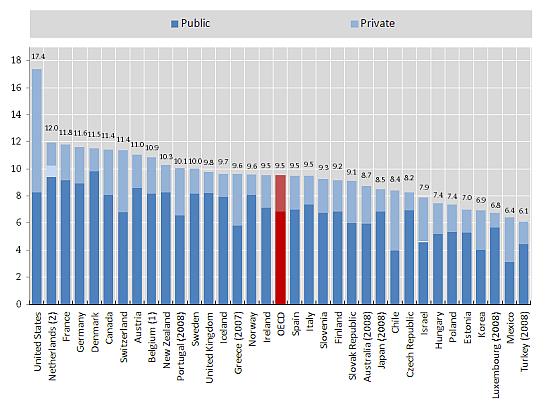
Ironically, poor lifestyle doesn’t affect overall health care spending that much. The reason is that people with poorer lifestyles develop more diseases, but they also die younger. The fact that they die younger saves money even though their disease burden is higher.

Also the medications to help control diseases of obesity (CVD, diabetes) are cheap generics now. So a person doesn’t need to spend much on medications for HTN, high cholesterol, type 2 diabetes, etc since there are multiple affordable generics for these.

Someone who smokes, eats junk food and drinks heavily likely won’t live long enough to develop alzheimer’s disease, which would require $15,000 a month in dementia nursing home care. They will be dead before they need that.

Australia’s obesity epidemic is almost as bad as the US’s, but they spend 10% of GDP on health care, vs 18% in the US.

25% of adult men smoke in Japan (far more than in the US), but Japanese health spending is 11% of GDP

The point is that, healthy living won’t save money on the health care system. it just redistributed when you spend it. Someone with a poor lifestyle may spend more on health care in their 50s, 60s and 70s, but they spend far far less in their 80s (compared to people with better lifestyles) because they are dead by then.

80 years ago, Canada did not have free-at-the-point-of-service healthcare. Lots of other countries have changed their systems since WWII: how did they do it, and why can’t the US follow a path already laid out?

I’m just not sure that the data support that premise (bolding mine):

{more at the linked site}

And – though there are surely medications available that are more affordable than ever, I would argue that they’re still less effective, in aggregate and over the long run, than prevention.

What is pretty inarguable is that the D&E (diet and exercise) burden falls squarely on the individual, while the UHC piece falls on the collective. Shifting some of that collective cost to incentives and subsidies might make a big dent.