Here's a Proposed Way Forward on USA Healthcare

Paul Krugman has a good substack. He’s put a series out there on US healthcare that, IMO, does a good job of summarizing our history, our politics, comparisons with other countries, a list of universal healthcare alternatives, and then a recommended way forward given our political system and entrenched opposition from Republicans. Basically, Krugman now recommends a Public Option. We’d keep Private Insurance if we want it, but Medicare would basically be available to whomever wants it. Over time, that would become the default option for many people.

What are your thoughts on this?

Unlocked Repost: Curing U.S. Health Care, Part I

Curing U.S. Health Care, Part II - Paul Krugman

Unlocked Repost: Curing US Healthcare, Part III: The Future

I always start with the unavoidable reality in America, which is that the elderly are effectively uninsurable. We either force private insurers to cover those 65+, which they will do everything in their power to skirt, or we take that on as a public benefit. Since we don’t want the elderly dying in the streets while fighting with private companies, we have Medicare. But since the elderly are such a poor financial proposition, we have to subsidize the program with high taxes on people who aren’t eligible for the benefit (but who get the promise of the benefit later).

It sounds like Krugman is proposing a non-subsidized public option, which would realize cost savings for consumers via a lack of a profit motive. This may provide some relief for middle-class families who can afford insurance, but does nothing for the tens of millions of Americans who can’t. The public option doesn’t make sense unless it’s also provides large income-based subsidies, similar to the ACA. If not, then the public option is just a middle-class alternative and does nothing to solve the problem of the un- and under-insured.

If it is subsidized, then it’s going to bear the burden of millions of recipients at or below the poverty level who can’t pay into it. Meanwhile, people who CAN pay into it will have the option to keep paying their private insurance, which might actually see premiums decrease as people flee to the subsidized public option and their risk pool gets healthier. That means funding the subsidies with general income tax funds, which is the same political quagmire we’re in now.

So I guess that’s my question that I didn’t see answered – is Krugman’s public option a universal and subsidized insurer?

Even if the public option provided no subsidies, just by being a middle-class alternative it would already put major pressure on health insurance companies. A whole lot of middle-class people are getting screwed despite being not-poor (Luigi Mangione and many of the UnitedHealthCare rage anecdotes were from middle-class folks), and they make up the majority of the vote in the USA. And it could gradually move towards subsidies, going no-subsidy at first.

But we also have a subsidized option for the poor already, in Medicaid. It has a lot of issues with it, like coming with big subsidies for insurance companies that don’t add any value, and having a hard cutoff that punishes people for working harder. But it still exists, and it’d be a lot easier to fix the flaws in it than to come up with something new from scratch.

A major problem is that the poorer you are, the higher your deductibles and copays because the crappier your health insurance.

A person making 120k a year probably has much better health insurance than someone making 40k a year, because the employer paying 120k a year is willing to pay a few extra thousand a year for a higher quality health insurance plan. the more money you make in wages, generally the better your benefits. Also the more money you make, the easier it is to pay for copays and deductibles.

This means that the working poor and lower middle class have insurance that they can’t actually use.

One potential way around this is some kind of federal cap on ‘all’ health spending as a % of income. Something like 10%, meaning that everything above 10% of gross spending has to come from public subsidies. So if you make 40k a year, then you can’t spend more than 4k a year on premiums, deductibles and copays in a year. Everything above that has to be subsidized by the public sector or your employer. This is one way to get around underinsurance.

But another plan that could work is called ‘medicare extra for all’. Its not medicare for all, but its a more advanced form of medicare that anyone can buy into. Its more advanced since it would cover things like dental, vision, hearing aids, etc that regular medicare doesn’t cover.

https://www.americanprogress.org/article/medicare-extra-for-all/

Premiums would be like the ACA, they’d be capped as a % of gross income. But also deductibles would be tied to gross income too so that you don’t end up with people making 20k a year on a health care plan with an 8k deductible.

Also all uninsured people would be auto-enrolled into medicare extra, which would mostly eliminate the uninsured.

So medicare extra for all would largely eliminate uninsurance and underinsurance.

Medicare extra for all would cost roughly 300-400 billion a year, most of which could be funded by savings on health care, and higher taxes on the wealthy. However a small payroll tax may be necessary too (a 1% tax added to the 15.3% FICA tax would raise an additional 130 billion or so a year). However medicare extra for all could be a bridge to a health system like they have in Australia. In Australia they have medicare for all, but you can buy private insurance on top of it. That would be the end goal, a system like Australias.

https://www.americanprogress.org/article/medicare-extra/
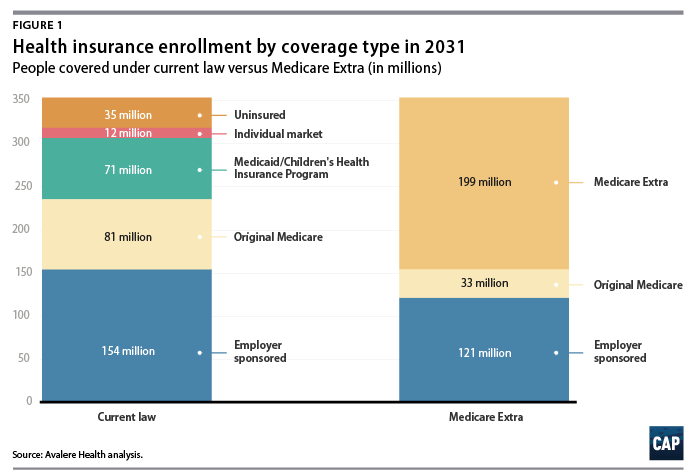
True, but even with Medicaid we have 10s of millions of people above the income cap (as you mentioned) who are still uninsured. Is Krugman’s proposal going to subsume not only Medicaid recipients, but the rest as well?

My point being, that’s a lot of subsidies, and once we’re talking about that amount of federal tax dollars going to health care, I don’t know why we wouldn’t just snap our fingers and take all the profits away from private insurers to help fund them.

I guess another way of looking at it, Krugman seems to suggest that slowly bleeding the private insurers out of business is more politically palatable than putting them out of business in one fell swoop. But there’s going to be a giant political battle over the massive subsidies we’d need to start insuring the uninsured. Plus, are we going to be coy about the fact that the private insurers are all going to have to downsize dramatically over the course of 10 years or so? That’s not going to be politically popular among their employees no matter what. Sure it softens the landing, but there are other ways to do that.

I think a two-tiered system is also a good idea. A person should have the freedom to purchase (with their own money) whatever they want, including top-notch private insurance and top-notch healthcare. If you request other people pay your medical expenses, fine. But… you shouldn’t be able to choose your doctor, waiting lists might be long, waiting rooms might be drab and crowded, etc. There would still be a minimum standard for the quality of care, however.

In other words, like the current US system.

It’s a poorly-kept secret that Britain’s National Health Service (NHS) has faced crisis after crisis. But the latest scandal over 3 million “unseen patients” may be its worst yet. In fact, this omnicrisis is worsened by the fact that barely anyone is speaking about it.**

Throughout the 2000s, headlines warned of an overwhelmed and underfunded healthcare system that was systemically failing, from facing “another winter of crisis” and bed shortages to a 2005 scandal forecasting that half of all NHS trusts would face hiring freezes due to a “cash crisis.”

These problems spilled over into the 2010s in the wake of the financial crash, worsened by the newly-elected Conservative–Liberal Democrat coalition government’s goal of cutting public services across the board. The austerity period saw a continued rise in NHS funding, along with warnings in 2015, and again in 2019, that the NHS was on the “brink of collapse.”

The Covid pandemic highlighted the perilous condition of Britain’s healthcare system. Some critics highlighted the apparent lack of funding, while others claimed that the crisis revealed the strength of the NHS in being able to respond under pressure.

Regardless of whether Covid revealed the contradictions or the strength underpinning the NHS, it has left a legacy of exploding waiting lists and what feels like a health service unfit for purpose.

**The British Social Attitudes’ survey from 2024 revealed just 21% of respondents were satisfied with the state of the NHS, while 59% were dissatisfied.

The idea of Universal Health care often hits a bump.

Myself- more systems like Kaiser, and lowering the Medicare age to 60 would solve some of the issues.

I think we currently have about $39.4T in national debt. By definition, this means that – as a nation – we’re willing to put ourselves, and future generations, deep in debt.

The perennial question is … for what?

Guns vs. butter

I’ve always liked the notion of the public option. It’s time.

Do you have anything to contribute re: Krugman’s proposal?

That’s a great illustration of how much better the UK system is than ours.

The elasticity of demand (in this case, inelasticity) predicts that a vital good like healthcare will result in huge costs in a for-profit market. Surprise! We have, by far, the most expensive healthcare in the world.

If Krugman’s proposal gets us part way to a single payer, I’m all for it. Almost anything would be better and more humane that the US system. Sorry if that’s glib, but it’s true.

We already spend more in taxes for the public healthcare we have (Medicare, Medicaid, the VA, federal workers) than countries that have universal healthcare. So I don’t see where all the hand wringing over subsidies comes from. Public funding accounts for about 2/3 of healthcare spending in the US as it is. Since our system is so bloated and expensive we could have true Medicare for all without raising taxes.

This chart is more aggressive than I recall, like I thought we were only ahead in tax spending per capita than like half of the countries with universal healthcare, and this shows us blowing past all of them by a comfortable margin. In this chart, only 43% of spending is attributed to public funding, but it doesn’t even add up to 100%. Either way we’re still spending a lot, and spending very poorly.

As far as the political hot potato, I think the simplest thing is to gradually reduce the age of eligibility for Medicare. Like reduce it by five years every so often. How often is so often? I don’t know, but considering what I said above, a better than 1:1 ratio should be doable, so at a minimum reduce it by five years every five years. I’d rather see it reduce by 10 years every five years or something to that effect. As long as the government is allowed to negotiate with providers like in actual civilized parts of the world, we can do this no problem.

Its because we want low taxes and tons of services.

about 23% of GDP is spending by the federal government, but we only raise 17% of GDP in federal tax revenue.

Another ~14% of GDP is from state and local governments, giving about 37% of GDP spent by the public sector. By comparison most of western Europe spends 45-50% of GDP via the public sector.

https://www.imf.org/external/datamapper/exp@FPP/USA/FRA/JPN/GBR/SWE/ESP/ITA/ZAF/IND

American media has created a narrative that we can save tons of money by cutting waste and by cutting welfare for everyone else (but not ourselves), and that’s not true. We need far higher taxes.

It’s easy to point the finger at Republicans, but remember the real power behind this issue is doctors - the AMA is responsible for the system we have now, by opposing anything that reeks of “socialism” which Medicare for All sounds a lot like. Even with bipartisan support, there are powerful and entrenched lobbies that exist to prevent any movement on the issue.

That said, I agree a public option that provides basic care for everyone, with a market for more/better insurance for those that want/can afford it, is a reasonable approach. This way we can extend the idea of “preventing the elderly dying in the streets” to “preventing anyone from dying in the streets.” It will take a major shift in the government’s role to act in the best interests of everyone rather than protecting corporate interests and catering to the powerful lobbies.

Doctors are now really sick of the endless hassles with the insurance companies and how much time they waste on it when they could be seeing patients instead.

That’s just silly. I’m in Canada, where “other people pay my medical expenses”, and I’m free to choose any doctor or any hospital I like. And whether waiting rooms are “drab” or not simply depends on who the doctor is and where they practice.

After my heart operation I was put in the care of a cardiologist who worked in a large clinic affiliated with the hospital. It was crowded, I didn’t particularly like this doctor, and the whole experience was grim, so I asked my PCP for a referral to a different cardiologist. It turned out to be the one who had treated me in the hospital, and his office is beautiful, with bright paintings on the walls, soft lighting, and uncrowded.. My visits there are pleasant and unhurried. The care I get is comprehensive and thorough, and the cost is exactly the same as with the other place – $0.

As I understand it, the American health system makes profits for insurance companies, lawyers, pharmaceutical companies, doctors and politicians (through donations.)

Universal healthcare takes those profits and uses them for healthcare.
(Also a giant organisation can achieve savings by buying in bulk etc.

Several states have created a public option. Washington, Nevada and Colorado I think. However they had to raise reimbursement rates to make sure providers would accept the insurance, so I don’t know if they are actually saving a lot of money.

The big issue is that per capita health care spending in the US is about 50% more expensive than it is in other developed nations. Even though we spend more we don’t have better outcomes, and even though our hospitals take in 1.6 trillion a year in revenue, most hospitals are barely breaking even. The overall profit margin on hospitals is about 1%, and many run at a loss.

The real solution is to find ways to make health care more efficient so we can get the same outcomes but only spend 12% of GDP instead of the 18% we spend now. However the business groups that benefit from our overpriced system will fight to prevent that from ever happening.

My understanding is 100 small reforms are needed to make health care more efficient in the US so our spending is more in line with other developed nations.