One other thing about Oshkosh: Sure you hear news stories of planes that crash on their way to and from the show, but part of that is simply the law of large numbers. If thousands of small planes take to the air on any cross country trip there are bound to be some incidents. It’s just that they become newsworthy when associated with an event like Oshkosh.
Well there is certainly the law of percentages applied to large numbers of planes. I’ll give you that. The problem with Oshkosh is that it combines close spacing of aircraft with people who don’t read the instructions thoroughly. I would advise going with a mentor the first time so you can both enjoy the experience and know what to expect the next time. I’ll tell you this, it all goes to crap when the VFR mins go down. I’ve had some very bad experiences when this happens. The procedures are to go into holding patterns over one of the lakes plus the town of Ripon. The last time this happened to me there were 2 rings of aircraft at one altitude and 2 rings of aircraft 200 feet above and some idiot flew straight through all of at between the layers. Scared the crap out of me.
And a few years before that event the visibility stayed below 3 miles. They wisely opened the airport up to get planes in and I was just about to turn on base from Fiske and we lost sight of the metal gray plane in front of us. It just vanished in the haze. We aborted the turn and it was quite stressful getting through the airspace until the Tower could deal with us.
I’ve seen many people land on the wrong runway because they didn’t read the instructions (they use a taxiway to create a parallel runway). That means they cut in front of someone else on short final. Heck, I saw someone land BETWEEN the runways at Sun and Fun. It was a Brokaw Bullet and every time the plane came across a connecting taxiway it launched back up. Quite the show. Also had a 172 pull up from below into a line of planes and I was riding in a twin that was already bordering on a stall. It must have looked like a giant snake as people started s-turns to space it out (S-turns are not allowed of course but nobody wants to leave the que to look for more dumbasses).
With that said I can say that turning final at Oshkosh is an exhilarating experience that should be on every pilot’s bucket list. That feeling just after you level the wings and trim it out is the moment when you can relax and take in a view of all the airplanes on the ground … I smile every time I think about it.
I haven’t been to Oshkosh, but I’ve flown into Sun n’ Fun a couple of times. Not the same volume, but similar in that a visual procedure is flown with one-way radio communications (meaning the controllers and ground spotters speak to the aircraft, but not the other way around - you acknowledge by rocking the wings).
Frankly, I found it very unnerving, especially the beginning of the arrival procedure. You’re supposed to fly to the north end of a lake and then find another aircraft to follow past several waypoints and into the traffic pattern. Having that many aircraft converge on a single point, all hoping to follow the other guy, was a bit of a Chinese fire drill. This was complicated by it not always being clear which aircraft the ground controllers were addressing.
And it happens very quickly. Once you’re in trail the waypoints go by very quickly, and the tower frequency is nonstop. What really worried me was so many people with varying levels of experience going into this beehive.
The departure isn’t so chaotic, but it does involve being close enough to other aircraft that you’re just about flying in formation. I wanted to be able to look in all directions simultaneously.
the ATIS radio instructions are a hoot. Once you leave the lake in tow they tell you to fly west until you cross route 4, then turn south and cross route 4. all the while you’re looking for an orange water tower which turns out to be a golf ball sized object that’s about as orange as desert sand. The trail of planes usually breaks up at this point because they miss the water tower. Jeeze loueeze, collect a quarter from everybody and paint the damn thing.
Sun and Fun approaches sucked before GPS’s because there is nothing but lakes in that area and it’s tough to find the one to join the que on. They release you via remote ATC once you’re circling it. At Oshkosh you only need to program Ripon into your GPS and look for the grain elevators. After that you follow the railroad tracks to Fiske and they split you off to either the North/South runways or East/West runways. That means you have 4 possible runway approaches each with 2 runways.
I go to the Air Races nearly every year (didn’t this year of course) and have predicted this would happen sooner or later. I’m suprised the death toll isn’t much higher. Generally very safe for spectators, but a freak accident could easily wipe out hundreds. We’ve had wing-walkers get scraped off by the runway (they don’t allow that anymore), mid-airs (2 T-6’s collided a while back. Ones prop chopped thru the canopy of the other), mechanical failure that caused several Unlimiteds to crash, including a Seafury into a house.
No, they won’t cancel them. Too much money involved.
Two strange side notes: Every year *I do not go *(since the 90’s, at least one day of the event), there has been a crash. The only crash to occur on a day I did go, we left early and therefor missed it.
Hanging in the Reno airport (as of last night) is a banner promoting the air races. It features a picture of the *actual plane *that crashed along with another P-51D rounding a pylon together. Security being what it is in airports, I didn’t even try.
Just another armchair analyst here, but the pilot and crew stated earlier that they modified the wing-span to be 10 feet shorter sometime before this event.
I wonder if that had any bearing on the cause of this crash?
It would (in theory) allow the airplane to go faster than originally designed. That may or may not have been a contributing factor. For darn sure, though, the faster they go the harder they hit so it would definitely affect the magnitude of the impact.
I’d say no because of the photographic evidence of mechanical failure in the tail. As I said before, calling the plane a vintage WW-II plane is pointless. It ceased being a P-51 Mustang a long time ago. It’s a one-of-a-kind racing plane that shares some structural design with a P-51.
Since this is the second mechanical failure of what is probably the same internal parts of the tail I expect the FAA to focus on it. As a general rule, the stress that cracks a part on one plane will eventually repeat itself in others. You can watch aging fleets of planes all go down in the space of a couple of years because of the same problem.
In a completely arm chair swag, not even a swag but more of a conjecture,… If the plane had NOT been modified to compensate for the need for additional rudder and aileron input then it’s possible that the failure of the tail trim immediately shot the plane up in a high G force which knocked the pilot out. That would negate any aileron input which would make the plane roll.
I say this because if the pilot did not black out from G-force he wouldn’t have rolled it over but rather pulled back on power and try to re-establish control of the plane.
Interesting.
I was wondering about the effects of recent maintenance on the airframe but haven’t kept up on the details.
Something happened here that was out of bounds. This was an experienced pilot and crew.
My heart goes out for all involved.
As another total amateur, I wonder if the clipped wings would make it less stable and in particular significantly increase the roll rate, leaving the pilot with a bigger control problem and less time to deal with it?
This post is the most insightful of the whole thread, I rather think. I agree with you. He was blacked out alright. From way before the apex of his inverted roll.
This photo… http://www.ericjacobsen.org/pics/Reno/Reno2011_3.jpg pretty much shows how far forward the pilot was slumped unconscious in his cockpit. This shot was taken while the plane was still 800ft or higher. All the way down, not one photo anywhere, shows the pilot’s helmet coming back into view.
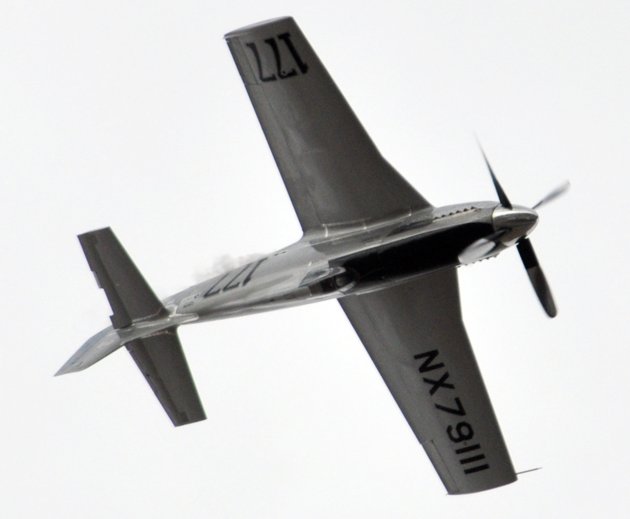
My prediction is that history will show the pilot underwent at least 500 degrees per second of clockwise body roll as well as +10G loading just after he called Mayday, and he was already loaded at 3.5g after leaving the back straight - and he was 74 years old without a pressure G suit. The photographic evidence is pretty strong - the pilot was blacked out by the time the plane was inverted at 800ft, probably 180 degrees of body roll earlier. The rear landing gear, apparently, can come out non-voluntarily under sufficient g-force loading.
The final shots of the plane diving at 20 degrees from vertical show no sign whatsoever of a pilot’s helmet. As nice as it is to think that the pilot might have pulled on the stick hard at the very last second, the photographic evidence indicates the rear ailerons were already in maximum up all the way through the clockwise inverted roll.
This photo… http://www.ericjacobsen.org/pics/Reno/Reno2011_2.jpg is another shot as the plane went vertical. No sign at all of the pilot.
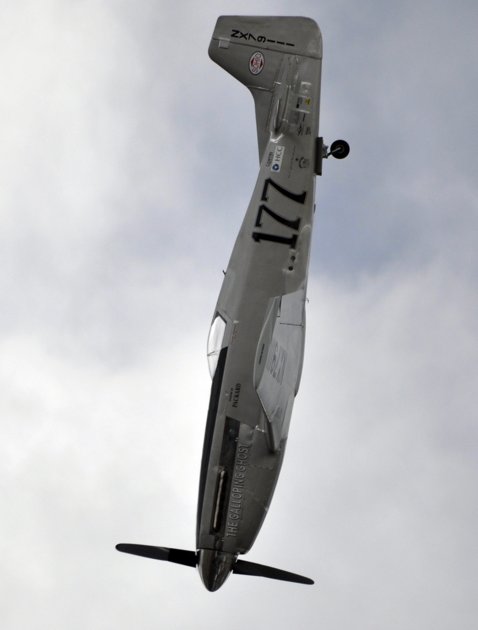
This video is from a better angle. It looks like pitch-up, GLOC, roll turns pitch-up to pitch-down.
May I ask a stupid question?
Does the NTSB investigate all air crashes, even the non-commercial ones?
In the US – yes, I believe so.
I should note that there have been a few instances when criminal acts were suspected to have caused the crash, notably Flight 800, where I believe the FBI was the lead investigating agency. The NTSB was still involved, though, because their people had the aviation expertise the FBI lacked. I don’t recall hearing it, but I wouldn’t be surprised if the 9/11 crashes were treated the same, though the causes were hardly mysteries.
Wikipedia (on the NTSB article) mentioned that the DoJ “lead” the 9/11 investigations, and that the NTSB provided technical expertise.
National Transportation Safety Board - Wikipedia )
In the linked section, it says the NTSB ivestigates every civil aviation accident. But I don’t recall hearing much about the investigations of noncommercial small plane events. (Every now and then, somebody lands his small plane on the freeway.  )
)
I told you my question was stupid.
Damn, Sam, that makes my knees wobbly.
The video and stills that are out now are just extraordinary. Those close ups when the plane disintegrates immediately reminds me of course of one and only one thing, archival footage of a kamikaze hitting right behind the camera. Clearly, there’s nothing else in our range of human experiences that can equate with the sheer ferociousness of an impact like this.
I too am struck by the unusual calm that quickly settled on the crowd right after impact. Obviously it’s a group accustomed to extremes, but even so they seemed to act with unusual purposefulness immediately thereafter. I’m thankful that for any that might have known in that brief instant that the plane was sure to hit near, that the realization was so very fleeting.
In the Los Angeles Times, I read an article that made it sound like spectators are viewing from a more dangerous spot at an air race as compared to an air show. Reno is the only place in the country that still has air races.
Reno crash: Air races offer thrills with an emphasis on safety
By John Hoeffel and W.J. Hennigan, Los Angeles Times / September 17, 2011
Because I fly small airplanes I, regrettably, have known some people who crashed. Yes, the NTSB does investigate the crash of all aircraft, and even some things that aren’t legally airplanes but still fly - by which I mean ultralights which they are not required to investigate, and don’t always, but sometimes they elect to do so.
I will point out, however, that successfully landing your airplane on the freeway is not, in fact, a “crash”. Given the amount of skill required I personally wouldn’t call it an “accident” either. In some instances, such as emergency landing due to engine failure, a report does need to be made and an investigation may subsequently occur. In other instances, such as a forced landing due to sudden changes in the weather, no investigation may occur.
I had an acquaintance-friend who did successfully land his small plane on a road, after which he subsequently crashed into a telephone pole on the ground (the alternative was to run head-on into on-coming traffic). Despite it technically being a traffic accident, the NTSB did conduct a full investigation.
You don’t hear about most of the little plane accidents because they’re by and large local news. They might headline in their immediate area but only a very few receive national attention. But yes, the NTSB does investigate them all.
I’ll quibble with some of this just in an effort to get correct information out there, although I’m only a pilot / flight instructor and not an investigator. The terms we should probably use here are “accident” and “incident”.
I’ve seen some airplane “crashes” that most people would call an accident, but that’s a specific term with regard to the FAA / NTSB. It involves either major injury to people (which itself has specific definitions), or a certain amount of damage in terms of dollars. Below those thresholds, they become merely “incidents”. The Reno airplane was most definitely involved in an accident.
There is also consideration of the type of operation. If a person is taxiing an airplane without intent to fly - say for a maintenance test or re-position - and rams it into a building it’s not really a flying incident / accident. However, I believe the FAA / NTSB have discretion to investigate pretty much whatever they want. But the point is, such a situation might not even need to be reported, depending on the details.
Broomstick, your assertion that an emergency landing due to engine failure needs to be reported isn’t strictly correct. Certain TYPES of failures have to be reported, such as in-flight fires and control system malfunctions. But if your engine quit and you simply dead-sticked into an airport with nothing else of note taking place, that in itself doesn’t need to be reported (assuming a Part 91 operation).
However, it should also also be noted that the flight rules are written in such a way that a pilot can be cited for reckless operation of an aircraft for virtually any reason. Even if a pilot declares an emergency, he/she is only authorized to disregard FAA rules to the extent necessary to meet the emergency. Go farther, and they can get you for that even if everybody else thinks you’re a hero.
Edit: Addressing your last point, another reason one doesn’t hear much about small plane accidents is that most don’t involve fatalities. The vast majority are takeoff / landing accidents that just end up bending the airplanes.