We say, for shorthand, that a digital circuit uses, say, +5V for “1”, and 0V for “0”. But the real world is never actually digital, so what actually happens is that there’s some threshold value. So a circuit that nominally considers “1” to be 5 V, might actually consider anything above 2V to be 1, and anything below that to be 0. So even if the power supply drops to 4V or 3V, the device will still treat it the same as if it were 5V.
Of course, even this isn’t a full description. There’s always error in the measurements, and so there will be some band around that threshold where there’s a chance that it’ll measure it the other way. Maybe 2.1V is 90% likely to read as a 1, and 1.9V is 90% likely to read as a 0, with a smooth gradient in between. But you’ll still usually work right with voltages a little below what they’re supposed to be.
One might argue that the “why” is easy: Because we find that to be a useful trait for batteries, so we deliberately engineer them to stay as constant as possible before they abruptly die. The “how”, of course, is more interesting.
The OP seems to think the voltage drop is linear. It isn’t. Note the dfifference between 2A and 100mA - lowere power devices, the voltage stays high (flatter) for much longer. (Presumably because the current volume - Amps - is what reduces over life more.
This link seems to indicate the battery voltage degrades slowly from 1.5V to about 1V before at about 1/3 or 1/4 life left it falls off a cliff. So a source that regulates voltage and can tolerate 1V input (per cell) can use a battery for most of its life, the difference being undetectable until the voltage can no longer be maintained at that current demand, at which point the device would stop working.
Good point: it involves natural log. pH curves take very wild swings when molarities get in certain ranges, because they are based on the log function.
So what changed to make cells that maintain a similar voltage for so much longer in their working life?
It’s been decades since CHEM 101 but I understood the basic point was that the chemical reactions produce a certain voltage. The main issue is how much current the reaction can produce. (and associated with that, internal resistance versus load resistance).
I think the motor does turn at constant speed (b/c no other sensors built in), but that does not make the tape move past the head at a constant linear speed.
the reason being that the constant-ly turning motor would turn the spool at constant revolutions, but the “driven” tape spool could be at its min. diameter or at its max. diameter - or anything in between (where every single rotation would move a different length of tape per revolution across the head … or am I off?
pic for reference:
IMHO, this would also (slightly) impact the audio quality, as when the spool is full - there might run twice as much tape per revolution across the rec / play head … and in tape, more tape x second is more better, soundwise …
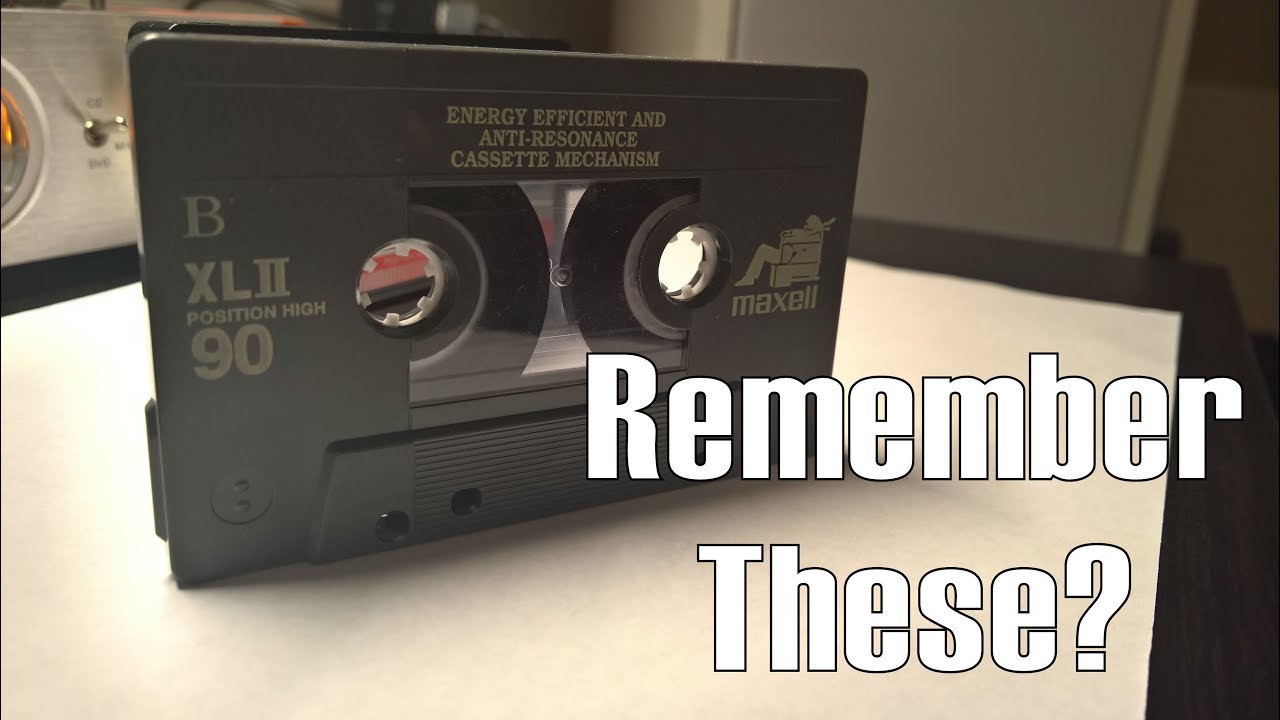
The cassette does not include the capstan. The capstan and pinch roller are part of the recorder/player. The capstan passes through the body of the cassette just behind the tape, to the right of the read/write head. The pinch roller is pushed onto the front side of the tape pinching the tape between it and the capstan. That provides the actual tape drive and accurate tape speeds. The pinch roller is disengaged when running the tape at high speed.
The drive to the take up spool or fast drive to either spool for rewind or fast forward are done separately. Cheaper recorders would do this with a complicated mess of pulleys springs levers and clutches all driven from the same motor as the capstan. Better and significantly more expensive machines had multiple motors.
If you remove the cassette body, you still have the basic architecture of any tape recorder.
Tricks to allow a player to play the tape in both directions, and thus play both sides without the need to flip the tape included an additional capstan and roller. Things could get remarkably complex in a small package.
The capstan ran at a constant speed and kept the tape speed to the standard. The take-up and rewind motors would pull the tape hard enough to ensure no slack, but not so hard that the tape would stretch, given the resistance from the capstan. Altnough warnings were that the 120-minute casette’s tape was so thin that stretching was a risk, so - like VHS - rewind was always a good idea as there was no resistance on the tape when rewinding, the tape ran as fast as the motor could go. Storing the tape un-rewound, wound under tension, could on cheaper players cause the plastic tape to stretch over time, especially if exposed to heat.
Of course, this warning doesn’t make any sense.
I mean - the tape is wound into a spool. How much longer could it get?
But, it’s possible that leaving the tape under tension could promote print-through, but I doubt that having the tape layers a sub-micron closer would make any difference.
In my experience, rewinding the tape was the most dangerous operation. I had many a cassette tape tear away from the hub when the tape slammed to a stop. I got pretty good at repairing them.
Didn’t we all? And with the special secret tool - a hex-sided pencil.
Cheap cassette decks could ruin anything. But the sound quality that could be wrung out of a format that was originally only intended for dictation was pretty amazing.
one of the worlds most heralded audiophile recording (Jazz at the Pawnshop) was made in the early 70ies on a reel-to-reel system, which is basically a bigger cassette running at higher speeds… or probably better said: the cassette was the poor-redheaded-cousin of the reel-to-reel.
… not to talk about many a fine jazz record from the 50ies and 60ies … that still have reference quality some 70 years later - especially true once studios in the 80ies got really good at fighting the tape-hiss on the reproduction end …
just as another add on: the “more tape running per revolution the bigger the spool is” effect is of course also true for LPs (vinyl) … where more vinyl is running under the needle per revolution at the biginning of the LP then once the needle progressed to the center of it … So, technically, LPs have the ability to sound better on the outer edge as compared to the center …
… taken advantage of this effect there are now some “audiophile LPs” that run on 45rpm (as opposed to the 33rpm of old) - just to get more information per second to the needle (often necesitating to turn a LP into a DoLP).
Plastic under tension can stretch. So if the take-up is under tension - which it needs to be, unless there’s a very clever take-up motor speed regulator) then the tape is under tension and slightly stretched, Leave it too long, that stretch becomes permanent. The trick to cassette player design is to not put too much tension in the takeup reel - othewise the tape will slip on the capstan, too. But takeup nees to turn fast enough to take up the slack when the tape starts and the diameter of the takeup is still minimal.
On rewind, the motor is not tugging against the capstan.
This is completely 100% wrong. As others have said.
You are looking at the reels, not the capstan. During playback (or recording) the reels are tensioned by reel motors or belts and clutches off a common motor such that both reels are pulling the tape gently in opposite directions to keep it taut. Meanwhile, the separate capstan and its drive motor are responsible to move the tape at a constant linear velocity, pulling against the opposite torque from the supply reel, and feeding tape towards the favorable torque on the take-up reel.
Now you did accurately describe how a phonograph record works. The constant RPM of the turntable means the linear velocity of the needle along the groove changes from fast near the perimeter to slow near the center. The linear speed difference between perimeter and center on a standard 12" LP is on the order of 2.5:1 or 3:1. The sound fidelity is a lot different and quite reduced near the center compared to the perimeter.
Audio CDs are the opposite in a coupe ways. First off, they playback from inside to out, not outside to in. And the linear bit density is the same along the entire spiral, but the RPM of the drive changes depending on the read radius such that the linear velocity under the read head, and thus the bit rate, is constant. The speed regulation isn’t perfect at digital speeds, but that is compensated for by adequate buffering and dynamic spindle motor speed control to prevent buffer under and overrun.
I was having a hard time imagining the capstan and such, because it’s been a minute since I looked into the business end of a tape player. A very old Technology Connections to the rescue. This made it extremely clear what is happening in a cassette player.
I’m sure I’m misremembering and confusing a variety of different technologies. I thought some CDROM drives to achieve their 60x speed and such spin at a constant rate, meaning data transfer is faster as it gets closer to the outside edge of the disk. It’s been a very long time since I’ve done something like read or write an entire CD, but I seem to recall it gets faster at the end. Maybe am I thinking of DVDs?
got it! … had to look up “capstan” on google - slightly embarrased that I had this wrong for so long (but cassettes weren’t much on top of my mind in the past 30+ years)
here’s a good graphical representation:
on a more conceptual level it also makes perfect sense … as a cassette is basically a highly portable reel-to-reel (R2R)… and R2Rs where the standard for professional recording well into the 1980ies (and beyond) … and that OF COURSE requires that the tape runs at constant speed, so you can punch-in and punch-out and do the edits and what not (and not have the pitch shifting ) …
I’ll note that the above diagram is a very advanced cassette player. Most do not have the slave capstan. Similarly, the diagram shows a split read/write head. Most recorders made the one head do double duty, which does lead to some compromises.
Where you do see a double capstan is in machines designed to run the tap both directions, where only one pinch roller engages, depending upon direction.
Dual capstans will require perfect speed matching between the two capstans - either that or a feedback system that measures tape tension in the gap between them. Not impossible, but a lot of additional effort. (You could for instance put a load cell behind the erase head.) Tape machines such as the legendary Nakamichi TT-1000 threw every bit of tech they could dream up at the problem. Arguably a gratuitous use of tech, but they were amazing.
I was talking about the original v1.0 audio CDs in audio CD players with analog sound outputs with no intervening computer. The bit rate off the drive had to be very close to real time, plus or minus just a couple seconds of buffering. So they operated in so-called “constant linear velocity” mode where the RPM varied with the read head’s radius so the bit rate was constant despite a different number of bits in each loop of the spiral.
Once we’re talking CDROM, CD-RW or DVD drives connected to computers everything is different.
As you say, those drives spin as fast (up to 60x) as the computer can absorb the data. That’s “constant angular velocity” mode in the argot. Which back in the late 1980s was just 2x or 4x, but now the limitation is the physical strength of the plastic media vs centripetal / centrifugal* force. The computer could slurp all 650MB off an original audio CD in a few seconds if the plastic disc could withstand spinning that fast.
Meanwhile, the audio playback of an e.g. MP3 or WAV or whatever file has nothing to do with the original audio CD spec. The computer inhales the data file off the CDROM, etc., drive as fast as it can, then an app trawls through the file in RAM at a measured pace to deliver the audio at the correct pace.
When you play an audio CD on a computer the file can be buffered in the computer’s RAM as well. So no harm in reading, e.g. data representing 60 seconds of music in 1 second of elapsed time; there’s plenty of RAM to buffer the other 59 seconds. The drive doesn’t need to spin faster than “1x”, but it might for design simplicity.
The design of the audio CD, and the player is a lovely exemplar of engineering design. There is a clear path from the available technology to the format and implicitly the design of realisable players. It needs to be remembered that the CD came out in 1982. Computers were either unaffordable, or so slow to be near useless toys. CD players were built with custom logic. (I remember a picture of a Yamaha prototype CD player - they had the entire controller built out of 7400 series chips on a large circuit board prior to turning it into a custom LSI chip.)
A fabulous resource is The Art of Digital Audio by John Watkinson. He describes how, starting with available semiconductor lasers, optical lithography process, and the data rate requirements for two channel audio, the entire system was designed. Early CD players had near to no buffer capability. The processing pipeline for the decoding of the on-disk data defined a minimum effective buffer needed to extract, reconstruct data and manage error correction. After that the data went to the digital to analog converters at very close to the rate they came off the disk. A carefully damped feedback loop controlled the disk’s rotation based on the tiny buffer’s fill. The rate of data drain from the buffer is clocked by a crystal oscillator, and this, in principle, provides the actual sample rate control. (So, back to the OP, thus until a battery in a portable player simply could not provide the power to run the device at all, the system ran at the correct speed.)
There was a lot of angst in the audiophool community about the effect of residual timing issues (jitter, aka phase noise) had on the sound, and it could be interestingly evil. There were staggeringly expensive and idiotic designs intended to fix it. That hasn’t entirely gone away.
I bought one of the very early consumer CD players. Insanely expensive at the time.
Around the same time I also got a copy of the CD Red Book* which was a fascinating exposition of how the damned thing worked. Wish I still had that book; it was a cool artifact of the beginning of digital audio in general.