Me too. A few. I cannot believe how much, in modern money, I spent on them. Young and foolish with too much money to waste. And what I spent on CDs would buy a nice car today. They are all in boxes in the cellar.
Yeah.
I just played with the CPI Inflation Calculator (bls.gov).
I recall the very first CD I bought to play on my new player. And what I paid for it. Equivalent to about $60 today. Per CD.
I got rid of the original jewel box probably 25 years ago when I put that first disk (and the rest of my collection) into a CD jukebox player. Kept the insert booklet. The disk and insert booklet were trashed for good when I cloudified my entire physical disk collection about 2 years ago.
CDs as a music format were mostly in the $15-20 range for their entire life, I think. I remember reading an article about that at some point, but a search just brings up things about “certificates of deposit.”
In the early 90s I spent $400 in today’s money to buy a portable CD player. That player has probably been gone for 20+ years, but for a month or two last fall my 10 year old was using the case for the portable CD player as a purse. I asked their teachers if it was a distraction, and it was a very interesting generational marker as to whether or not the different teachers knew what the bag was originally for.
To bring it back around to this thread. I mostly used the portable CD player in the car driving back and forth between Colorado and Texas. Batteries worked and played perfectly until they didn’t. I can remember stopping at a Walmart between Amarillo and Lubbock to buy more, because I ran out of charged NiMH ones.
From an earlier period I can remember using cheap non-Walkman portable tape players, and they would slow down before the batteries died. Once the slowdown was noticeable, it was going to die within minutes. They would usually still work to play the radio, though.
There were plenty of jokes in those days about investing in CDs in regard to the money people spent on them. Time and technology moved faster than people predicted, the availability of music on demand on your phone wasn’t something that seemed to be around the corner.
A group of audiophile engineers at the company I was working for banded together and got the local audiophile stereo store to give us a “bulk purchase” price on Sony’s1st-generation CD player. That thing was built like a tank. It must have weighed nearly 30 lbs. We saved over $150 each by buying a lot of them at one time.
It was my only dedicated CD player for my stereo system. By the time it died, I had ripped all my CDs to Apple Lossless and stored them on a hard drive.
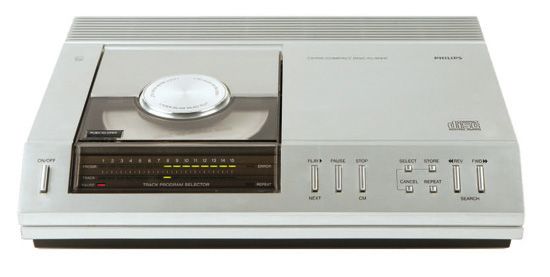
being european, these were prob. the heydays of Philips …
they had really strong horizontal distribution … and that was the player many early adopters bought:
IIRC about $2k…
I think the speed at which simple lateral acceleration creates forces that exceed the material strength of the disc are extremely high. The problem CDs/DVDs seem to encounter before that point is the critical speed:
For spinning shafts, the critical speed is the rotational frequency that matches the natural lateral vibration frequency of the shaft. If you’re dealing with a long thin shaft, it’s going to have a low critical RPM. You can operate faster than that speed, but the trick is accelerating through it rapidly enough so that you don’t destroy it with high-amplitude lateral vibration before you reach safer/higher RPMs.
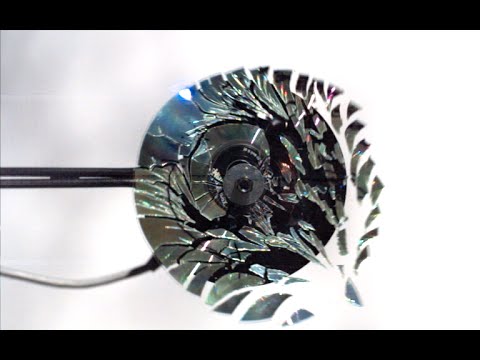
Something similar happens to CDs and DVDs. The discs are very flexible in an axial direction, and exhibit a particular natural axial vibrational frequency related to their thickness and material properties. At the critical speed, they develop standing waves that are excited by the matching RPM of the system. Plastic has a natural damping property that serves to limit the peak amplitude to some extent, but even so, it can only withstand so many high-amplitude vibrational cycles before it’s just too much.
The critical speed varies a bit depending on the thickness of the disc. The Slo Mo guys demonstrated this behavior, and for the discs they used, the critical speed appears to be about 23,000 RPM, corresponding to about 127X speed for reading data at the perimeter of the disc:
Great info. Thanks. Those guys’ vids are always great.
As well the drive manufacturers need to deal with people using damaged disks that might be microcracked, warped, or unbalanced. All of which will tend to reduce the RPM at which they fail, whether from critical speed vibration or centripetal forces.
Said another way, the RPM of CD/DVD drives has reached a plateau. The inherent limitations of the specs for the physical media dictate that. The good news is that rotating physical media is an obsolete tech approaching it’s natural dead end. IMO there won’t be a “son of DVD/Blu-ray”; at least not as a consumer tech.
Not quite sure what is amazing about this. From the end of the era where recordings were made directly to acetate (actually lacquer) discs until the advent of digital recording all recordings were made on some variation of the analog reel-to-reel tape recorder. All such recorders use the same tape speed control technique (capstan motor sets the speed, reel motor provides tension), just with different numbers of simultaneous tracks, different tape widths, and different tape speeds.
If you make the disc thick enough, the critical speed can be increased to the point where it’s higher than the speed that induces simple material failure due to centrifugal loading. I did some basic math and figured that a polycarbonate CD/DVD-ROM would probably rupture somewhere around 40,000 RPM. So once you get the CD thick enough so that the critical speed is above 40K RPM (this requires making it about 60% thicker than a standard CD/DVD), then it doesn’t matter if you make it any thicker.
Exactly. The to reel went through some extraordinary developments over time, and was only really supplanted by digital in the late 80’s early 90’s. It is currently seeing a niche resurgence- at bit like Hollywood directors going back to film. (Along with things like all tube mixing desk, or reviving SSL desks.)
For very high fidelity there were things like the Mercury Living Presence recordings that used a custom built wide format high speed tape.
The sound of 80’s rock and roll is that of saturating tape fed by an SSL desk. So much so that there are a plethora of digital emulators of tape available for modern digital audio workstations.
I wouldn’t call Jazz at the Pawnshop the exemplar of high fidelity. I would call it a well recorded good sounding recording. The idea that it is in some sense near perfect in reproduction is more hype than reality. Euphonious distortion is a key part of what makes many of these hallowed recordings so good to listen to.
That may have been more a function of the temperature drop in the capsule.
Maybe–it was a movie, so they did that effect for whatever reason they wished.
I do remember old tape players playing slow as they lost their juice in the '70s. It was always a bit of a sad thing hearing the tape get slower and slower knowing that the end was near.
Nevertheless, people who know far more about electronic devices than me (a very low bar to achieve) have provided huge amounts of much more useful commentary than my own.
Most low cost tape players would not have the same level of speed regulation that the Walkman had. You have to remember that the Walkman was not cheap; it was not easy to design a player that would work well swinging from a strap while the user is jogging. I’ll wager that a substantial driver for the crystal-locked speed regulation was to stabilize the motor speed as the Walkman was subjected to wide G variations.
It’s also good to remember that the first Walkman came to market in 1979, well after the whole Apollo program was kaput.