Firstly, the snakes: I know there are snakes living in the area. I’ve spotted a garter snake or three over the years, and recently I found a dead DeKay’s snake on the patio. Herpophiles, what snake-spotting methods do you recommend?
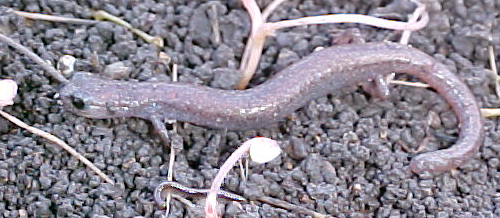
Salamanders: there’s a nature preserve hiking place not far from where I live. It’s got a huge lake, several rivers, and enough flora and fauna to nearly make up for the New Jersey Turnpike. Plus, it’s been raining in biblical proportions over the last month. It should be the perfect place to look for salamanders, in theory.
I’ve been looking under rocks, but no joy. Am I looking in the wrong place? Is there a special sort of rock I should be checking out?
The best way to learn how to find reptiles and amphibians is it familiarize yourself with the habitats and habits of individual species. A good resource for this is A Field Guide to Reptiles and Amphibians of Eastern and Central North America, by Roger Conant. It’s a great book. Under each species description, it gives information about where and when to look for these animals.
For salamanders, look under rocks and logs near streams, in shady areas.
For snakes, go to Sampiro’s house, or look for flat rocks or broad logs or stone fence lines that are in direct sunlight – you’ll see them sunning themselves. It’s about the only time they’re not in cover of some kind.
A point to general readership, not you specifically:
Interest in our cold-blooded kin is great – but give some thought before deciding to collect them to take home. It can be tricky to keep them alive, especially amphibians, and some are probably Federally protected. They are beautiful and fascinating animals, and do not deserve to die in a glass box in the basement when somebody forgets to take care of them.
A lesson I learned the hard way as a child. And it applies to pretty much ALL wild animals brought indoors to observe.
When I was about 10, I found a monarch butterfly chrysalis on one of the milkweed plants in my aunt and uncle’s rural property. I was fascinated (for those who aren’t familiar with it, the monarch butterfly chrysalis is like a Mother Nature’s Faberge egg…gorgeous jade green with golden hobnails) and took it home in a margarine container, intending to put it in a larger jar.
Well, I was 10. It was late. I put it down on one of the bookcases and went to bed. And promptly forgot it. By the time I found the margarine container again and remembered what was in it (about a week later), the pupa had metamorphosed and the butterfly had come out. But, lacking room to pump its wings out and nectar, it died with its wings still shrivelled.
I still feel guilty about that sometimes. It was a singularly successful object lesson…I never did that again. If I brought something home, it went straight into whatever observatorium I had for it, along with food.
Visit the Great Plains. I’m not kidding - due to a lack of decent cover, it seems like every other log or rock you roll will have something interesting under it. Elsewhere a multiplicity of places to hide means it takes a lot more work to find that elusive Sharp-Tailed Snake ;).
Well, there’s my water garden. I’ve also seen newts in there.
Then there’s my driveway.
Call before you come by. Any more reptiles and I’ll be selling tickets.
Another caveat about searching out salamanders under rocks: be extra careful not to crush them when you put the rock back! This happened to me with a tiger salamander–it moved when I was replacing the rock and I crushed one of it’s legs. Needless to say, it ruined both of our days. Even though salamanders are known for regenerating limbs, I was devastated.
Yeah, that’s the other thing I remembered about looking for critters under rocks- “Put the rock back first, and then let the animal crawl back under it.”
I don’t know how it is with the Eastern types of salamanders, but in Northern California there was a type of orange-bellied newt thing that would congregate in great numbers in any pond or lake or large puddle during their mating season in the Spring. We had fun playing with them if we happened to be hiking around that time.
The amphibian I’d be most interested in finding in the wild is the caecilian (no pun intended). They fascinate me…it’s hard to believe they’re related to frogs and salamanders at all.