Yes, but how many football fields long is the bridge?
Gaah, that stuff pisses me off too.
Yes, but how many football fields long is the bridge?
Gaah, that stuff pisses me off too.
Eh, if the bridge is well-enough balanced, then torque doesn’t actually matter. And power only matters to the extent that you want to raise (or lower) it quickly. You probably could operate that bridge with 36 HP; it’d just be slow.
I understand this but I also think there is some value in putting numbers into some context people can relate to.
What does 4,000 tons mean to most people? When you tell them their car is probably two tons or a 747 is 200 tons it lends a sense of scale. It may be imperfect but it is a ballpark estimate.
Although I gotta say I am amazed that one leaf of that bridge weighs as much as 20 Boeing 747s (not including the counterweight).
Knowing when those bridges were built I bet you could build a modern bridge to carry the same load with half the weight but still using ordinary steel as the main building material.
Yes and no.
Certainly you could (in theory) perfectly balance the bridge so a child could push it up.
But in reality the bridge needs to be heavy and not perfectly balanced. I have walked across that bridge many times and it bounces. Not a lot but you can’t miss it either. If it were perfectly balanced it would bounce a lot…it would be unusable. So, it is intentionally “heavy” to stay down and stable. I do not know how much that needs to be though.
I suspect you are right but, FWIW, that particular bridge is a double-decker. It’s not obvious but you can see it in the OP’s pic. There are two road decks. As such, the bridge is heavier than most like it in Chicago (these bridges are every few blocks downtown).
It would not. The bridge still has immense momentum, and the impulses of a person or even a bouncing truck would be irrelevant. There’s no need for it to have any imbalance at all. Most likely, it’s within 245 lbs of being perfectly balanced, since that’s the granularity of their counterweight adjustment.
If the bridge is bouncing, it’s because steel is flexible, not because it’s rotating on the fulcrum.
As I said, I have been on that bridge many, many times. It bounces in its current state. Not a whole lot but you sure notice it when walking across it (buses or other large vehicles are usually the cause).
I don’t remember that on other bridges like the Golden Gate or Brooklyn Bridge.
All bridges bounce, since everything is at least a little flexible. Steel bridges bounce quite a bit. You can see the Golden Gate flexing by a few feet in this video:
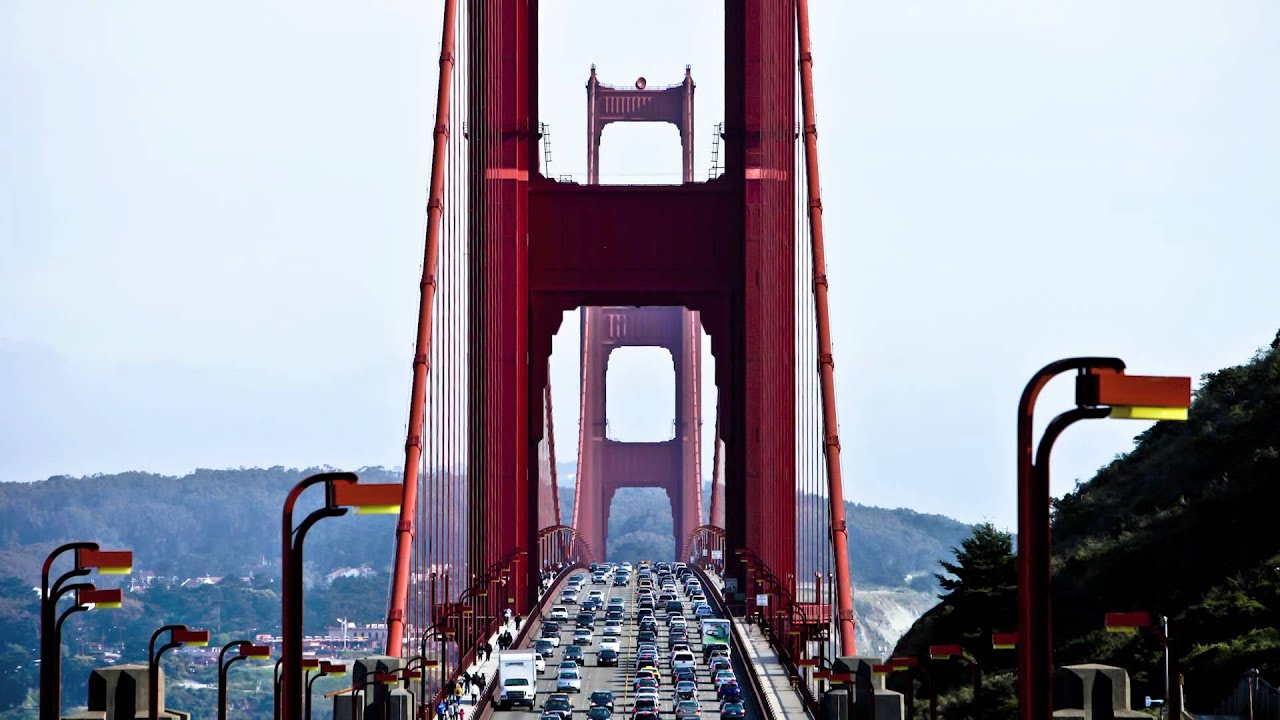
If a drawbridge is bouncing, it’s not because it’s see-sawing on its fulcrum. It’s just because steel is flexible, and any sort of force (wind, large vehicles, etc.) can cause it to flex.
The bridge has a lock mechanism that stops its movement when down. There are four bar over centre locks driven into place by electric motors at the pivot ends, and sliding bolt locks that pin the leaf ends together.
There are also brakes, but these are for controlling movement and holding the bridge open. The working brakes act through the drive train so will be subject to a bit of backlash. But this only matters for an open bridge.
Bridges really do flex. In the end everything does. Steel bridges bounce. Without damping in the structure to adsorb energy they can get quite a bit of amplitude when energised.
Are those the same motors that the bridge used when it was built in the 1920s, or have they been upgraded since then? I would assume the latter. And I wouldn’t be surprised if the original motors were less powerful than the current ones (although the sign in the OP does use the present tense, so it is still technically wrong even if true).
There seems to be a bit of confusion as to 100 versus 108 horsepower. But the original build is two 100 horsepower motors each side.
There may not have been much need to consider new motors. Whilst new designs will be smaller and a bit more efficient, there isn’t a huge amount to go wrong, and it is surprising how well solidly designed and built equipment will last if properly maintained.
When you get to very old systems, you run into standardization problems for frequency–all kinds of crazy standards were available at the turn of the century, from 25 Hz to 140 Hz. North America wasn’t fully standardized on 60 Hz by 1920, so it’s not impossible that the original motors ran on something else. I’m not sure what Chicago ran on at the time, though.
Depends very much on each jurisdiction’s philosophy of how infrastructure works in the world, but a notional 100 year design life is very common, and was popular from the 1880s onwards. The original motors may or may not remain, but they were designed to either last a century with suitable maintenance, including big upgrades, or to be replaced at a fixed time, like 30 years. The point is that they were required to work to a predicted level of reliability and future maintenance / upgrading / replacement were factored in and planned for.
For bridges especially, thinking about things in century-long increments leads to taking what seem like small issues seriously. A good example is the shaking induced on the long cables in cable-stay bridges. Just a few mm at a time, but when its once a windy week 50 times a year over a century you have a small but real risk of wear and tear leading to snapping. Once that risk is recognised, then you can think of creative ways to deal with it [like spiralizing robots].
The motors probably also don’t rack up much run time. It cycles maybe 40 times a year, and looks like it takes a minute to go up and another minute to come down. So figure maybe a couple of hours of operation every year.
You can avoid this issue if you just paint the bridge a lighter color.
Alternatively, paint the bridge and the counterweights.
d&r
I’ve walked across the Lion’s Gate Bridge in Vancouver. It bounces… a lot.