The Japanese word for “niece” is mei. So let’s say my niece is Suta. Would I address her as Suta-chan (leaving out the mei)? Or Suta-mei? Or Suta-mei-chan?
Suta-chan. Mei means “niece,” but it is a noun, not something you attach to a person’s name like a title or suffix.
How old is your neice? I know no Japanese but I was just talking to a friend who lives there. He was saying that if you use chan on any kid basically older than a toddler it might incur some major eye rolling.
I have no Japanese niblings, I was just asking academically because I’m interested in the concept of honorifics (which are largely absent from English).
What I learned from living in Japan was this:
Girls:
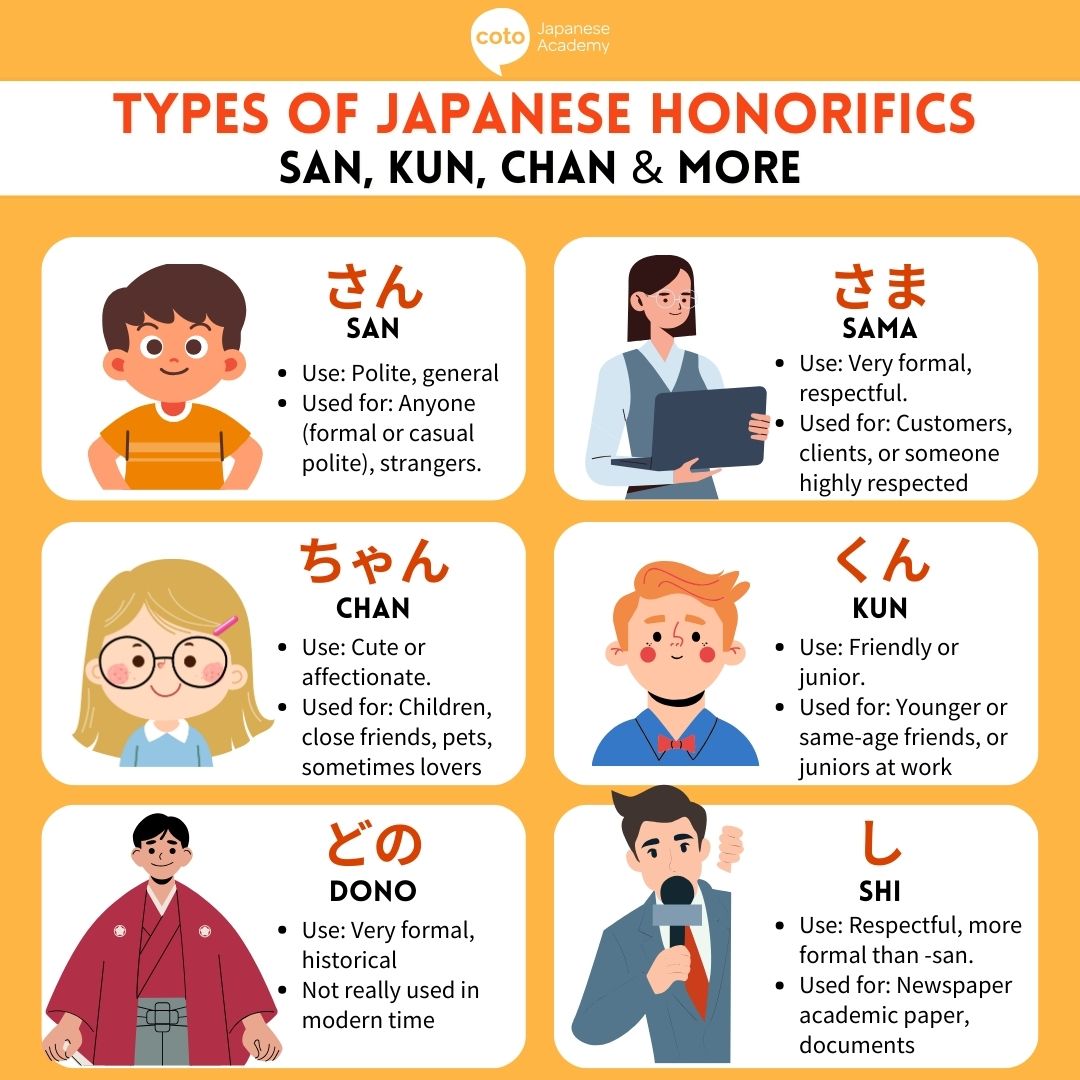
Until ~puberty, she is Name-chan
After ~puberty, she is Name-san
Boys:
Until ~preschool age, he is Name-chan
Between ~preschool age and ~puberty, he is Name-kun*
After ~puberty, he is Name-san
*I’ve heard that men and boys can address younger men/boys as Name-kun, but you do so at your peril. Also, the family I worked for was friends with a family that had a preschool aged boy. I called him Ryo-chan until one day when is mother told me specifically that he was now Ryo-kun until further notice.
Interesting, I’m talking from a position of complete ignorance. But my friend has a daughter not a son, so maybe this has become more gender neutral in recent years (he’s living in Tokyo and him and his wife moved there from San Francisco, so are very up-to-date in terms of gender neutral language)
Name-kun is also used but you have to know them, not some kid in the street.
" 'Sup, Mei-chan?"
Joking aside, is that an acceptable thing?
I have a handful of nieces, and I address each of them as “Favorite Niece.” I see Kady, I say “Hi Favorite Niece!” I see Olivia, and I say “What’s up, Favorite Niece!”
Mister, Miss, Doctor, General…
Does the Japanese language use different words based on the type of niece? Like distinguishing the daughter of your husband’s brother vs the daughter of your sister, etc? (Asking because Korean does so.)
As people referred to above, it really is going to depend on how long you have known them. If they were close to you their whole life, it would probably be by their diminutive (chan/kun), or their actual name without an honorific. I can’t think of any situation where you would call them name+niece.
I have a friend that is in his twenties that everyone refers to a name+kun, because they knew him since he was a kid. He is married and not a kid any more, but we still refer to him by kun, It did not automatically change when he became of age.
While Japanese does have different words based on age and gender, for example you can’t just say brother, you use the word for either older brother or younger brother, they don’t as far as I know have words depending on the parentage of the person in relation to you. Of course you have words for in-laws, etc, but niece or nephew are the same regardless of who their parent is.
The one family link word I have always found interesting is cousin, which is pronounced the same regardless of if they are male or female, but the kanji is different.
//i\\
As others have answered, you would never use Mei to indicate niece.
The rules for using -chan, -kun, -san are more complicated than the simple ones outlined in this thread, and really depend on the family, the relationships between the parties (how close they are), where they are from, their socioeconomic groups, etc.
Some parents will call their children, both male and female Name-chan, and not name-kun for the boys. Some will sometimes only use their first name. One of my friends said she called her boy Name-chan until he entered elementary school then just Name. Another friend uses Name-chan for both boys, event though they are now in their twenties. That friend thought that only Name was too harsh.
Some families use お兄ちゃん onichan (older brother) instead of their name or お姉ちゃん oneechan (older sister).
Some Japanese will use Name-chan for nieces and Name-kun for nephews, but others may just use Name if they are particularly close or Name-chan for really nephews they are particularly close to.
My ex wife’s mother was shitamachi, the traditional working class neighborhoods in Tokyo and my ex was just called by her first name, by her parents and even by her younger sister. Those aunts and uncles also just called her by her first name.
My exwife’s father was from a more middle class and the aunts and uncles used お兄さん (with san) when addressing or referring to him. I don’t remember if they used -chan with my exwife, but they certainly didn’t use san. That family was close, and met a number of times a year.
Correct in part, but not completely.
In some high schools, girls will routinely be called Name-san while boys are called Name-Kun by their teachers. Other schools will also have the boys called Name-san.
Most of the teachers at our school will refer to my daughter as name-san when they talk to me, but some use chan. Note that I teach at the same school, so I’m a parent / teacher.
High school girls and women will often / sometimes use chan or a nickname for their friends, or even just Name.
Note that the the manner of address is an indication of the relative status of the the people, such as a difference in age or rank and the closeness of their relationships. There are complex social conventions as well as individual taste.
It is common to refer to younger males and Name-Kun, but it depends on the relationship, and if you are in the same group or not.
It is rude to address someone in an overly familiar form, such as not including -san, but including more formal honorifics on people you shouldn’t can also indicate that you don’t believe your relationship is close for friendly.
I’ve had customers who referred to their female subordinates as Name-Kun while referring to the male subordinates as Name.
(It’s expected to drop honorifics for people inside your group when referring to them when talking to people outside of the group. Inside the group, you would refer to 田中部長 Takana Buchoo (general manager Tanaka) as Tanaka Buchoo, but refer to him as Tanaka (no honorifics) when talking to a customer.)
The larger the group, the more formal things tend to be. The smaller and more intimate, the more informal, although when important things are discussed, then things can become more formal.
When I was working in sales, I really paid attention to this sort of thing.
I’ve never heard of it.
Just curious, why did you decide on that as an example?
Just like in the US. What people call each other doesn’t follow a rigid set of rules.
Most people who learn Japanese will learn a particular set of rules and then assume that it is universal.
Also, most people who have lived in Japan for a few years will not be exposed to many different environments.
I’m surprised that @HeyHomie has only heard that it’s possible that younger men can be called name-kun because that’s so common.
Another issue is that as this board tends to skew towards older people, so much of what people report about Japan is 30 to 50 years in the past.
My kids are in high school, and the rules they follow are completely different than what I learned when I first came to Japan 45 years ago, or even back in the 90s when I was working in corporate Japan.
Lots of teen girls / younger women use -kun, for example.
True, but AIUI the impact of the faux pas of addressing someone incorrectly in Japan is likely to be greater than it is in the USA, depending on the situation.
@TokyoBayer Is it customary (or even okay) to ask the person–past toddler age anyway–how they want to be addressed? The way you might say here, “Do you go by ‘Bob’ or ‘Bobby’ and have the guy tell you, ‘It’s Robert!’”
And what about the OP’s original question: how should he address his niece?
Hoping to have my ignorance fought.
I watched a video with a Japanese mom and her little (~4) girl, her name was Suta. I thought it was cute.
NB: Suta-Chan was asked to sample a dish, and she didn’t care for it. While Mom stifled giggles, Suta-Chan was like “ika, ika” (I think), which I guess is Japanese for “yucky.”
As I said upthread, no Japanese nieces or nephews here. I have white-bread American nieces who, save for an older teen, are all adult women. I address them as “Kady” or “Brittany” or whatever.
Okay then, how should you address your hypothetical niece.
Yeah, but generally they use hiragana.
Yup. It can be much greater.
It’s not customary to talk about it. (Most) Japanese are really good at reading the clues.
For adults, you start off with the polite forms and feel out the situation. You can get a good read on what they want.
One would never insist on being addressed in a more formal tone. It’s far too arrogant, which is one of the worse things you can do.
Yes, indeed. How should he address his niece?
It depends on the relationship he has with her, how formal his family is, how close he is with this sibling and how often he sees them.
For reference, some families have the children call their father お父様, otoosama, (only old money does this) other お父さん otoosan, and others パパ papa, in decreasing degrees of formality.
If he were a Japanese man who only saw his sibling once a year on New Year’s, then call her Name-chan.
If he and his sibling and their families see each other several times a month, are particularly close, then he would use Name-Chan, only Name, or nickname, and often all three.
If the parents want to set a good example of being polite, they are more likely to use chan with their own daughter in order for the girl to develop that habit when she addresses her friends.
But if they are from shitamachi, working class neighborhood, then the chan isn’t as necessary.