What’s the straight dope on eating hot (temperature, not spiciness) food in hot weather? (say, 101 F heat wave.) Would you get hyperthermia?
An adult weighs 150 lbs or so and has an internal (not mouth) temp around 99F. If that adult quickly ate 150 lbs of food that was at a temp of 101 that would add enough thermal energy to raise their body all the way up to 100F. One whopping degree.
Since most of us eat far less than our body weight of food at a sitting, I think it’s safe to say the excess thermal energy in hot food is not material. Even eating 15 lbs of 100F food would only be enough to raise body temp 0.1F.
Even on the hottest of days you’ve got enough excess cooling capacity to handle that.
There certainly is an upper limit to human cooling capacity, where you’re teetering right on the edge of heat stroke. At that point, downing a bowl of piping hot soup might well push you over the edge. But so would a slight change in breeze, sweating out the last free water, or turning and facing a different part of your body towards the sun.
Thanks. Maybe I was unclear, I meant the outside air temp is 101. (The food might be 140.)
But yeah…it might not add up to much.
I’ve done hot saké shots out in my yard when it was 105 out. It wasn’t the most comfortable thing to do, but after the initial shock, you actually felt less hot. Tho that is probably because the alcohol was numbing things.
You were clear. I was reading like a dummy. :smack:
The point still stands that the weight of food we eat is a tiny fraction of the weight of us. Which is more or less equally true whether we’re a kid or a grownup, big or small, fat or skinny.
So even if the food is WAG 50 degrees hotter than the eater, once you multiply that by the ratio of the food’s weight to the eater’s weight it doesn’t amount to much.
If the food is at 140F you need to eat just over 2.5% of your body weight to raise your temperature 1F.
You get the same with hot tea. The explanation I was given was that when drinking something hot, you got more blood flow to your skin, which made you feal cooler, while also increasing the risk of heat stroke.
People barbecue food outside in hot weather all the time. Hot dogs, hamburgers, steak. Eating hot food in hot weather isn’t going to push you into heatstroke. Well, staying out in the sun without keeping hydrated might, but as long as you have plenty to drink, the food won’t affect you.
Looks like a competitive eating event might be a good place to record the phenomenon in real time.
Wikipedia has a list of some of the top competitive eaters, but I’m not sure if their individual pages give body weights. Also unknown is what the temperature of the food is.
Right. Just to show the point, let’s consider someone small eating a whole quart of boiling-hot soup (and somehow not damaging their mouth or throat). That’s two pounds at 212 F. With a 100 lb person at (roughly) 100F, that’s raising their overall body temp by a little over two degrees F. Which is nothing to sneeze at, but not immediately fatal either.
In fact, in the medium-term, it might help, since dehydration is usually a major factor in heatstroke, so two pints of liquid would probably be a positive.
(On the other hand, a whole bunch of protein without water could be a bad idea, since digestion uses water, and if you’re facing heat issues, you could be needing to use all the water you can get for sweating)
Hyperthermia occurs when the body heats up faster than it can dissipate the heat, which I suspect happens most often in connection with dehydration, or exertion. In the case of exertion, your whole body is heating up more or less uniformly due to heat generated by muscles. That’s a lot more heat than you get from eating a bowl of soup.
The human body is remarkably adept at shedding heat. A healthy person’s body can easily manage the task of handling heat from hot food. As mentioned, the weight of the food is small compared to your body weight.
In the case of alcohol (regardless of the temperature of the drink), it dilates your capillaries, which makes drunk people feel warm but then you are losing heat faster (in the winter this could contribute to hyperthermia).
I do not know whether hot liquids have this effect or whether it is the placebo effect. It seems to me that even if your body reacted like this to hot liquids, your body is trying to maintain equilibrium. That is, you would not be any cooler after drinking a hot liquid and then dissipating more heat than you would be if you had not drunk the hot liquid in the first place.
How hot does something have to be before you don’t eat it? I thought hot water heaters over 135F would be enough to scald - I can’t imaging consuming large quantities of 140F food would be healthy for the gullet or mouth. Or is it?
(The classic McDonalds coffee - and Starbucks - at 185F is enough to cause 3rd degree burns with short contact…)
I’ve found that I want food to be about 150ºF on the plate, measured with an infrared thermometer. Much cooler and it seems lukewarm, much hotter and it’s “piping hot,” which is a bit much for my taste.

ETA: As for scalding, that’s quite a bit hotter. This site says “Coffee is best served at a temperature between 155ºF and 175ºF (70ºC to 80ºC). Most people prefer it towards the higher end, at about 175ºF.”
Maybe your mouth can tolerate higher temperatures than your skin. 140F water can cause third-degree burns in 5 seconds.
Serving, temperature, maybe. NOT drinking temperature. Consuming liquids in those temperature ranges will cause serious damage.
Here’s a nice graphic on how quickly hot water can cause 2nd and 3rd degree burns, based on temperature.
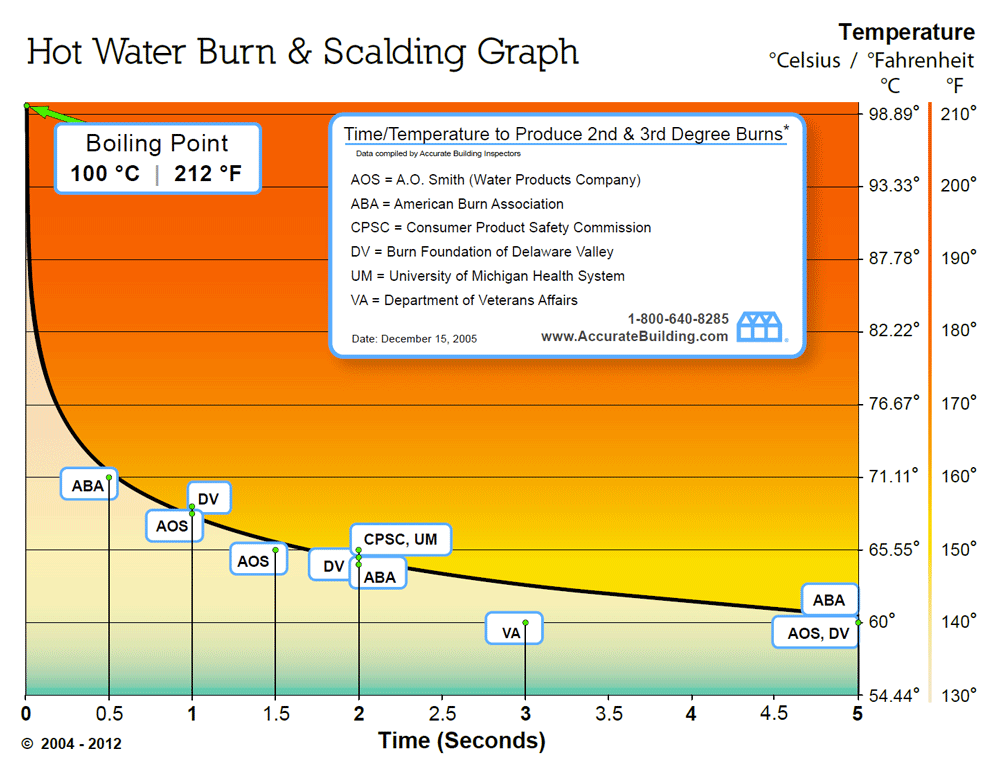
5 seconds at 140 F will cause blisters, while only 0.5 seconds at 160 F will cause that and worse.
Lower temps will burn too, according to uptodate.com
[quote}Hot tap water causes nearly one-quarter of all pediatric scald burns, and most of these occur in the bathroom. The damage caused by hot tap water burns tends to be more severe than that by other types of scald burns [30]
. In an animal study, partial or full-thickness burns occurred after six hours of exposure to water at 111ºF (44ºC) [31]. Yet if the temperature of the water was increased to 140ºF (60ºC), burns occurred within three seconds of exposure. Water at 120ºF (49ºC) took 10 minutes to cause significant thermal injury to the skin and this temperature is considered to be the ideal setting to reduce the risk of a serious burn.
[/quote]
Doesn’t the very act of digestion generate warmth? AIUI explorers in Antarctica will warm up from eating trail mix, even if the trail mix is completely unheated.
Yes, I suspect serving temperature is not consumption temperature. Things cool quickly on a plate or even in a cup due to convection or evaporation. An exception would perhaps be pizza, where the semisolid cheese layer insulates without conducting heat easily and prevents evaporation since the cheese has oils - so burns from the sauce layer are not uncommon.
[/QUOTE]
And McDonalds was serving their coffee at 180–190 °F!:eek:
Are you surprised? Same with Starbucks. That’s why it’s pretty good - but for the first few minutes, until it cools, you can only take very very tiny sips and yet still risk burning your mouth. And if you put a fresh foam cup of it between your thighs in the car and squeeze so the lid comes off and the contents soak into your terry cloth pants, you WILL get third degree burns.