Well, the OP’s question was about whether it was normal that his/her seats were fucked up after the accident, not about yellow light etiquette. So I’ll limit my answer to that.
Yes, it’s normal. When truck driver decided to slam into you, your car had to absorb and distribute that energy. Crumple zones do wonders, but there was still enough energy left around to bend/distort your seat tracks and mechanism. Better the seats than you, eh?
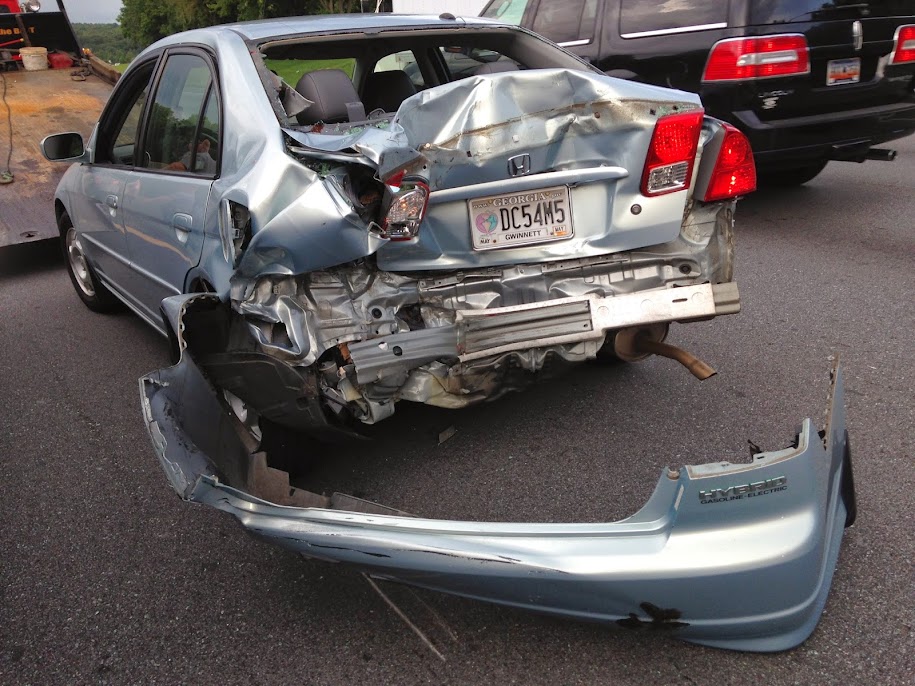
My ex-wife was rear-ended about a year ago in her Honda Civic Hybrid. Post crash pic here. Her seat back was deformed pretty dramatically and the recline mechanism was mangled. Car totaled BTW. She was hit by a Ford Excursion towing a horse trailer. Trailer was loaded with hay, not with horses, luckily for the horses.
While driving around the UK, I have seen the aftermath of a good many collisions. It is not uncommon to see the occupants of a complete wreck standing by the roadside scratching their heads and thanking whoever their deity is for crumple zones.
Just as another data point, I was once at a stop and was hit from behind by a pickup truck doing 45mph+. My seat back completely failed and I ended up lying completely flat. While I’m not sure if it is part of the design, I’m sure some energy was dissipated in breaking the seat that would have otherwise found its way into my body. The actual mounting points I think held.
FWIW, I wish I had decided not to stop at the yellow light. The road was wet and I really didn’t quite have enough room to stop once I decided to make the attempt. Just as the truck hit us, I had decided to give up on the stop and continue through the intersection. We then got propelled through the intersection. Still, the person driving the truck should have left himself enough following distance to stop. He may have thought I had decided to proceed through the intersection and was going to follow me. My deciding to stop surprised him and, well, crap.
I actually got this car after my daughter totally my 1999 Stratus. She was the one who rear-ended someone else (a garbage truck!). The impact did not deploy the airbags, but it did move the spare wheel off of its mount in the trunk. My daughter’s only injury was a mark where the seatbelt restrained her. I had no problem going back to Dodge and telling them just to give me another Stratus. All I want is for the car to crumple up, keeping the occupants uninjured.
In my recent accident, it just seems like the seats left me and my son to fend for ourselves rather than acting in concert with the seatbelts to hold us in place. However, maybe the seat did dissipate the energy by breaking. Maybe my body remained in contact with the seat cushions throughout its travel until it stopped (relative to the body of the car).
doesn’t really matter. if he didn’t have enough time to stop behind you safely, he was following too closely. If he did, then he wasn’t paying attention. Either case, he was at fault.
watch some of the IIHS videos of crash tests (the moderate overlap ones.) You’d be surprised at how much things move around in an impact. Including the occupants.
Good deal. Now we can continue the hijack about how poorly made and unsafe Dodge/Chrysler vehicles are. Which are the four lowest ranked brands in Consumer Reports 2014 reliability survery? Why, they are Fiat, Dodge, Ram, and Jeep. All from the Fiat-Chrysler stable.
Don’t know that I would be using a Consumer Reports surveyto prove any point. Amongst car enthusiasts, CR is never quoted or referenced when discussing the merits or lack thereof of a particular brand/model.
For those who don’t want to click the link, I’ll summarize:
[ul]
[li]Flawed survey model[/li][li]Does not take into account different brands attract different kinds of owners who do varying levels of maintenance[/li][li]Different vehicles are used in different ways.[/li][/ul]
For the last bullet there, a great example is given of Jeep. They ranked near the bottom of the list that JKilez linked to. But part of the unreliability is likely linked to the fact that Jeep owners typically use their vehicles in more challenging ways than your typical Honda owner. Break a CV joint while boulder climbing in your Jeep Rubicon. Yep, counts against Jeep.
I had a Jeep before buying my present daily driver, a Subaru. I had to replace a major component in the 4WD system (the viscous coupling) I also had a major repair to the differential while I had the vehicle. I also regularly took the vehicle through terrain that I would have dared any Lexus owner to follow me through.
My current daily driver, the Subaru, ranks much higher on that CR list. In reality, I’ve spent a pretty fair amount on repairs and maintenance on that one as well, maybe as much as on the Jeep. Anecdotal? Sure. Just like a survey is really nothing more than a compilation of anecdotes. At the end someone has to interpret what all that data means, and I don’t trust the filters/bias that CR places on their data.
IMHO, every manufacturer has a mix of great cars, and crappy cars.
It’s not unreasonable to assume that reliability is a marker for safety, to a degree. If the rest of the car is likely to fail, there’s not much reason to think the airbags or side impact systems or ABS or whatever won’t. That is not to say I personally think Chrysler vehicles are unsafe.
Have you had a look at their products from before 2005?
The hijack was about how poorly made and unsafe Dodge/Chrysler vehicles are, the reliability survey is just about how (apparently) poorly made they are.
And, I am not sure I get leftfield6’s logic on the significance of the survey. Apparently, when you collect anecdotal problem data on over a million cars annually, and have been doing that systematically for over 60 years, it is garbage. But, the anecdotal data from the handful of cars an individual may have owned is somehow the gospel “truth” on reliability?
FWIW, I’ve had this Stratus since 2006 (it was a “program car” and had ~26K miles on it when we bought it). It now has 81K on it and we’ve had very little trouble with it. The body has some unfortunate creaks and groans as it goes over bumps, etc., but that’s pretty much it. I can only think of one time I’ve had it in the shop aside from oil changes.
My 1999 Stratus had a few more problems, but nothing particularly serious, except for a freeze plug. The garage botched the repair and the plug blew out when my daughter picked it up. She was less than two miles from the repair garage when, in her words, “the car sort of automatically slowed down.” She damn near melted the engine. (It was a hot day – it’s Texas – and she was driving at highway speeds with no coolant). The garage repaired the damage, but the car was crashed about six weeks later.
Yeah. 3.0 seconds is the federal minimum, and that’s for roads that are 30 mph or slower. I believe it goes up 1 second for every 10 mph. (I successfully challenged a red light ticket recently when the yellow duration was 2.9 seconds, as shown in the photo.)