And thanks for these comments. I hadn’t actually thought of itthat way, that the various mammal “lines” had already diverged in the Cretaceous, but, being that were still underfoot to the big lizards, that they weren’t nearly as morphologically dissimilar to each other as their descendants today, and in most cases not even remotely similar to their descendants.
If you are referring to Dravidosaurus, the extremely fragmentary material upon which it was based was found to instead be a form of pliosaur, back in 1996. There are currently no definitively known Late Cretaceous stegosaurs.

That’s exactly what I meant, and I’ve never seen any reports on this (not doubting your word of course; that’s a lot more my limited access to good palaeontological reports than anything else). Got a link, preferably not totally technical, I can look at?
There’s a lot of sketchy stuff on the interwebs (largely because the material itself is somewhat sketchy), but the following sites all seem to go for the “not a stegosaur” option:
Wikipedia link
Dinosaur Mailing List archive
The Plesiosaur Site (little more than a blurb, but its presence on this site at all says something :p)
DinoData link
In print, I checked my copy of Dinosaurs: The Encyclopedia, Supplement 1, and found the following as well:
At this point, then, the remains and locale seem to indicate “plesiosaur” rather than “stegosaur” (or pliosaur, for that matter…my oops), though nothing is necessarily definitive at this point. The best one can really say is that Dravidosaurus is currently a nomen dubium, and the fossils may or may not be a plesiosaur, and that the notable stegosaurian traits (plates + skull) seem to be absent. Since Chatterjee and Rudna are the most recent to publish anything on the specimen, their papers (see the DML archive link above for the actual references) represent the current status of the beastie.
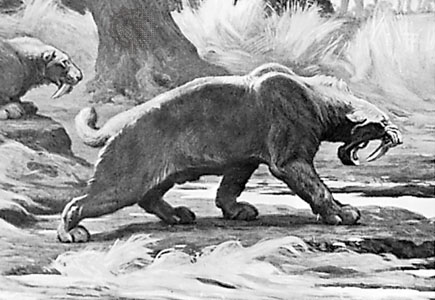
I’m currently working on an exhibition on the Great American Biotic Interchange, which will also feature some examples of convergence. We’ll be comparing fossils of rhinos and toxodonts, horses and Thoatherium, and Smilodon and Thylacosmilus.


Some recent controversial evidence suggests that the condylarth ancestral ungulates could have originated in India.