Let’s say that I put a big Fresnel Lens the ideal number of meters away from my solar panels in the ideal position and at the ideal angle (no, I don’t have solar panels IRL). The focused sunlight then lands on my panels.
Does this:
a. Produce mad extra power … profit!
b. Put the panels at risk of melting/burning/overloading/words like that?
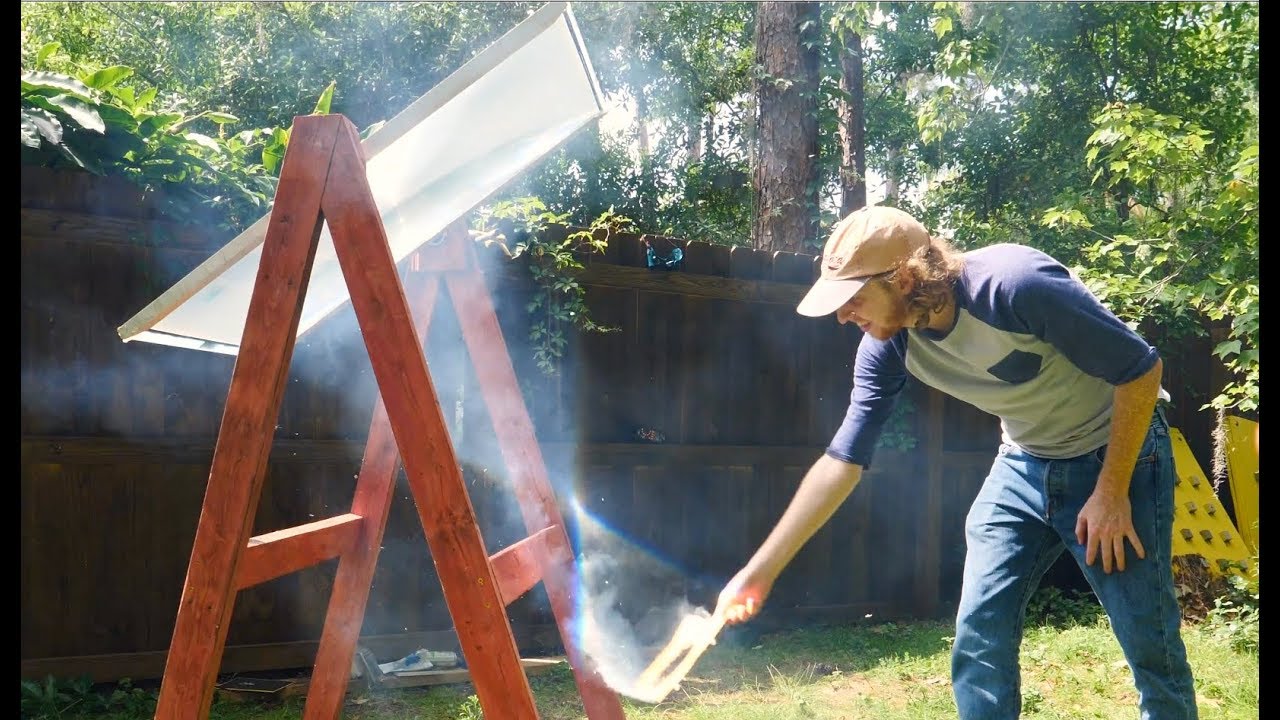
That would be a very bad idea. You don’t want to focus all of the sunlight at a single point. That will completely fry that part of the solar panels. What you want to do is have the light spread out evenly over the entire surface of the solar panels.
You could probably accomplish that if you put the Fresnel lens significantly less than the ideal distance away from the solar panels. That will focus a larger amount of light down to a smaller surface area, increasing your solar output. At some point though you’ll damage the cells in the solar panel, so this has its limits. Depending on your area you might be able to increase your solar panel output by somewhere between 10 and 30 percent or so. You’d have to look at some actual specs to figure out exactly how far you could push it.
Incidentally, there is a type of solar power that does focus the sun to get more power. It’s called a molten salt power plant. As the name implies, it uses focused sunlight (typically focused using mirrors, not lenses) to melt salt. Water pipes run through the salt, and the heat turns the water into steam. From there on out, the plant is just like any other steam powered plant (coal, nuclear, natural gas, etc). The steam is used to spin a turbine which is connected to a generator that makes the power.
The big advantage this has over solar panels is that once you get the salt hot enough, it takes it a long time to cool. So this type of plant can ride through momentary cloud cover and can even run overnight while still producing power. As long as you have enough molten salt to get through the night without it losing all of its heat, you’re good.
There was a major plant in the southwest that was built using this principle. Unfortunately, it lost money for all of its investors, so as innovative as the technology is, you’re not likely to see many more plants like it in the near future.
You could theoretically do the same thing with a Fresnel lens, but that would cost significantly more than just using mirrors to focus the sunlight.
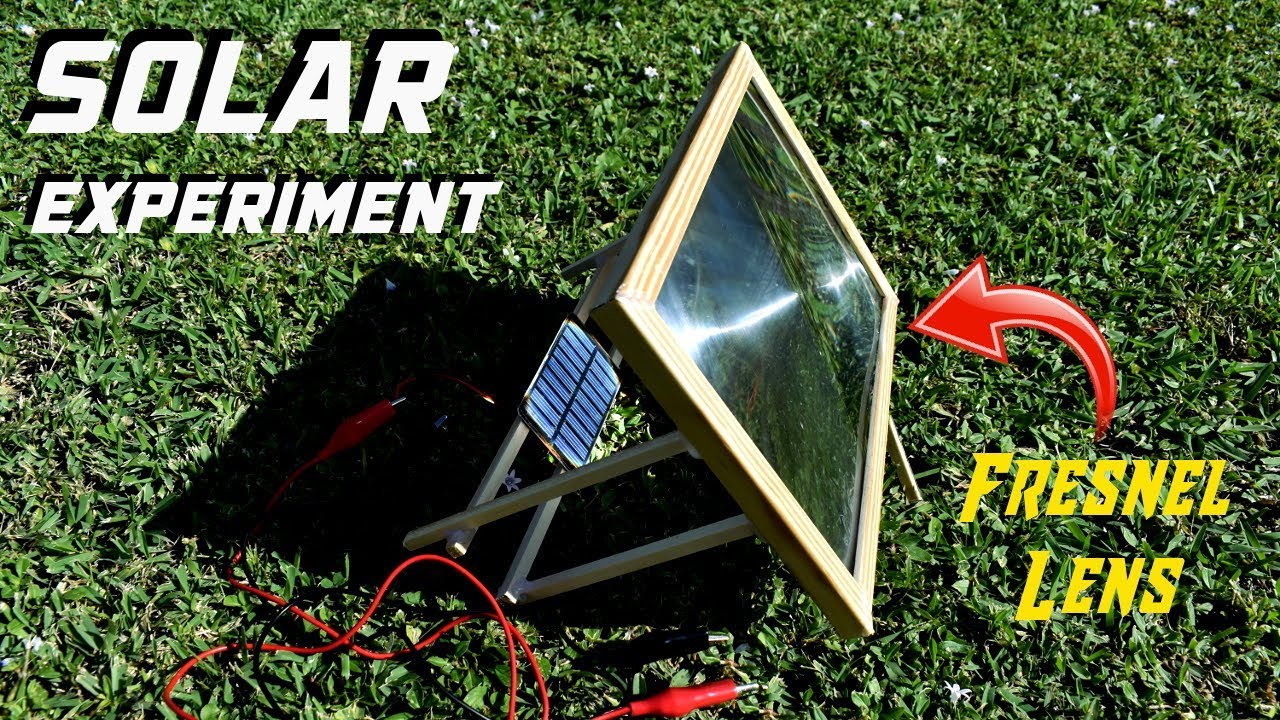
Here’s a video example of a test of Fresnel lens focusing sunlight on a small panel.
TL;DR: with the panel placed so that the light is distributed over the full surface of the panel (i.e., not at point focus), the panel generated nearly one volt higher and with greater current capacity than before light concentration, but heated up and began to lose efficiency, to the point of finally not being much better than un-concentrated light.
A followup experiment with a passive heatsink on the solar panel worked much better, sustaining the higher voltage and current for tens of minutes.
But the energy increase doesn’t seem to have been earthshaking (maybe tripling the wattage output). And practically speaking, there is a lot of engineering needed to do this on a large scale, and much care and feeding to maintain the lens assembly in addition to the PV panel, and you reduce the density of actual PV panels deployed by spacing them at intervals that match the lens size and focus.
Heat is the enemy of solar power. Output drops off quickly as the solar cells heat up. I worked at a facility that tested arrays of cells. All of that data you see about how much power your solar panel will output is generated in a split second using a large Xenon lamp and a computer that ramps the resistance from zero to infinity to generate the knee curve of voltage vs current.
I’ve seen this concept before; I deal with inventions and this is one I’ve seen a couple of times.
Even theoretically, in order to get more power out of solar panels, you will have to expose them to more sunlight. Assuming the sun is at full power, the only way to do this is concentrate more area of sunlight onto your panels. So to get more power you will need a lens that has more area than your panels.
Its probably cheaper and more efficient to use more panels that cover the same area of the lens rather than focus the same area on a smaller panel.
As the earth turns and the sun appears to move across the sky, with 2D focusing it would need to move mechanically over he course of a day. With 1D focusing, there could be a way to only need moving over a year.
It would need better cooling. Suppose this system produced both electric power and hot water?
You could probably engineer a panel to be optimized for the more intense light. But the whole system of re-engineered panels and focusing optics, combined, would probably be more expensive than a conventional panel.
That reminds me of a Science Fair project I constructed with a friend. We wanted to build a Photophone - something Thomas Edison invented, that used light to pass audio signals over long distances. We tried to build a parabolic mirror, but gave up when it became apparent that we really needed to grind glass that we would then have to silver. A bit much for 13 year old kids.
So we scarfed the Fresnel lens from an overhead projector, and used that instead. At one end we had a microphone, amp, and speaker with a small mirror glued to it. At the other end, an amp and speaker with a silicon photovoltaic cell as the input.
Once we figured out the correct angles between the sun, transmitter mirror, and receiver, we got transmission distances of 30-50 meters on a sunny day.
That was a great project for a couple of electronics nerds. The led chaser we built into the display panels to show the signal path was a great touch.
There are systems designed to track the sun and designs that optimize the amount of light falling on panels. Incidentally, the optimum shape for concentrating light isn’t a parabolic mirror, but something called a Compound Parabolic Concentrator, which the cross-section (on each side) of a parabolic, but isn’t a simple paraboloid. It’s an example of Non-imaging Optics
No losses due to partial reflection at the interfaces, and mirrors can be made very highly reflective.
SA properly-designed CPC will capture the light falling on it and deliver it to the surface at the bottom , with only one reflective bounce. THat’s all pretty good for efficiency.
The thumbnail of the YouTube video @gnoitall posted shows just what the problem is. While it is concentrating the light down to that tiny panel, everything around it is in deep shade. So if you engineered a tiny panel that could handle the higher concentration of light and heat, you’d need a lens that’s just as big as the original panel (presumably, I don’t know the math on this), only farther away, to get the same power. It’s similar to why flat panels don’t have hundreds of tiny little solar collectors inside that can be angled to track the sun, because they’d start shading each other. If you space them out so they don’t shade each other, then you have a much bigger panel, and we’re back to square one.