All great advice here! As an avid bicyclist, I’ll just echo other comments about fit - a poor-fitting bike is a waste of money, no matter how good the deal or how fancy the components. The best bike for you is the one you are going to ride, so when you are test riding at your local bike shop, pay attention to the details of fit, specifically your contact points: saddle, hands, and feet. Fit can be adjusted, but only within limits to make you comfortable. If you fall in love with the fit, that’s the bike for you!
Totally agree with this advice, as stated by @snowthx and by others.
There are no end of really great bikes available these days. To a degree – with a decent budget – you basically can’t go wrong.
Unless the bike fits you poorly.
Also agree about finding a really good LBS (Local Bike Shop) that has a great reputation – both for service after the sale and for being good bike fitters.
One other thing to consider: you said your intention is to ride road. Will you primarily be riding alone? With a friend or friends? With a local club? Any plans to race?
If the bulk of your riding will be alone, then – particularly if (as you say) you’re in really good shape – you don’t have to get the lightest, highest-tech bike. That actually expands your options, IMHO.
I’m going to echo what others have already said: Fit, fit, fit. And make sure you know how a bike should fit. The easiest way to do this is to go to a good bike shop and be fitted, It’ll probably cost you some $$ because it can take a little time to get you all measured and surveyed, but there’s a lot of bad advice WRT bike fit that could leave you hating your bike and hating cycling in general. If you’re lucky enough to live near an REI store, ask if they do bike fitting. Some do, and it used to be much cheaper at REI vs a LBS.
Probably the most common piece of crap advice is that you should be able to touch the ground with both feet while sitting on the seat. The only type of bike that this might be appropriate is a chopper bike, but if you’re wanting a chopper bike, you’re probably 8-10 years old, and probably not a Doper.
I’ll throw in a plug for a tadpole trike. I have one after years of riding a two-wheeler recreationally. I didn’t like being saddle sore on 20-mile rides. It’s a heavier bike with less agility, but the sling seat is comfortable and I don’t ride outside of neighborhood streets now.
Yeah. My bike is an ancient Trek 2200 got used back maybe 20 something years ago when I was still doing tris. 700cc wheels. Skinny. Would much prefer something wider but only so wide fits. Changed out from the 23 to 25 cm but that’s as big as I can do.
It works for me. My typical ride is the ten miles to and ten miles back from work when weather permits. Only occasionally longer.
But if I was buying new I’d get somewhat fatter tires. And also yeah, I use maybe three of its 21 speeds.
FWIW it was a replacement for my Softride beam bike that got stolen. Had also gotten it used and loved it! Anyone remember those things?
Agree. The first e-bike I bought was too small. We kept it for guests and I bought a larger one.
My wife was a triathlete, and the first time she saw me ride it she said nope, nope, nope.
We took pictures of each other while we where in the saddle stationary, just leaning against the wall. I was obviously too big for it.
I didn’t try it out before I bought it. I was a bit intimidated by the bike and wanted to just ride it around our quite neighborhood to get used to it.
All of my riding is on roads, but I wouldn’t think of getting a road bike. There are roads and there are roads, and too many of the roads around here are in bad shape. I find a hybrid (between a road bike and a mountain bike) much more practical.
Nothing wrong with a hybrid, especially one with some suspension and wider tires, if you have a shorter ride over shitty roads.
What the road bikes give you is potentially more comfort over longer distances, IF a) it’s fitted well, b) you learn how to use the different riding positions (more upright sometimes, dropped into aero other times). They help distribute the weight of the body better than a purely upright hybrid typically would (which can make your butt sore after a few miles).
But it’s more of an art than a science — the basic category of the bike might start from the particulars of its frame geometry, but then you can further tweak that a lot by adding different handlebars, spacers, forks, wheels, tires, seats, seatposts, etc. The ready-built bikes are just marketing “checkpoints” along a broad continuum of different bike configurations for different purposes, usually some compromise between comfort/speed/versatility and of course price.
In terms of riding comfort, your fit and position are probably the most important (including good padding at the points of contact, as in saddle adjustment and proper seatbone contact points, potentially padded bike underwear, good handlebar tape, etc.), followed by tire width and PSI, frame material compliance, and your wheel quality and material.
A well-tuned, quality suspension can help but they’re not strictly necessary, and the bad ones (like the ones you might find at Target or Walmart) can be overly springy and cause increased fatigue over long distances, since all that bouncing is lost movement efficiency and body judders.
The modern gravel bike is basically the “best of both worlds” between road bike geometry and design + hybrid comfort. They just cost a lot more (since they usually have much higher quality components); “hybrid” bikes have unfortunately become a marketing synonym for “budget commuter bike” and it’s hard to find high-quality versions of them in the US. (The EU market is totally different and there are many commuter bike designs there that we don’t have here.)
I find drop bars more comfortable for long rides and what I want on my road and gravel bikes. I have bar ends on one of my bikes with flat bars, but I still prefer drop bars. Most hybrids come with flat. Also, as you say, gravel bikes can have bigger tires.
Also, it’s worth pointing out that people rode the first Tour de France — all 1500 miles of it back then — in bikes like this:

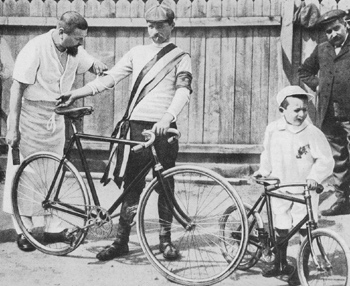
Even your grandpa’s hand-me-down bike likely has 10x more technology and comfort than that. As the bikes get better, I guess the riders get wimpier  Some carbon fiber, wind tunnels, and steroids later, it doesn’t even feel like the same sport anymore…
Back in those long ago tri days I was … bemused … by the men (always men) who had no more of a chance to be in the front of the pack than I had (faster and fitter than I though they mostly were) who were spending more on their bikes than I had on my car, trying to shave off a few ounces or be wee bit more aerodynamic.
I test-rode some bikes with suspensions, and they all felt like I was riding on marshmallow roads. Rigid forks for me, thanks. And what’s wrong with a “budget commuter bike”? That’s a pretty apt description for what I want in a bicycle.
Nothing at all!
I was just addressing this part of the OP (sorry for not being clear):
Like, it’s hard to find a “premium hybrid” if someone WANTS a cushy but luxurious ride. There’s a subset of the gravel market that might fit that criteria. But otherwise, I think the “grandpa” bike market has largely shifted to E-bikes.
And I don’t mean that as any sort of put-down. My current bike (a Specialized Diverge STR, which they don’t make anymore) is very much a luxury gravel grandpa bike. It’s got fancy everything, including over-engineered quasi-shocks that are going to be incredibly hard to find parts for in the future, I’m sure… (sigh).
Budget hybrids are awesome and still more than enough bike than most people ever need. But I think the OP specifically asked for a fancy road-centric bike for 30+ mile rides.
Apparently there are at least a few options for higher-end hybrids now, marketed as flat-bar “all-road” or “fitness” bikes, e.g.
It’s also possible to DIY build a bike, either on your own, at a bike kitchen, by spec online from specialized builders, or talking to your LBS — they’d probably be excited to do a fun custom project. Expect to pay more though. The ready-built bikes generally are better values, so unless you’re looking from something unusual, that’s probably the way to go for your first “real” ride.
Whatever you buy, avoid the mass marketed “75 miler” bikes. Those are bikes that are so poorly made that they only get ridden 75 miles before being dumped or consigned to a garage corner to gather dust. At least get a bike you’ll enjoy riding for years and miles to come.
Can someone educate me about “gravel bikes”?
Is it a relatively recent marketing thing?
Back when I was last in the market looking at bikes there were mostly road bikes, mountain bikes, and a fuzzy hybrid group that seemed like a good compromise for riding on city streets with frequent potholes. Vague memory of “city bikes” that were sitting upright things? Oh folders too.
What now gets called gravel bikes seem like a best option bike for riding through potholes and out on bike paths of various qualities. But really mostly that they have wider tires without being those silly big fat tire things that seemed popular for a bit . And what is the deal with those?
Gravel is mostly a marketing term. Similar to the previous hybrid – maybe a bit more sporty.
(and I’m talking from the city that hosted (and will host) USA Cycling Gravel National Championships)
The really fat (3+") tire bikes are good for snow
Brian
Gravel bikes tend to look the most like road bikes (usually drop bar, but sometime straight bar), with a cluster of gears in the back and two or three rings in the front, although many gravel bikes are 1x. They have wider clearance in the fork and stays, the better to accommodate wider tires, and their geometry tends to more slack than road bikes, which means they are slightly longer with angles that make for a more comfortable ride. They also have more ground clearance - higher bottom bracket - than an equivalent road bike. Gravel bikes also tend to allow a more upright riding posture.
Gravel is the latest the bike industry effort at creating a need, then filling it. There’s not a lot you can do with a gravel bike that you couldn’t with basic mountain bikes. Then again, the earliest mountain bikes were ubiquitously universal 10-speed frames mounted with the fattest/knobbiest tires available and a flat bar.
Well there’s lots of overlap of what we can do, but it always seemed to me that most “mountain bikes” were not the best fit if most of your riding was city/suburban roads and paths paved and ground gravel.
But frankly my road bike isn’t perfect for that either. I’ve skidded out more than once taking a turn just a wee faster than I should have on gravel or wet pavement that I think wider tires would have managed.
If I was buying a new bike not sure what would be best. Of course good fit!!
If most of your riding was city/suburban roads and paths paved and ground gravel in the pre-gravel bike times, I would have recommended putting street-friendlier tires on a rigid mountain bike. That’s what I did for my parents when the knobbies on their mountain bikes (1st gen Stumpjumpers, ca. 1985-ish) rotted away.