In the (US) military, is it forbidden, or considered dishonorable, to relieve a dead enemy's corpse of his valuables?

Coincidentally, I was reading about the Hesse diamond theft this week.

A group of American Army officers were stationed on garrison duty in a German castle immediately after WWII. Some of them found a cache of diamonds and other valuables that had been hidden in the castle. They took them and transported them back to America.

When they got caught, their main defense was that everyone in Germany had been looting stuff and they just happened to get a particularly lucky haul. They were found guilty despite this. (But it’s worth noting, the American government waited several years before returning the diamonds and the castle to their legal owners.)

Battle of Kadesh, ca 1274 BCE. Ramesses II led an Egyptian army north to attack the Hittites, who, led by their king Muwatallis II, were on their way south. Ramesses had been suckered into believing that the Hittites were over a hundred miles away, when they were much closer. Muwatallis attacked, and the Egyptians were forced back, away from their camp. The Hittites, believing that the Egyptians had fled, paused to loot the Egyptian camp – and were caught by the ensuing counterattack. Oops…

LULZ - Sauer und Sohn 38H [first gen] and a 1917 Imperial Issue Luger - I have the paperwork he filled out to bring it back on the Queen Mary. Also have an SS helmet, a de-explosived potato masher grenade [I guess would be better to say grenade body?] um, a mortar round [also no explosives] and I have his WW2 issue footlocker and an enlisted class A uniform [he ended up going officer so he also had officers togs too but the class As died in the house fire], and wore his M43 field jacket for decades … And he bought out his issue M1 carbine … sitting in the corner of the bedroom in the gun safe.

Geeze, the worst thing my dad’s unit did was drink out the wine cellar … and empty the pantry and barns off stored food =)

My dad had a german nanny and spoke enough german - they used to send him out with trade goods and a trailer to trade for fresh stuff [one time he came back with the trailer loaded with weapons and followed by surrendered germans like ducklings and their mommy =)]

Compared to what has been the norm for most of the history of war, it’s pretty restrictive, being specifically limited in the Iraq conflict to: “(1) helmets and head coverings; (2) uniforms and uniform items such as insignia and patches; (3) canteens, compasses, rucksacks, pouches, and load-bearing equipment; (4) flags…; (5) knives or bayonets, other than those defined as weaponry…; (6) military training manuals, books, and pamphlets; (7) posters, placards, and photographs; (8) currency of the former regime; or (9) other similar items that clearly pose no safety or health risk, and are not otherwise prohibited by law or regulation.”

This also precludes valuables, like the diamonds that were illegally looted in WWII (per the earlier post).

Weaponry (including firearms) are specifically prohibited, as are “personal items belonging to enemy combatants or civilians including, but not limited to: letters, family pictures, identification cards, and ‘dog tags.’”

But those weren’t military issue. Anything the enemy issues is fair game.

And of course extra ammo and even med stuff from your own downed buddies.

There was an episode of Sharpe’s Rifles I never understood. An officer “liberated” a Napoleonic Eagle and Wellington absolutely lost his shit over it. Like that was the worst thing an officer could possible do in a battle.

I don’t remember that episode. Was it because the officer took it from the French, or because he took it for himself instead of letting the unit as a whole have it?

From the French. IIRC Wellington specifically banned the capturing of Eagles but a reason was never given.

In the book “Band of Brothers” when Easy company was proceeding at a fast pace through Germany, they essentially looted every civilian house they billeted in. They’d arrive at a village or town, take over the best houses, and take everything that wasn’t nailed down. With direct quotes from the soldiers who Ambrose interviewed, so he didn’t make anything up. There’s even a description where one of the officers (Spiers?) chewed out a replacement for giving the residents too much time to grab their valuables before evicting them.

So that wasn’t even enemy soldiers, they were looting enemy civilians.

Disregarding the actual legality of it, looting the dead was not only common in WWII, at least in the Pacific so was making trophies of the enemy’s body parts. It was so accepted that this ran in Time magazine:

Young Woman With ‘Jap Skull’: Portrait of a Grisly WWII Memento | TIME

Wiki article on the subject: American mutilation of Japanese war dead

I’m assuming if it was a sword, it was Japanese, not German. I’d also take the story with a grain of salt. Not that the other kid’s grandfather had the sword, but that he obtained it after having personally shot the German or Japanese officer. I have a German helmet, a Nazi flag, and a German canteen along with some of his personal kit that my Great-uncle brought back from Europe. I highly doubt he personally shot their previous owners.

Lots of militaries include a sword in formal uniform for officers. That might or might not be the uniform any given officer is wearing during a fight.

Interesting you should mention the looted skull. Here’s an interesting story on the topic:

Springfield, Illinois, c. 2002. A human skull is found in Lake Springfield, and the local police become very interested, as they should. No local homicides match the victim’s skull, and so the cops ask the public for help. Long story short, local teenager fesses up: some kinsman of his had brought it back from Japan (it was the skull of a Japanese soldier) and the kid had wound up with it. However, after far too many nights of having the thing stare at him while he tried to sleep, he got scared and threw it in the lake. Oops.

My dad had two of those swords. He also had a bugle, a set of binoculars, and a rifle. He said he was issued them by the army after the surrender. I’ve still got the binoculars and big sword and my sister has the saber. Dad gave the rifle to my cousin. It got stolen when their house was robbed. The bugle just got thrown out since it was badly worn out.

How do you wear out a bugle?

You don’t want to know.

A section of the tubing was corroded through. It was also badly bent when two kids yanked on it (Give it here! No! Yank…).

If you watch “The Pacific” on HBO Max or read the books it’s based on, you’ll find out far more than you want to know about how US Marines treated dead (or wounded) Japanese soldiers.

No, the Nazis also had swords. Ceremonial.

Read the initial quote:

No German officer in WW2 was wearing his ceremonial sword anywhere near the frontlines, any more than he was wearing his ceremonial dress uniform on the frontline. Frontline officers weren’t even the ones given ceremonial swords in Germany in WW2. Japan, on the other hand, not only mass-produced ceremonial swords, but they were also worn in the field, not just in formal dress uniforms, and not only by officers but also by NCOs. Guntō - Wikipedia - Military usage.

They were also used in the field as well. The history of the Pacific War is littered with accounts of Japanese officers and NCOs brandishing said swords leading so called “banzai charges” - gyokusai attacks, lit. “shattered jewel”, figuratively suicide charges aimed at achieving honorable death instead of being captured alive.

They were also used for less honorable activities. During the Rape of Nanking, there was a contest reported in Japanese newspapers of two lieutenants having a contest to be the first to behead 100 Chinese ‘enemies’, i.e. defenseless prisoners.

Japanese Media Followed the Report on the “Competition of Killing 100 People” 82 Years Ago | The Memorial Hall of the Victims in Nanjing Massacre by Japanese Invaders

On December 13, 1937, Tokyo Nichi Nichi Shimbun (lit. Tokyo Daily News) published an article with the headline reads, ‘Incredible Record’ - Mukai 106 – 105 Noda—Both 2nd Lieutenants Go Into Extra Innings", and attached a photo taken for them by Shinju Sato near Changzhou city.

In fact, this is the newspaper that tracked the series report on the Beheading Competition for the fourth time. Since November 27, 1937, the two lieutenants started the competition in Wuxi after its capture by the Japanese Invaders, and the newspaper’s three correspondents (Asami, Mitsumoto, and Yasuda) interviewed them in front of Changzhou Railway Station.

The first report on Tokyo Nichi Nichi Shimbun on November 30, 1937 was titled Competition for beheading 100 enemies! Two lieutenants already got 80 people. “Two young lieutenants of Katagiri Unit started the Competition of Killing 100 People. We heard that since Wuxi, soon one has killed 56, and the other 25.” One lieutenant was Toshiaki MUKAI, 26, of Toyama Unit; the other was Tsuyoshi NODA, 25, of the same unit.

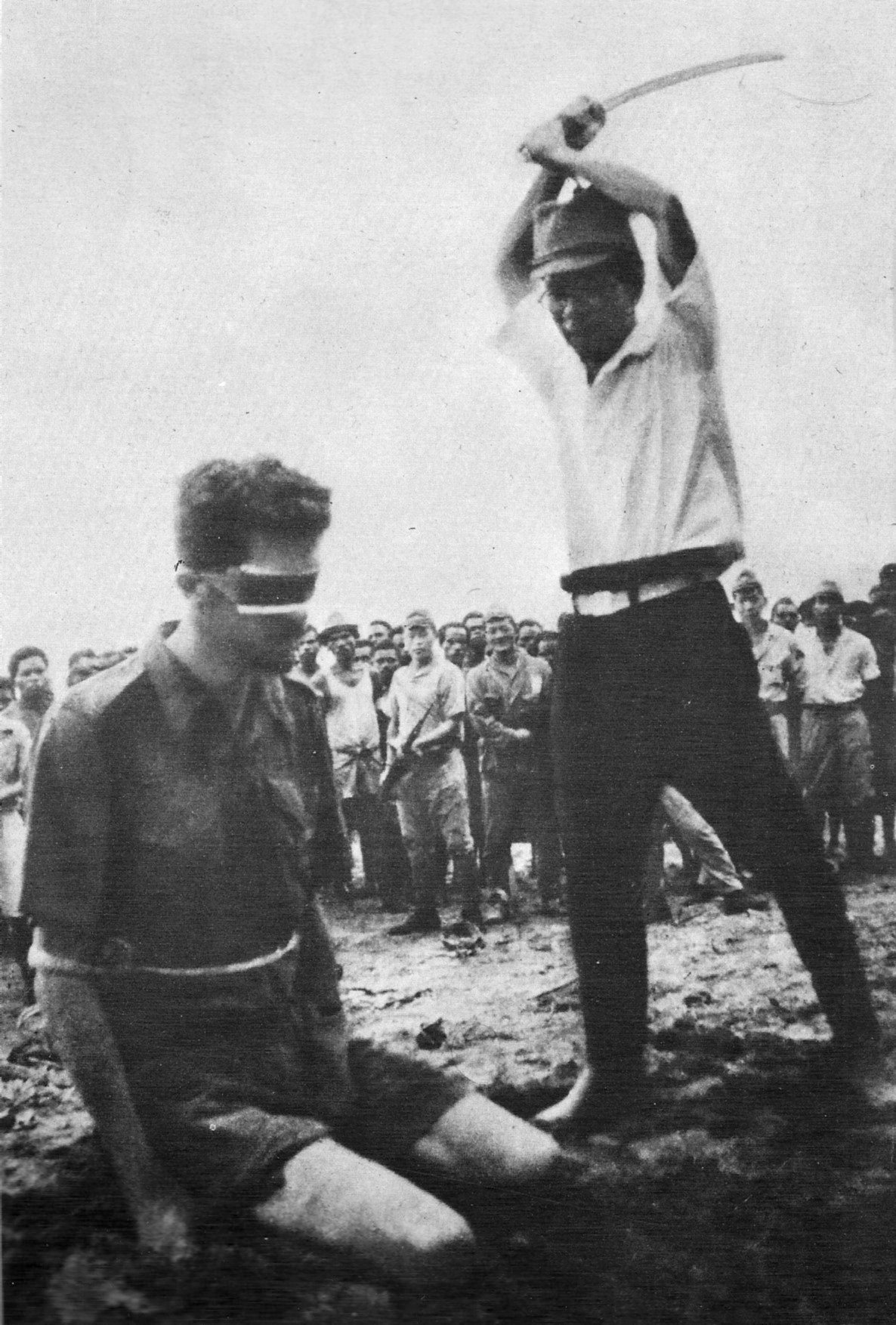
It was also commonly used as a means of executing captured Allied airmen
ETA: the prized German trophy item was actually the SS ceremonial dagger, which was worn by officers in field uniforms: SS-Ehrendolch - Wikipedia

As of 15 February 1943, all officers of the Waffen-SS were entitled to wear this dagger also with the field-grey dress uniforms. For these occasions, the dagger was fitted with a tassel and sword knot made of aluminium lace, similar to one used by Wehrmacht officers.