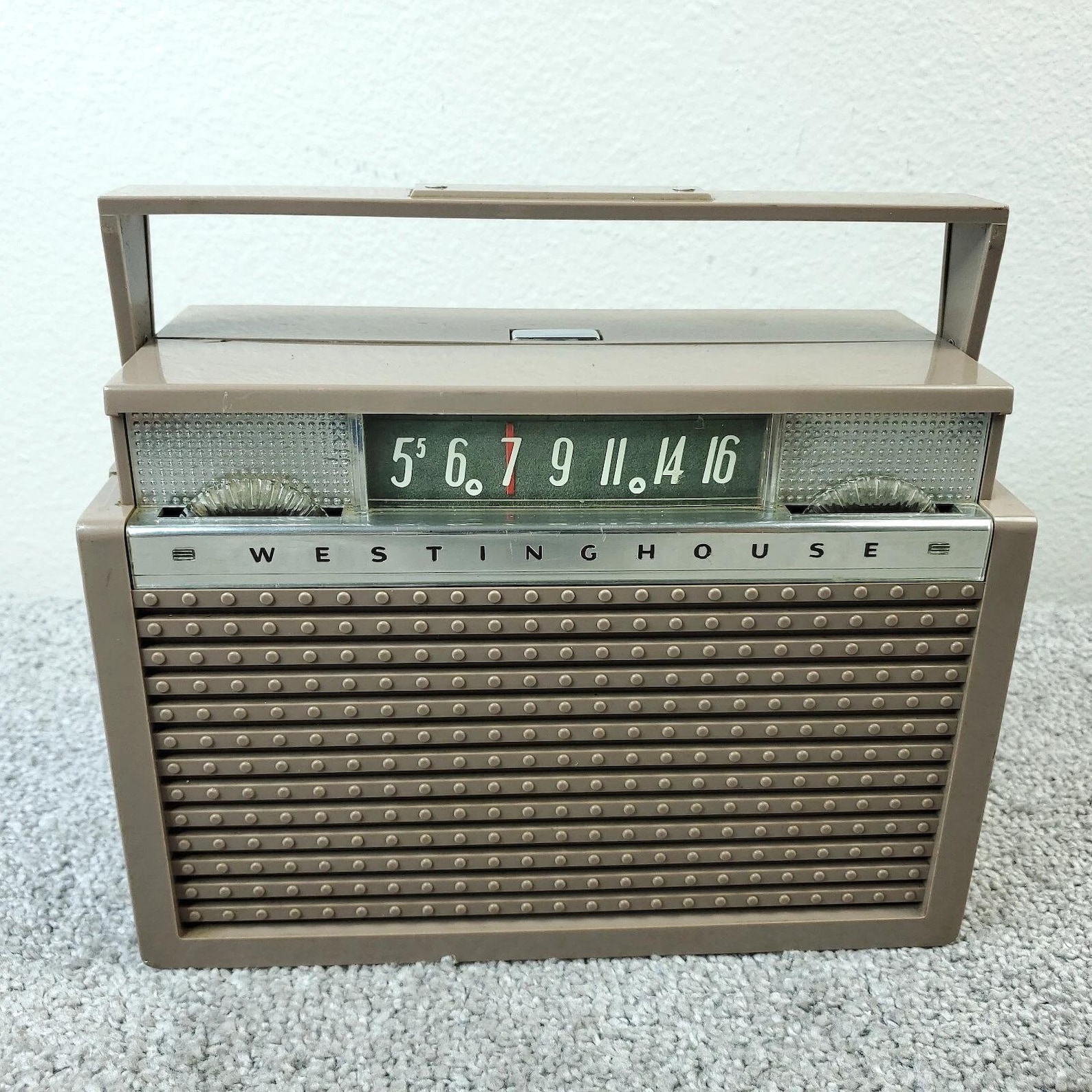
Though I’m of an age that I can remember using radios such as this, and I remember the smaller numbers, I don’t know what they’re for.

The AM dial range was 530- 1605 kHz. So they just want you to know not all of the 500 block and a bit more than the 1600 is covered.
ETA: I’m not seeing a small number next to 11. Oops! You’re talking about the little circles (zeros?). No idea. Sorry.
I remember them on car radios. It seems to me that they were little triangles (think civil defense logos) and were places to dial to during a major civil disturbance. Look up “Conelrad.”
In the OP’s picture, they’re also triangles, not numbers. Here’s a much better picture.
And this page also says it’s a civil defense thing.
Between 1953 and 1963, all new radios sold were required by law to carry a triangle-in-circle at 640 and 1240 AM on the dial. The triangles were referred to as CD marks, for Civil Defense.
They might be a quick way to locate CONELRAD stations, at 640 and 1240 kHz.
Ninja’d! Elmer’s post was the only response showing when I started looking fo info.
Yep, that’s it. Like I said above, look up Conelrad. Wikipedia has a good description of what it’s all about.
As a kid, I had radios with those symbols. I’d always assumed it was a Civil Defense thing, but never knew all the details. I’ve learned something today!
I remember them in the old car AM radios. However, I didn’t know what they were then, (just learned today, in fact) so I wonder why the powers that be didn’t educate the public in case of a real need. Maybe I was just too young?
Oh, there was plenty of public education. Every time a radio or TV station did “a test of the Emergency Broadcasting System” they would tell you that if it were an actual emergency you would be “instructed” to turn to 640 or 1240 on your radio.
There were also uninspiring PSA announcements like these.

If you weren’t at least a teen by 1963 you’d not have encountered much of the public service education effort. Your parents probably knew about what they represented.
That was also the heyday of all things Civil Defense in the USA. Conelrad was just one art of the much larger Civil defense in the United States - Wikipedia effort. The triangle logo would be immediately recognizable to any teen or older as part of the overall Civil Defense effort. Lots of ordinary buildings had the CD triangle shelter signs flanking the entrances.
That’s how I knew what those triangles on the radio dials were, even if I’m a bit younger than that initial communications program. The televised Civil Defense tests (the alert sounds really scared me as a kid) always showed the logo on the screen, and signs with the logo were still common on buildings with shelters when I was a child in the early '70s.
Now that the OP’s been answered, I’d like to chime in to say that many of those old radios are quite collectable nowadays, and can command a high price. Especially the ones made from Bakelite.
It’s also interesting to note that, unlike old radios, most old TVs are worthless.
Looking at that old radio in the OP’s photo reminded me of a Thurber story in which he reveals his ignorance to an auto mechanic, when he brings his car in for a check on an apparent engine problem.
He anxiously points to what he thinks is a dashboard gauge and asks the mechanic if it’s a dangerously high reading.
“That’s your radio, Mac. You got it set to WQXR.”*
*which was at 1540 on the AM dial.
Yeah, because the radios work. The TVs don’t any more, at least by modern standards.
Well, they’d work, once the tubes heated up. We had one of those old bakelite AM-only tube radios at our place up north, and just like those old tube TVs, it took time to warm up. Weird-sounding, I suppose, now that we have instant-on radios and TVs, but it was the way things were. (We also had a rabbit-eared TV, but it only got one channel. “Home entertainment” at our place up north meant mostly board games and card games to the radio.)
I remember when my parents won a transistor radio in a raffle. That replaced the old bakelite radio up north. Now, we got instant-on! But being up north, it was the same old crud: farm reports and elevator music.
Old radios have nostalgic value, TVs don’t. Down in a room in the basement I have a 32" Sony Trinitron sitting atop a matching Sony TV stand. It works perfectly fine. It weighs as much as a battleship and I’d gladly pay someone to haul it away.
In that same room I have a 1940s era console radio with a built-in record player (78 RPM only, of course!). It’s a cherished memento that’s probably worth something to a collector but I wouldn’t sell it for anything. I remember as a small child listening to the Jack Benny program on it. Its only “defect” is that it has some scratches on the bottom panel made by the front paws of my first puppy. Talk about nostalgia!
If you look at the back of the radio with all the tubes, there’s also a warning sticker that you must have a license to operate it. This may seem strange to USAians but in that era, in Canada but not in the US, you needed to pay an annual license fee to have a radio. It had nothing to do with wartime security – it was a way of helping to fund the CBC (Canadian Broadcasting Corporation). The fee was finally abolished in 1953.
Those kind of things matter. Oh, not for the collectible value, but for the story of the piece. Your radio has puppy scratches; those undoubtedly remind you of many happy memories of that puppy, I’m sure. My wonderful old upright piano, built circa 1925-1927, has cat scratches on it, from when my cats tried to jump up and didn’t quite make it. The cats are gone, but the piano remains. So do the scratches, which remind me of the many happy times I could get a kitten to run back and forth on the keyboard. And when I played that piano, with a tired kitten, exhausted from running up and down the keyboard, on my lap.
That piano of mine is likely worth nothing to anybody else. But to me, it is priceless. It contains so many happy memories. If your radio contains the same for you, then keep it.
I’m not sure which point you’re trying to make. I’m not disagreeing, just not following you.
Some thoughts of my own:
-
Old pre-digital TVs certain can work if in good condition. There’s just no signals to tune them to. It’s station-off-the-air static on every channel. An AM or FM radio taken to an area with no signals is equally useless. For analog TV, that’s everywhere on Earth. For AM radio, that’s very few places other than wilderness. So far.
In the early days of both AM & FM broadcasting there were a couple of competing standards before the governments and industries settled on the frequency bands and other technical details we’re used to. There are now-ancient 1910s and 1930s radios respectively built to now-obsolete standards that can also work fine but have no signals to receive. -
Tube era TVs (say pre-1970) are 10-15x as complex as tube-era radios. Making one work despite the deterioration of the decades is a much taller order. Damned few of either will still work using all their factory original parts.
-
Discrete transistor era TVs (say 1980s) are much more reliable than their tube-era predecessors, but so are radios of the same tech. They’re still 10-15x as complex, and hence 10-15x harder to keep operating once age-related failures start.
-
The quality of sound & picture on a pre-digital TV is awful compared to a modern digital TV. It’s stuck in the past. The sound quality of an old (or new) AM or FM radio is awful compared to modern digital radios receiving modern digital signals. E.g. Sirius or streaming. In that sense both TV & radio are equally primitive and unsatisfying to watch/listen. But …
Somehow we’ve emotionally attached ourselves to AM radio as a distinct sound that’s nostalgic despite sucking by any objective standard. At least for those of us of a certain age; I doubt current kids get much excitement from AM radio’s sound.
OTOH, AFAIK very few people are nostalgic for the look of old TV. It’s bad enough watching e.g. a Youtube of an original analog video recording shown as broadcast. But watching something screen-captured with the funky colors, ghosting, and all the rest we all put up as just how TV reception works is a whole 'nuther layer of awful. Hard to get nostalgic about that.
And this explains these mysterious words from Bob Dylan’s “Talkin’ World War III Blues”
Well, I seen a Cadillac window uptown
And there was nobody aroun’
I got into the driver’s seat
And I drove down 42nd Street
In my Cadillac.
Good car to drive after a war
Well, I remember seein’ some ad
So I turned on my Conelrad
But I didn’t pay my Con Ed bill
So the radio didn’t work so well
Turned on my record player—
It was Rock-a-day Johnny singin’, “Tell Your Ma, Tell Your Pa, Our Love’s A-gonna Grow Ooh-wah, Ooh-wah”
Ignorance fought (in this corner of the UK, at least) after 63 years!
AIUI, they still can show a signal if you attach a digital converter to them. Back when US stations switched over to digital, the Federal government had a program which supplied free converters to people who had older TVs. That program has long since ended, but you can still buy a converter at retail.
But, even then, you’d be getting a far substandard picture to what you’d be used to on a modern TV. It’ll probably cut off the sides of the picture (as networks switched away from the old 4:3 ratio to 16:9), and those old tubes aren’t HD.