Recently I’ve been seeing a lot of comments on reddit that seem to take it as given that the universe is infinite. (Obviously the whole universe, not just the observable universe.) I have been pushing back on this, characterizing that as an interpretation. To my mind it’s like taking the many worlds interpretation as a given; I would push back with the equally valid Copenhagen interpretation.
In one of these debates, someone has replied to me with this:
Yes, the model most commonly used by modern cosmology is and always has been infinitely large.
This assertion caught me off guard, as I’ve never heard that the universe is infinite until quite recently. Not that I ever took any high level physics classes; my only exposure was reading quite a few “physics for laymen” books back in the 80s and 90s. But I don’t recall any of them saying that the big bang was super dense and infinitely large. Quite the opposite, actually. Most or all of them said the big bang was super dense and very small.
So I ask the teeming thousand: Ever since we came up with the big bang theory, was the universe always assumed to be infinite?
People far smarter than me would know better, but it was my understanding that string theory predicts about 10^500 universes.
Cosmic space is big – perhaps infinitely so. Travel far enough and some theories suggest you’d meet your cosmic twin – a copy of you living in a copy of our world, but in a different part of the multiverse. String theory, which is a notoriously theoretical explanation of reality, predicts a frankly meaninglessly large number of universes, maybe 10 to the 500 or more, all with slightly different physical parameters.
10^500 is a big number, but its still finite. Far smaller than 10^5000000
Right there with you, but to my mind, our universe being infinitely large or not is unrelated to how many other universes there may be. (Plus, my understanding of multiple universes is that nothing can ever interact with anything outside its own universe.)
EDIT: Also, the “perhaps” in “perhaps infinitely so” seems to indicate that our universe being infinitely large is not a given.
I certainly do not know if the universe is infinite but, if you want to mess with their heads, point out the obvious implications of an infinite universe. #1…there are infinite many versions of them in the universe. Has to be. Which then kinda lends a sort of immortality.
The quick and dirty version is there are finite combinations of matter to be had (we have finite elements and finite ways to arrange them). So, in an infinite universe you simply must start repeating a given combination (e.g. you, or earth or the earth solar system and so on) and do it infinite times.
There’d be a whole universe identical to ours except one blade of grass was missing from one. (can get more granular than that…infinity is weird and big)
ETA: Watch Rick & Morty episodes. They like playing with the weird implications of this stuff.
Discussion of multiple universes just muddies the water on the particular question of the size of this universe. To my simple non-cosmologist mind, shortly after the Big Bang the universe was very small and very hot and definitely finite in extent. Therefore ISTM that it follows that the universe today is also finite in extent. But because beyond the observable universe space is expanding faster than light, we can travel forever and never reach an outer boundary, so in that sense the universe can be thought of as infinite. It’s perhaps more accurate to say that the universe in its totality contains a finite amount of mass-energy.
Not so much small, as compact. According to modern “inflation” theories the area of space we call the observable universe was small at the Big Bang and massively expanded afterwards, but there might be an infinite amount of space outside of that that we can never see.
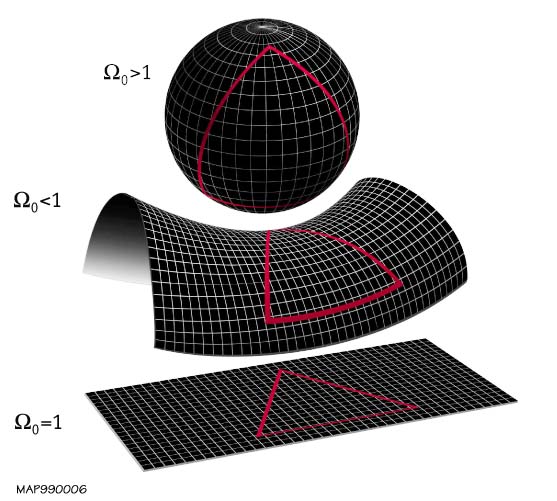
At any rate it comes down to the shape of the universe. Older theories leaned towards the universe being “positively curved”, and therefore finite and destined to eventually collapse in a Big Crunch.
These days the more popular theories hold that the universe is negatively curved or at most flat, meaning it’s infinite and will expand forever.
Why do either negatively curved or flat necessarily mean infinite?
I do think it will continue expanding forever, but will stay finite. To my mind, it would become infinite only after an infinite amount of time passes, meaning never.
I’m under the impression it’s because if it’s finite and flat or negatively curved, the universe would have to have an “edge” of some sort, and nobody has any idea how that would even work.
My take is that space is expanding at the edges faster than c, effectively making “whatever lies beyond” (ie: void; nothingness; not even space itself) utterly unreachable by any means and thus wholly irrelevant, even theoretically. Seems perfectly reasonable to me. ¯\_(ツ)_/¯
Also, of note, is that those laymen’s physics books I read back in the day (A Brief History of Time, The Tao of Physics, et al) all seemed to talk about a very small beginning of the big bang, possibly even a singularity. The entire (not just observable) universe in a tiny point. Was that not ever actually considered viable? Because a teeny tiny singularity would have edges. (Which, again, would be rushing outward in all directions faster than c. That outward expansion of space being faster than c seems like a coherent and functional “edge.” Frankly, I find the idea of an infinite universe to be incoherent.)
The initial state of the universe being a singularity (which is generally thought to be a defect in our description, not physical reality) doesn’t entail it being ‘infinitely small’, it can be infinitely extended but at the same time infinitely dense. As for whether a finite universe was ever a contender, certainly, the early models used by Einstein where finite, and also later, models with positive overall curvature were discussed. If the overall curvature is zero or negative, however, as @Der_Trihs points out, the simplest models are those with an infinite underlying manifold, although topology can also play a role—the 3-torus is flat, but still bounded (in the sense that there is only a finite distance between any two points on it), and doesn’t have a boundary (it’s a closed manifold).
Why Flat Often Implies Infinite Simple Topology Assumption: If you assume a flat universe has a simple, “simply connected” topology (like a sheet of paper), then it must be infinite.
I don’t understand: Why must a flat “sheet of paper” universe be infinite?
The cosmological principle is usually stated formally as ‘Viewed on a sufficiently large scale, the properties of the universe are the same for all observers.’ This amounts to the strongly philosophical statement that the part of the universe which we can see is a fair sample, and that the same physical laws apply throughout. In essence, this in a sense says that the universe is knowable and is playing fair with scientists.
If a flat universe isn’t infinite, then it has an edge and therefore has a “privileged” point of observation.
Not if the “edge” is spacetime expanding outward faster than c. People “near” the edge would experience all the same laws and rules. The only difference is that the direction toward the edge would have fewer stars. That doesn’t seem unreasonable to me, much less impossible.
That is exactly the sort of thing that violates the Cosmological Principle, as it postulates a region of the universe that is behaving wildly different than the rest of it.
It would also probably produce a continuous Big Bang as it expanded, as I understand it; that sounds like Eternal Inflation.
First, I just want to say thank you for patiently answering my questions, especially going to the trouble of providing links. (Sadly, this has just ended up raising more questions for me. But I do recognize that you are providing legitimate answers for my questions.)
How would that be any different than the observable universe? Google says the observable universe is 93 billion light years across while the universe itself is only 13.8 billion years old. In other words, the observable universe is expanding faster than c. It seems to me that the edge of the entire universe expanding faster than c would be perfectly consistent with the observable universe, and by extension, everywhere in the universe.
The difference is, it’s all expanding, there’s no edge or center. Nobody can look around and say “that direction over there is expanding faster than c”.
And again; a theory that included an edge to the universe would also have to come up with some explanation of what an “edge to the universe” would even be like. How would such a thing even work?
Right, exactly. So the space-time beyond the “furthest” (closest to the edge) matter and energy is expanding faster than c, just like everywhere is.
Spacetime expansion faster than c fully insulating the entire universe (ie: all matter and energy) from the edge of space-time by many (millions or billions of) light years, forever unreachable and unobservable. Like a black box that can never be opened. Effectively as removed from our universe as a different universe in a multiverse.
As a thought experiment, imagine planet star z, defined as the closest matter/energy in the entire universe to any bit of the universe’s edge. (Or a dust cloud orbiting it or whatever.) Advanced beings set out from star z heading toward the edge. They can never reach it, or even make any progress at all. It always falls away from them faster than they can move toward it. All laws of physics still apply normally on this journey in all directions. They just can simply never catch up or ever even glimpse the edge. And it’s not a limit of technology; it is a fundamental property of the universe that they can never even reach c, much less exceed it to match the expansion of space-time in order to make headway.
I suppose a technical definition of what the edge is or what lays beyond it (“beyond the edge” isn’t even a coherent concept) would be similarly undefined as the interior of a black hole. Surely the interior of a black hole violates that same cosmological principle, right?