Through the 20th century with both the great expansion of the total number of living humans and far greater opportunities for populations to mix, it would have looked like genetic diversity had never been wider. But in the last quarter century not only have reproductive rates fallen but we’re now seeing a significant number of people who will apparently never have any children. It may of course be too early to tell but e.g. a 25% reproductive failure rate would in any other context be considered an enormous selective pressure.
My understanding is that almost all population growth in the world in the 21st century is expected to occur in sub saharan Africa. So right now sub saharan africa makes up about 16% of the worlds population, but it’ll make up 35% in the year 2100 due to higher fertility rates.
So that’ll affect genetic diversity too of the entire human race, as a small group of the population makes up a larger percentage of the world’s population. However, there is more genetic diversity within africa, than between africa and the rest of the world. Homo sapiens have been in Africa for 300,000 years, but homo sapiens only left africa about 70,000 years ago. So there has been far more time for genetic diversity to grow within Africa, than between China vs Europe for example (whose populations only split off around 40,000 years ago).
I don’t know exactly what that means though. But the part of the world with the most genetic diversity will see the most population growth this century.
Human’s are already suffering from low genetic diversity (compared to other species) due to population bottlenecks tens of thousands of years ago.
25% of people not reproducing would mean 6 billion people who are reproducing. I think genetic diversity will survive.
As long as technological civilization continues, the vastly greater mobility of humans means that the sorts of percentages that would doom a small isolated population of animal species X will have negligible impact on humans when so many of us are breeding with people from far, far away.
Now couple some heavy racist political push for “pure” blood and a major collapse of planet-wide travel and also add in 25% non-reproducers and now we may have a problem.
So don’t do that.
It’s not just the total numbers, it’s how many Y-chromosome and mitochondrial lineages never get passed on.
Is this akin to Mitochondrial Eve and Y-Chromosome Adam? Common ancestors to every human on the planet?
I read somewhere (and never have been able to find it again) that this sort of thing can happen again. Go far enough in the future and the population will have a common ancestor from this time (give or take a few thousand years). Put another way, all lineages will fail except one matrilineal lineage and patrilineal lineage (which is not to say those two will know each other…they almost certainly will not and probably will not even be close in time to each other).
So, if you have kids, waaay down the road you will either be the mother/father of everyone or the mother/father of none.
Not compared to other animals 75% of the population getting to reproduce would be pretty high, in most animals (even most mammals) I think. Even taking into account the fact that the main reason other animals don’t get to reproduce is they are not alive to do so (I assume that 25% number does not include people who passed away young?)
Good point.
Any egg-laying species, from insect to fish to bird, has very few offspring live to reproduce. If all WAG e.g. 5000 eggs in a single spider egg sac grew up to make more baby spiders, well, the planet would be a solid ball of spiders within a few years.
It’s only that on average, one mama spider produces just one new mama spider per lifetime that prevents that runaway. That’s a 99.999%+ reproductive failure rate. By “design”.
Yep, that’s the kicker. There is no bottleneck.
I suspect it’s not the “right kind” of genetic diversity that has the OP concerned…
Don’t put words in my mouth. The impetus for this thread was a couple of YouTube videos about the Neolithic Bottleneck, in which it is estimated that as little as 5% of the Y-chromosome lines survived. This combined with the concern by many that increasingly people in first world countries find it literally unaffordable to have children.
Warning issued for yet another time insulting posters. This is probably the end for your posting on the SDMB.
Right now, under current conditions, a lot of humans aren’t reproducing.
If the population of humans fell to, say, 10% of the current number, conditions would be extremely different, and under those conditions you’d probably get almost everyone reproducing again.
And even 10% of the current number would still leave us more populous than almost any other mammal.
Lack of biodiversity is not an issue for modern humans, at all.
xkcd weighs (heh  ) in …
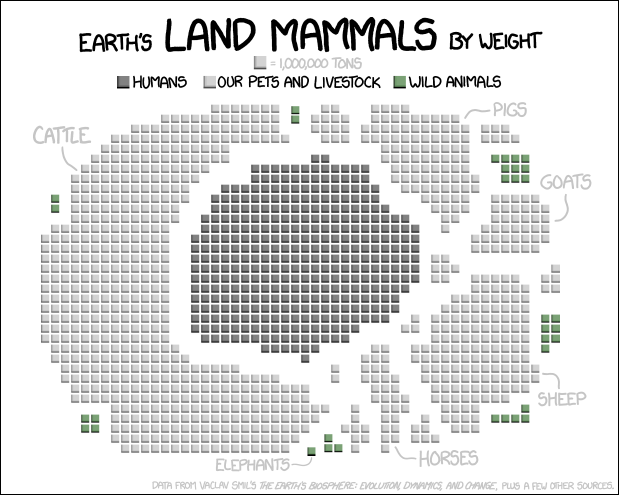
from xkcd: Land Mammals.
Humans individually aren’t very heavy within the ranks of land mammals between e.g. mice & e.g. elephants. But dayum do we have the numbers.
But this was going to happen anyway. Every living human can trace their ancestry back to exactly one male ancestral lineage and exactly one female ancestral lineage, because all lineages except one are eventually broken due to chance. So every Y-DNA and mtDNA lineage is going to die out except for one.
Well no, that assumes they’d all continue to have enough food to eat and room to live and weren’t eaten by predators, killed by diseases, etc. Maybe it would work for a couple generations, but they’d quickly exhaust the environment’s carrying capacity. Christian apologists try to use this same argument to prove that the Earth must be only 6,000 years old, because if it were older then even starting from just one couple (Adam and Eve) there’d be trillions or quadrillions of Humans by now. You can’t just do the exponential growth math and ignore real-world mitigating factors.
Of course you can’t. But all those sources of loss are the thing that collectively holds the species to just a rough replacement rate.
My larger point was that the OP’s assumption that low rates of individual reproduction are necessarily a sign of a species’ impending genetic failure. It’s not.
True, and there are three different factors at play. The first is the number of offspring being produced, the second is the number of offspring that survive to reproductive age, and three is the number that actually do reproduce, or at least how much they reproduce.
Historically humans had more offspring to make up for the fact that few survived to reproductive age, and the ones that did survive also had many offspring for the same reason. This led to steady but slow growth.
Come the invention of modern medicine and agriculture, survivability goes up dramatically, but there’s often a lag of several generations before birth rates drop, so population explodes. This is what led to the recent huge increase in population.
So we went from a world of:
[high birth rate] + [high mortality] = low population growth
to
[high birth rate] + [low mortality] = high population growth
to
[low birth rate] + [low mortality] = low population growth
I’d argue that the high population growth phase of the 19th-21st century is the aberration, and we’re actually heading back to a more normal population growth curve. That some cultures are reproducing at less than replacement rates is perhaps an economic concern, but genetically you could say it’s a response to an environmental-like pressure, but it probably isn’t really a factor.
Not what OP had in mind perhaps, but I’d argue we are going through a diversity bottleneck this century for most species simply due to climate change. And I’d further argue the magnitude of climate change as a forcing effect dwarfs any other potential effect on diversity we might care to consider.
Yes but playing devils advocate, climate change is going to lead to some genetic changes in biological life. Certain life forms will be able to survive and thrive in the new climate, and those new species will spread rapidly. This is already happening in the ocean where species that can handle the higher acidity levels are spreading.