Typically electric. As far as “meant to go on roads” – kinda?
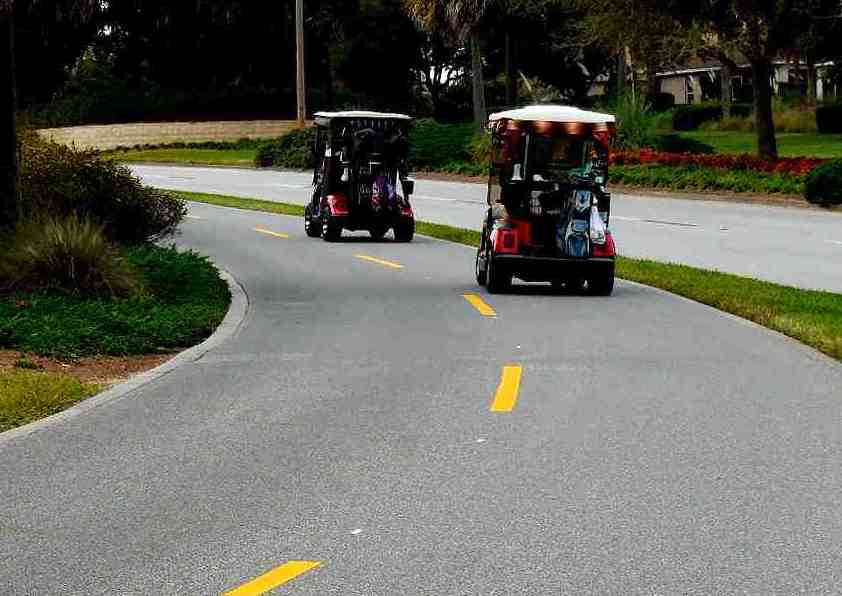
Their original purpose was, of course, for use on golf courses, which meant driving on cart paths and grass fairways. However, as noted in this thread, golf-cart-like vehicles have become common in retirement communities in places like Florida and Arizona, as mobility vehicles and small, low-speed replacements for cars. In that context, you see owners driving them around on dedicated cart paths, as well as on residential streets with low speed limits – the latter may or may not be technically legal, depending on local laws. A lot of those retirement communities – like The Villages in Florida, and Sun City – are built specifically around the premise that residents use golf carts as a primary mode of transportation.
However, generally speaking, golf carts aren’t crashworthy, and aren’t licensed as on-road vehicles (i.e., you don’t see them with actual license plates).
A lighter electric golf cart starts at around 500 lbs at the low end. The batteries themselves for the lightest carts weigh more than the entire weight of that vehicle in your OP.
I looked up the ELF vehicle, and found this article:
So as you say, it’s basically an electric tricycle with a shell over it. A quality e-bike is around $2,000 (you can get one for half that price but those are usually considered to be garbage that you should not waste your time and money on). An ELF Solo right now, if you were to buy one (because there are places that sell them), they cost more than 4 times that price, and what you gain over a standard e-bike is some minimal protection from the elements while losing the convenience of being able to store it the way you would a regular bike (parking in a bike rack, mounting on a car, and so on). It doesn’t seem like a great trade-off to me.
Here is an alternative item I found, the “Simple Glide” powered quad bike.
It weighs a little less than the ELF. It doesn’t look as fancy, like it was designed for a 1960s science fiction film. And it costs half the price of the ELF. Honestly, it looks a lot more practical if you want something that does basically the same thing, if you are looking for function over style.
“Scam” might be a strong word. But yeah, it sounds like the OP is evaluating the company based on whether they subjectively think this product is a good idea.
Another approach is to evaluate the company not giving a shit about what the product actually is.
The OP says the company previously sold 850 of these. At $7,500 a pop, that’s $6.3 in revenue.
I asked ChatGPT what a good revenue multiple for companies that make “bikes and human powered vehicles” and it said 0.5 to 1.5. So that’s probably where they came up with the $9 million valuation.
How much did it cost to make and sell those 850 (total and per unit)?
How many of these things can the company manufacture in a year? 1,000? 10,000? 851?
What is the plan to scale manufacturing?
What is the per unit cost of sales?
What is their marketing and sales strategy?
Basically, it doesn’t matter if they are making bikes or widgets if they don’t have the capacity or plan to eventually make more of them.
On thinking about those stats a bit more… They claim a top speed of 20 MPH without pedaling, 30 MPH with pedaling, and a power of 350-3000 watts, depending on model. The top speed is limited by power, and power is equal to speed times force. The resistive force on a bicycle is a mix of rolling resistance, which is proportional to speed, and air resistance, which is proportional to speed squared. That means that the amount of power needed is proportional to somewhere between the 2nd and 3rd power of speed. Which means that, best case, for that 30 MPH speed, they’re expecting the driver to provide more power than the motor. If the 350 watt motor is just barely able to make 20 MPH, then to get 30 MPH, the driver needs to supply 437.5 W, or about 0.6 horsepower. A human can do that, but it takes a pretty fit human, especially to sustain it for any significant amount of time. If, on the other hand, the 20 MPH motor-only top speed is for the 3000 W model, then you’d need to add over 5 horsepower by pedaling to reach 30. No human can do that.
Either they’re lying about their numbers, or the numbers are based on something other than the physical limitations.
Exactly. If they can’t find even a tenuous connection to AI then there’s no possible way for that valuation.
In the tech / dot-com bubble of the late 90s the companies I was working with were implying they had much greater potential than the market could bear.
One company has worldwide sales of $20 million and the other’s was $150million-ish. The problem was that as products for commercial institutions, there just wasn’t that much potential growth.
Both went public because it was a tech bubble and investors had bad cases of FOMO.
Unless Organic Transit goes public, how would a small investor get their money back? Who could they sell their shares to?
There are a lot of restrictions on selling non-publicly traded shares to “small investors”. For many reasons, but one of them is the lack of market for the small holder to get back out of their position.
Which is often why pre-public companies raise operating capital in small dribs and drabs in the form of deposits on production positions, “guaranteed” discounts on the purchase price, membership in “blah blah”, etc. Those things they can legally sell. But not ownership shares.
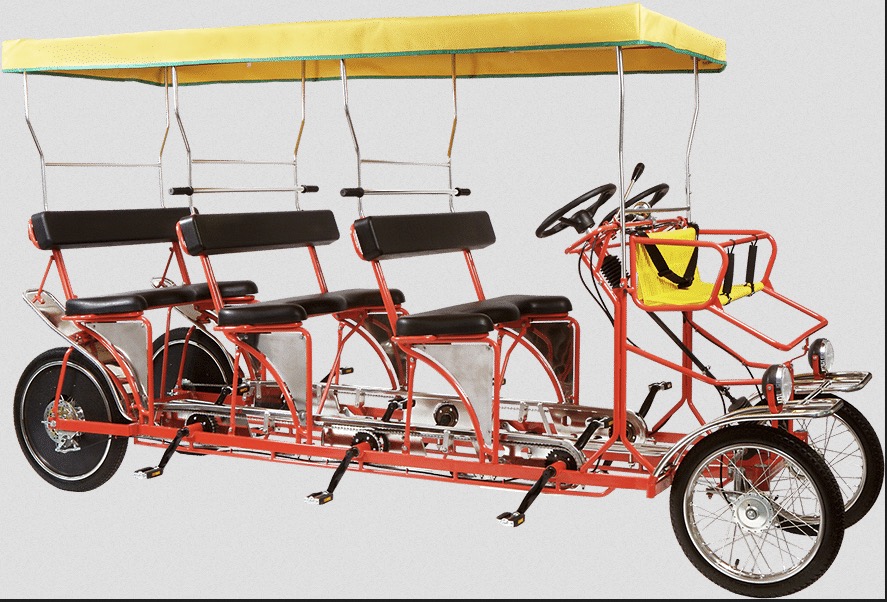
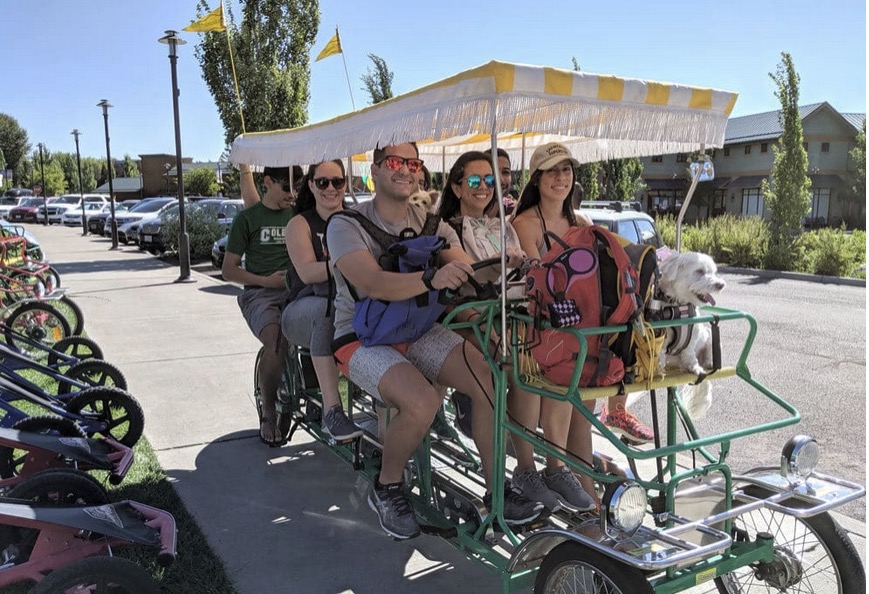
Really? I didn’t know those existed. It’s really interesting how different towns can cater to their local niches. Ours has a bunch of bike paths winding through town and into the woods and mountains, but no “golf cart” lanes per se. We do, however, have these heavy-ass 9-person bikes for unsuspecting tourists (non-electric, powered solely by pain and suffering):
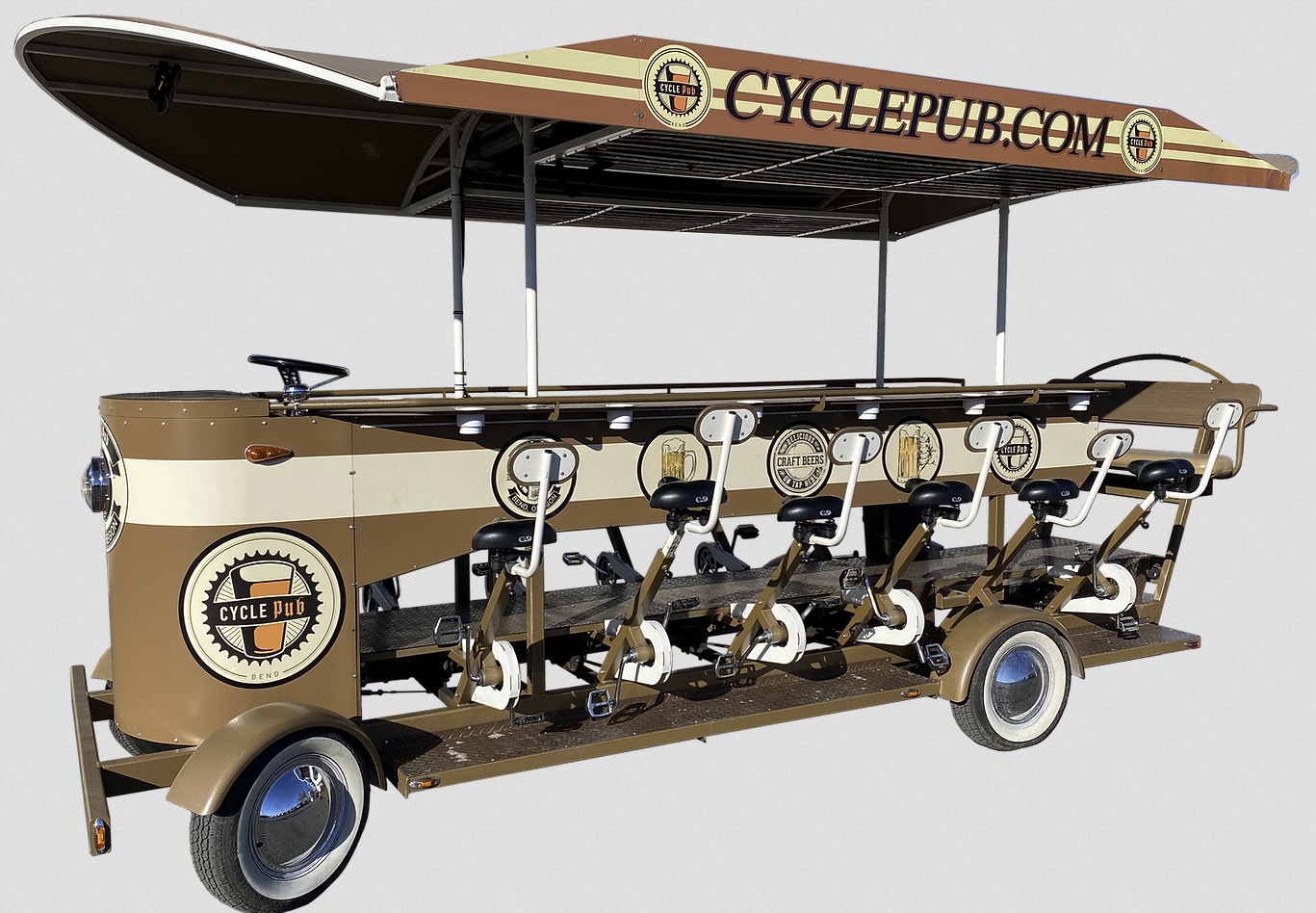
And a 12-seater that’s more (in?)tolerable because everyone’s drunk from the integrated bar:
That does look interesting (if hideous). To use a car analogy, if the ELF were going after the Beetle look, this thing is like grandma’s old Accord Model T. Too bad it also doesn’t have an enclosed canopy
I wonder if there’s anyone out there who makes a true pedal-assist winter-capable trike/quadricycle…
Yeah, good way to look at it! Their fundraising appeal page is written like a Kickstarter, telling you about the product but nothing about the business itself.
A class 3 e-bike that can legally go up to 28 mph (in some states) should use less than a kilowatt of power. 3 kW is insane for something of this weight. There are probably fat riders + regular ebikes that are already heavier than this thing + a skinny rider.
Is it possible (as in could it explain the math) if the physical max speed were actually much higher, but simply electronically limited to stay within ebike speed limits? Maybe the more powerful motors could drive faster acceleration but still won’t let you go above 30 MPH? I dunno, just guessing.
Selling shares isn’t the only way for a company to return profits to shareholders, is it? There are dividends, share buyback programs, etc.
I technically own some tiny portion of REI, for example, but that company is structured such that they don’t technically pay dividends. Some of my smaller local food co-ops did, though.
(And if this ELF business were similarly structured as a worker-owned or consumer co-op, I’d be far more inclined to “donate” this “investment”. As it stands, as a traditional business, all profits simply flow to the owners… if they ever even make any.)
Your 12-seater bar works better because 10 of the 12 are drunk frat boys in good shape with strong legs. And the other two chix are skinny little things.
OTOH, whenever I see the 9 or 6 passenger bike-carts around here in the tourist zones there’s an exhausted Mom & Dad struggling to pedal a brood in the rear seats, maybe one of whom is old / tall enough to pedal most of their own weight, but none of their share of the cart.
Where I live we have none of the dedicated cart paths. But our ordinary well-off suburban housing developments of various era have a LOT of golf carts in their garages and many people from teens to soccer Moms to elders use them as their local daily drivers. The teens really love them because under FL law you don’t need a driver’s license; you just need to be 14+yo. Which is 2 to 4 years earlier than you can get a driver’s license.
You’ll see them on the residential streets and hugging the right lane / bike lane on some of the smaller slower thoroughfares. And parked at the grocery store, restaurant zones, etc.
They’re vastly in the minority compared to ordinary cars. But they’re also completely common sights every day and night.
Unless you live in a place where it’s always reasonably warm and rarely rains, that’s a total non-starter. It is only the benign climate here that makes it work.
And it only works here within the few enclaves which have a reasonable density of both housing and retail, such that most people can live most of their daily life within 3 miles of home, 5 tops. Without needing to navigate on major boulevards or state highways. And that are mostly detached single family housing where the space is available to each household to store and charge what amounts to a 2/3rds scale but 1/4th capability car.
I live in a highrise in that same golf-cart friendly mid-density enclave. I have nowhere to keep a golf cart unless I give up my automobile. Which mean no driving farther than a few miles and no freeways and no shelter from rain or nighttime chill. Which ain’t gonna happen.
Golf carts are a luxury add-on for the well-off who park them next to their big SUV and their sports car. Right alongside the boat trailer & boat. They are not low cost urban mobility solutions for the masses.
Illinois allows golf carts on roads with some restrictions (drivers license, insurance, mirrors, signals, etc.). Villages can then further restrict them – requiring registration or outlawing them. I see them occasionally in the suburbs. My brother’s town is on the river and they’re common enough they had to institute additional ordinances. His local bar parking lot is nearly 100% carts in good weather.
It think it’s also partially cultural, though, and the effect of different schools of urban planning. Maybe a bit more nurture than nature?
I visited Finland in the winter, for example, and despite the ice and snow and early darkness, people were happily biking around. In Helsinki it was common to have bike lanes integrated into the sidewalk (above street level) and shared with pedestrians, and studded bike tires were common. They were totally nonchalant about it… in much of the US you’d get looks like “what is that crazy person doing biking in the snow”.
There’s also many places that simply have better public transit, all through the year, thus vastly increasing walkability. Even some US cities are like that, just rare.
And for the nicer seasons, there are many places that could be more bicycle/cart/etc-friendly but simply aren’t. Car culture is everywhere in the US; walking or biking or transit culture, not so much (yet). Even the idea of, say, bike thoroughfares or pedestrian-only daylight downtown cores, are still relatively rare in the US. We prefer big, heavy, unsustainable, deadly vehicles, but that isn’t a cultural norm everywhere (thankfully).
I totally grant that when I said “non-starter” what I really meant was “non-starter given standard US culture with standard US sensibilities about e.g. inclement weather or personal physical effort or inconvenience”.
It’d a lot easier to move to Amsterdam than to bring Amsterdam’s bike culture to even the currently most bike-friendly city in the USA.