I had a boss who served in the Navy. He said when he was a junior enlisted, an admiral came on board and asked if anybody knew how to type. He was the only one who raised his hand. He got to be the admiral’s assistant for pretty much his whole enlistment.
Yeah, my Dad was called back to the Pacific front to join the HQ there, and he was never clear why he was in such demand, but he did say he could type on a Army typewriter (Those were ALL CAPS at that time). So maybe not super rare, like"Dog sled driver" but in demand.
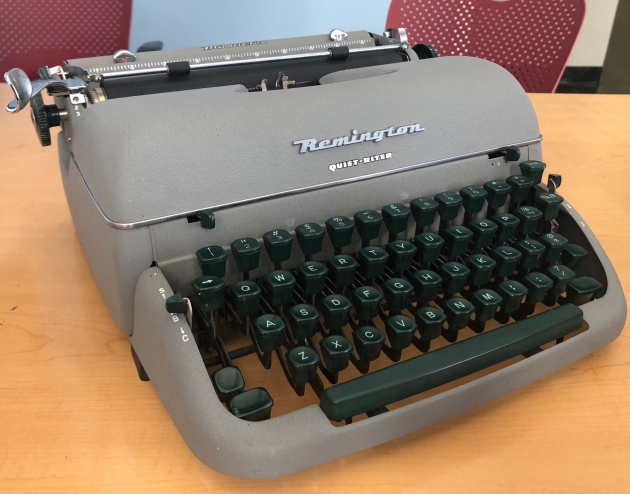
Shortly before the Covid shutdown the children’s art museum opened an exhibit, The Art of Writing that covered where inspiration comes from and similar themes. One of the items was a Remington Quiet-riter on a pedestal with a stack of paper. The exhibits crew said the hard part was finding a ribbon.
The kids were fascinated by this weird machine that had a keyboard of separate keys at a steeper angle than they were used to. They’d tentatively press a key and watch the type bar rise out of the basket. I’d say, “No – you’ve got to whack it, like this!” and type out half a line.
Lemme tell you, after decades of computer typing, my fingers got tired. I imagine the secretaries of old had no trouble opening jars.
My parents had several typewriters, and both of them were touch-typists. My mother was better than my father, because she made extra money in college typing people’s papers for something like $0.50/page, which was a lot of money in the 1950s.
They had a huge and heavy one in the study, which I couldn’t even lift until I was about 9 years old, as well as a portable one, that had been my mother’s in college. I didn’t understand why, if they could make a light one like the portable, they needed the big, heavy one (which I think was solid steel).
Apparently, it was just sturdier, and didn’t need to be adjusted or repaired very often, but mainly, it could handle several carbon copies at once. The portable couldn’t handle triplicate forms.
Then, they had a third typewriter with the Cyrillic alphabet. They both spoke Russian fluently. My mother taught Slavic languages, and my father taught Soviet politics, so it saw a lot of use.
My notes to school were always typewritten, then signed with fountain pens. I didn’t cotton onto the fact that my parents were showing off a little. But once when someone asked how the teachers knew I didn’t fake a typewritten note, I said “no mistakes.”
I learned to type in grade school a lot earlier than my peers because my handwriting was just that bad. I had a legitimate excuse for it too; some developmental problem with the part of my brain that controlled fine mother skills.
I’m surprised typing was recommended for college bound students more often. Shorthand seems like it’d come in very handy for note taking too. On the flip side I’ve heard that women working in business, with the obvious except of secretarial jobs, were once advised to never let on that they knew either.
That’s true - and a little extra piece is that sometimes they were advised not to learn shorthand or be a good typist. Because you might have been tempted to take a higher paying* secretarial-type job that required those skills - and once you did, you might be pigeonholed.
* It wouldn’t have been a high-paying job , just higher paying than jobs that didn’t require those skills. My HS friends who took typing shorthand and bookkeeping earned more than I could until I was out of college a couple of years. t
Pretty much.
In my case, they didn’t want me to go through the Gunnery and ARTEP rotation and become a Qualified Tank Crew, just to up-and-leave and create a hole in the org chart. On top of that, I had just made Sergeant in January, and it was decided I could/should also learn more of the admin-side of the Big Green Machine. I had been a Line Doggy since Basic (a bit over four years), having been a Loader, Driver, then Gunner in turn, so I’d “been there/done that” as far as Line experience went.
My typing never amounted to much, maybe 20-25 wpm (mostly because my hunt-and-peck style induced more typos than useable words  ), but as I said earlier, there wasn’t much need for more than that at Company level. We could fill out most of the routine and common forms in ink pen. The weekly Training Schedule was probably the most typing I did in any given week, and after a few weeks, I’d learned enough to line everything up and knock it out pretty quickly.
We used IBM Selectric III machines, and I wore out more Correction Tape ribbons than ink ribbons.
One summer in the mid-80’s my father brought home an IBM clone but it came with very little software. The one thing that did come with it was learn-to-type software.
In the few days between that and us getting some games to play on it, my brothers and I turned the learn-to-type software into a competitive sport (we turned everything into a competitive sport). Which accidentally resulted in me learning - without question - the single most useful lifetime physical skill I ever acquired.
I never knew that if I’d ended up in the military it would have kept me off the front lines.
My school started offering typing courses in the early 1970’s - an all-boys private school. Unfortunately, they started with grade 9 and I was already in a higher grade. This was also about the time they discontinued Latin as a subject.
My brother actually learned typing in the Canadian army, but he was trained as a radio operator intercepting Russian submarine messages in the Arctic. He also learned Russian, which helped - when he got out and went to university, he took Russian for non-Russians as his elective arts course and got a very high mark.
90% of the jobs in the Military will keep you off the front lines.
I was in the military from 1967 to 1990, and someone who could type was a rarity unless he was a Personnelman, a Yeoman or other similar rating. I was one of about three guys in my 9th grade typing class in the 60s, and the only one who could touch-type on a manual typewriter at about 80wpm. It’s a skill that has served me well throughout my life, and it’s one that I encouraged my military subordinates to learn, if they wanted to get their jobs done efficiently.
Back in high school, it was a single semester course, 45 minutes a day. We spent the first half more or less, learning how to actually type. The second half was more along the lines of how to use a typewriter and how to generate commonly typed things- how to set tabs, how to do a business letter using a typewriter, how to set up for typing on an envelope, and so forth.
So the typing itself doesn’t take all that long really, but it does take practice and repetition to build that muscle memory to the point where you don’t have to think about it. While I could touch type going into college, I didn’t get good at it until I was a professional programmer and did it all day every day for several years.
From the other side of being useful; my uncle was a carpenter and learned typing from my aunt/wife. She was in the massive typing pool the served the insurance company conglomerate that is/was Connecticut. WWII came and he joined the navy. Made him a SEABEE because of his carpentry skill? Nope. Made use of his typing skill? Nope. He spent 2-1/2 years going deaf while loading 5"/38 shells in a turret on a destroyer in the south Pacific.