Tomorrow’s Dunesbury (we get the Sunday comics on Saturday) contains a character that is obviously Donald Trump (although it doesn’t name him). And not in a complimentary way.
Very old urban legend. Arthur C. Clarke’s novel version of 2001 states “HAL stands for Heuristically programmed ALgorithmic computer.” and both he and Kubrick have denied any IBM connection since the sixties.
It’s true that IBM was the image of a computer company and that IBM’s 704 computer did the first synthetic voice, singing “Daisy”. Kubrick checked with them to make sure they didn’t object to the script. But that’s the connection and not the name.
Surprised nobody’s mentioned that Apple allegedly (convincingly, from the number of articles about it, but I of course have no proof) forbids Bad People from using Apple products in movies. This isn’t legally enforceable, of course, but with the studios all being part of mega-corporations, pissing off Apple is not something any of them wants to do.
So the Good Guys (and Gals [Good People?]) can use iPhones and iPads but the baddies will have Android devices.
As others have stated, there is no general prohibition in U.S. law on depiction of branded goods in fictional works.
And as others have stated, major television and motion picture producers and distributors are extra careful about it, however, because
(1) they don’t want to attract the ire of displeased brand owners, who can make trouble even if the depiction doesn’t violate any law or civil right. This is, because, just because you aren’t prohibited from depicting a brand doesn’t mean you are immune from a claim of defamation or some other tort.
(2) they want to preserve their ability to sell placement to brand owners
You will probably find that novels and other literary works are generally much less strict about this because they don’t expect to get the kind of attention that movies and TV get.
This is not just because they want to avoid pissing off Apple. This is how they get Apple to supply them with Apple products to use on camera. Apple asks for this in exchange for the producers’ saving some production costs.
The downside to suing is amping up the publicity. (Streisand effect). If, hypothetically, a character on Big Bang Theory working at Cheesecake Factory had threatened to spit in someone’s food… then CF had sued… It wouldn’t look good for them if a string of real former workers from their various enterprises had testified live on Court TV that this sort of thing did in fact happen from time to time.
There’s the throwaway bit in Family Guy many years ago where Stewie runs naked across the background yelling “Help! Help! I just escaped from Kevin Spacey’s basement!” At the time, Kevin prudently did not sue.
You can depict real people - SNL does it all the time, among others. the catch is of course, what they say. Plus, everyone watching knows it’s a joke and not true.
What’s most fascinatingly prescient about the computers in 2001 is the character using an iPad.
I’m surprised nobody mentioned the bit in Wayne’s World with Pizza Hut.
Using somebody’s image or likeness without their permission can fall into the general field of publicity rights. I really don’t know enough about them to explain them well at all. It’s my understanding that it mostly centers around commercial use. For example, if I create an image suggesting that some famous person endorses my product, I may have violated that person’s publicity rights. The idea being that person has the right to decide if they want to endorse my product, and perhaps be paid for it.
Like many other things, such as copyright, trademarks, libel, etc., publicity rights exist in tension with the 1st amendment (in the US), so the question of whether any particular work violates somebody’s publicity rights is a question to be decided by a court.
I’m going to guess this is (mostly) because of that interview Rian Johnson gave to Vanity Fair which went viral a few years ago about how Apple wouldn’t let “bad guys” use Apple stuff in his movie. His comments didn’t really make a distinction between if positive placement was due to the Apple/production contract or if Apple was maybe actively keeping its products out of other productions. Because he was vague and stories on the web about Apple produce clicks and web news editors are clickbait junkies, all the headlines came out “Apple won’t let villains use iPhones in movies” which is at best a half truth.
Apple is known to be exceptionally sensitive about its image (which didn’t help that VF interview), but villains (or at least people who do bad things) have used Apple products on screen. Some examples are House of Cards, Dexter, Billions, Only Murders in the Building and even Apple TV’s own The Morning Show. Oh, and Sex in the City if you consider Carrie Bradshaw to be a terrible person.
Back in the 70’s a young model was placed on Ivory Snow Detergent labels holding a baby. It was a mini scandal when it was learned that model was none other than porn actress Marilyn Chambers.
Fast forward to 1980. Chambers stars in the adult film Insatiable (I’m not going to link to it) and @ 3:50 she goes into a cabinet that has a big ol box of that detergent with her label. She closes the cabinet with a slight smirk on her face. If you consider the hubbub about her being on the packaging you’ll appreciate the humor of this scene.
I’m certain Proctor and Gamble did not authorize their product to appear in a porn flick!
In the kids show Henry Danger the characters very clearly use “pear” computers and phones, with a picture of that fruit exactly where the apple would be.
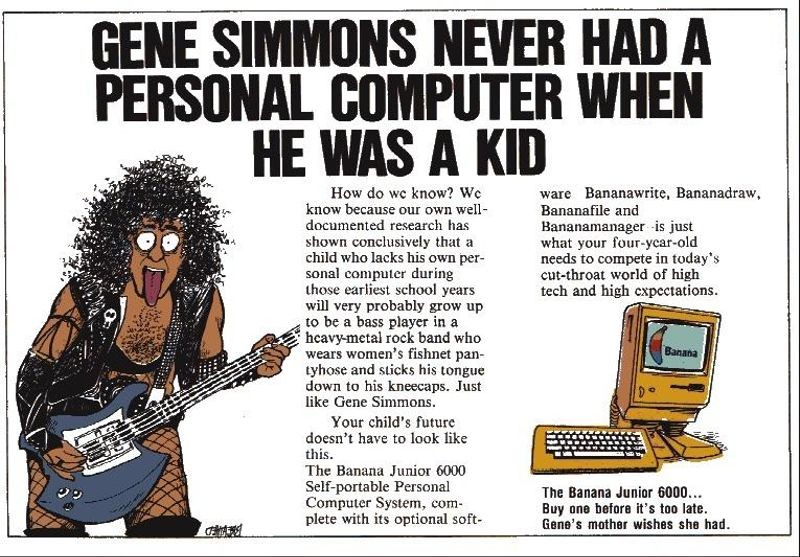
Not unlike the “Banana Junior 6000” computer, in the Bloom County comic strip in the 1980s, which was very clearly a spoof of the original Apple Macintosh.
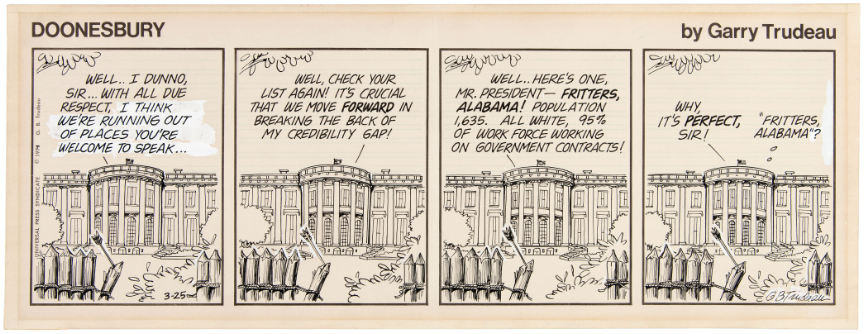
Note that the comic strip below also features a portrayal of a real celebrity. 
It’s Doonesbury not Dunesbury, and Trump has been portrayed in the strip for thirty years, as have every president and other real-life political figures since the strip started.
No other president’s face has ever been depicted in Doonesbury. He - very famously, I thought - used symbols. Bill Clinton was a waffle, e.g.
Trump has been a rabid public idiot for decades. Trudeau put out an entire book of cartoons about him. He’s always had his face shown. Why stop now? He’s not an actual politician, merely a joint hallucination for a few years.
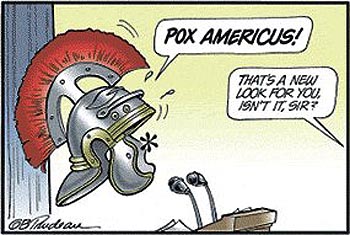
Though, in early years of the strip, Garry Trudeau frequently portrayed presidents and other political figures “offscreen” (i.e., their voices, but depicted as coming from a view outside of the White House, or coming from the unseen other side of a room). Later on, he sometimes depicted Reagan as Max Headroom, and the Bushes as being invisible, save for headwear.
Trump, OTOH, he’s frequently directly drawn in his strips.
https://www.maxheadroom.com/images/6/64/Mhcom_ronheadreststrips.jpg

I just saw trailer for the upcoming movie Bros. There’s a line about “trans-terrorists like Caitlyn Jenner”.
I doubt Ms. Jenner is going to sue, nor would I expect her to win.
Makes sense.
By the way, I have seen at least one or two instances where the well-known disclaimer “any similarity to actual persons, living or dead, is purely coincidental” (typically placed in the closing credits of a film) was actually a blatant lie. In an Archie comic book in the 1990s, there was an installment in which Jughead’s baby sister played with the phone, unwittingly dialling various numbers and running up an enormous phone bill. Right at the beginning, Buckingham Palace is shown being called, disturbing the Queen during high tea. Her face was largely obscured (I think she was shown holding the teapot or her teacup in front of it), but it’s clearly the late Queen Elizabeth II. Moreover, she tells “Charles” to have the number changed; he replies, “Immediately, Mumsy!” The current King is shown from the back, so we don’t see much of his face, but his hairstyle, ears, whatever, are unmistakable. I recall there being an “any similarity to actual persons, living or dead”-type disclaimer at the beginning of the same comic book.
Enough for a whole book.
That’s boilerplate that gives the lawyers something to point to and say Everything in this show is fictional. See? Says so right here. That’s important when the court is determining whether a reasonable person would believe the depiction to be real or made-up.
Not just one book. There’s also SAD!: Doonesbury in the Time of Trump, Lewser! More Doonesbury in the Time of Trump and Yuge!: 30 Years of Doonesbury on Trump. A collection of Donald Trump comics.
Movies and TV productions in some cases also go out of their way to ensure that character names aren’t likely to piss someone out there off. Novelists don’t worry about that as much.