vison, I for one appreciate your post. For me, a lot of my ethically-motivated shopping comes not so much from concern for the animals (though that factors in), but from a concern for human beings. From short- and long-range ecological concerns to worrying about farms breeding super-bacteria to utter distaste for the way workers tend to be treated, I’m motivated to hit the Whole Foods rather than the Kroger or the Wal-Mart, and at least try to invest in foods that do less harm. (Reading Fast Food Nation really inspired my views here.)
As for expense, on one hand, I feel we do spend quite a lot on groceries. But I could spend a lot less if I wasn’t a picky foodie! And we have made some changes that allow us to spend a bit more on Whole Foods meats, eggs, and dairy. We don’t go out to eat very much any more. We also switched about half our meals to vegetarian, so that when we do eat meat, it’s easier to afford the earthy-crunchy stuff. Also, we’re eating more fish, and yes, there are some environmental concerns there, but I’m certainly less concerned about the suffering of the animals in that case.
I am not perfect at living up to my ideals, so I’m not going to throw stones, so much as implicate myself along with others here: if food ethics is at all a concern to you, yet your argument is that it’s too expensive to feed a family without factory-farmed meat, I find that hard to support, given that vegan sources of protein are dirt-cheap and plentiful, and hell, even free-range, happy-joy-chicken eggs are quite inexpensive compared to meat. I still find myself eating out sometimes without thinking of the sources of my food, and yes, even hitting the fast food drive through, but I’m trying to improve those habits, and I don’t pretend that I am forced by circumstances - sometimes I’m lazy or thoughtless, but hopefully less so as time goes by.
I wrote earlier about the differences between conventional egg farming and conventional meat farming, but I didn’t really give my opinion of the promotion of free-range farming for meat.
To me, it seems like they are focusing attention away from the real problem areas of commercial farming. OK, the broiler chickens are not raised in ideal chicken conditions, but their plight is nothing like that of a commercial laying hen. If you’re going to talk about chickens that is where the real problem is. I think these people are just trying to take the easier route. It is far easier to produce meat in a free range environment than it is to produce eggs, so the price difference between the conventional vs. free range product is far less for meat than it is for eggs. It’s a lot easier to convince people to pay double for meat than it is to have them pay 10 or 20 times the conventional cost for eggs. But if they really cared about the animals, that’s where the fight should go first. This meat debate is just taking attention away from where it should be.
How are eggs collected from free range chickens? Isn’t it a laborious process, and not one that could easily be scaled up to the size of a battery operation?
I remember visiting a battery farm in primary school. From memory, the sheds were massive, and contained thousands of birds. So how do commercial free range egg producers accomplish it?
Yes, you’re correct about the battery farms. The whole reason the hens are caged is to control the collection of the eggs. They lay the eggs in the cages and the roll down to a conveyor belt that collects them.
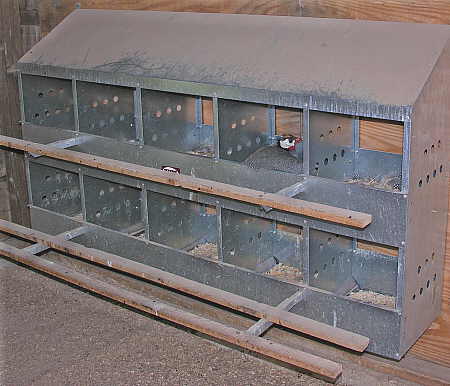
I don’t have any idea how you would make this easy in a free-range environment. You can provide nests where they are likely to lay the eggs, but the collection would still be very labour intensive. I’m not familiar with free-range operations, though, so maybe they’ve come up with something I don’t know about.
[QUOTE=WVmom]
Are you?
[/QUOTE]
I can cite (link in Dutch) some preliminary market research done by the producers of Quorn and Valess. One assumes they have no reason to lie about their own chance of making sales to particular segments of the buying audience.
Other posters had not much more to offer then an “No, it doesn’t”.
[QUOTE=WVmom]
Yes, you’re correct about the battery farms. The whole reason the hens are caged is to control the collection of the eggs. They lay the eggs in the cages and the roll down to a conveyor belt that collects them.
I don’t have any idea how you would make this easy in a free-range environment. You can provide nests where they are likely to lay the eggs, but the collection would still be very labour intensive. I’m not familiar with free-range operations, though, so maybe they’ve come up with something I don’t know about.
[/QUOTE]
In theory, it could be made fairly easy (although nowhere nearly as mechanised as a battery farm - but that’s the whole point) - by constructing nesting areas with easy access for humans to collect by hand, but quickly.
But in practice, hens are pretty dumb and will lay eggs in places you don’t expect them to, so going in there and picking them up one by one is pretty much the only option.
I can’t speak for any major producer, and I am just starting out small, but I intend to have a portable coop that I can move. I free range and pasture my chickens and turkeys. For people that don’t know what that means, pastured poultry usually means the birds are contained in some sort of movable enclosure and moved frequently. Mine are moved at least once a day, sometimes more. With the layers they will be contained with electric fence, and be more on the “free range” scale, meaning they can wander at will in the fenced area, so they will be move less frequently.
[QUOTE=Dominic Mulligan]
How are eggs collected from free range chickens?
[/QUOTE]
The farmer offers nestingboxes. Most chickens prefer to lay eggs in such a secluded, semi-private place., rather then somewhere on the floor or in a self-made nest. If you group the nesting boxes together, and collect eggs daily, the process isn’t that labour intensive, and the chickens are happy enough.
[QUOTE=Dominic Mulligan]
How are eggs collected from free range chickens? Isn’t it a laborious process, and not one that could easily be scaled up to the size of a battery operation?
[/QUOTE]
The hen houses that the chickens lay eggs in have egg collection systems.
[QUOTE=Maastricht]
I can cite (link in Dutch) some preliminary market research done by the producers of Quorn and Valess. One assumes they have no reason to lie about their own chance of making sales to particular segments of the buying audience.
Other posters had not much more to offer then an “No, it doesn’t”.
[/QUOTE]
I think the point is eating “real” food. Not something manufactured to taste like real food.
More of our food is ‘manufactured’ than you might first realise. After all, chickens don’t exist to make meat and eggs for us - we’ve coerced them into that role, changing them in the process.
[QUOTE=Maastricht]
The farmer offers nestingboxes. Most chickens prefer to lay eggs in such a secluded, semi-private place., rather then somewhere on the floor or in a self-made nest. If you group the nesting boxes together, and collect eggs daily, the process isn’t that labour intensive, and the chickens are happy enough.
[/QUOTE]
But even if you can ensure that the hens are laying in the nests, you still have to pick them up - by hand. I have done this in an older battery hen set up where there were no conveyors to collect the eggs. There are thousands and thousands of chickens on a commercial egg farm, so collecting the eggs by hand is extremely labour intensive.
Not to mention the cleaning and disposal of manure - for battery hens it all drops through the cages to the floor, where it’s collected mechanically. I guess for a free range operation, though, the hens might be dispersed enough that it would naturally go into the soil, but I can’t help but think that this might be a major concern.
[QUOTE=Mangetout]
More of our food is ‘manufactured’ than you might first realise. After all, chickens don’t exist to make meat and eggs for us - we’ve coerced them into that role, changing them in the process.
[/QUOTE]
Really? How did we “manufacture” a chicken to produce eggs and meat?
[QUOTE=FarmerChick]
Really? How did we “manufacture” a chicken to produce eggs and meat?
[/QUOTE]
Well, it’s not manufacture in the sense that we built it from pieces, but we domesticated them - selectively breeding them to alter their characteristics from those found in the wild ancestors, in favour of those that we prefer.
[QUOTE=WVmom]
But even if you can ensure that the hens are laying in the nests, you still have to pick them up - by hand. I have done this in an older battery hen set up where there were no conveyors to collect the eggs. There are thousands and thousands of chickens on a commercial egg farm, so collecting the eggs by hand is extremely labour intensive.
Not to mention the cleaning and disposal of manure - for battery hens it all drops through the cages to the floor, where it’s collected mechanically. I guess for a free range operation, though, the hens might be dispersed enough that it would naturally go into the soil, but I can’t help but think that this might be a major concern.
[/QUOTE]
Free-range chicken houses can be as automated as battery-farms. See my quote above.
[QUOTE=vison]
BTW: crops are not sprayed with fertilizers, plants do not absorb fertilizer through their leaves but through their roots. Contamination can occur, certainly, but not because the leaves are sprayed, whether that fertilizer be compost or chemicals.
[/QUOTE]
You don’t really think Monsanto has people out there gently scooping tablespoonfuls of nitrogen lovingly around the base of each plant, right? They spray the stuff on and whatever lands on the leaves lands on the leaves.
Maastricht, I am “most people”. In fact, I’m quite a bit *less *picky about my food than most people. And Quorn does **not **taste or feel like chicken. It’s not bad, don’t get me wrong, but if I’m craving KFC and you put mold nuggets on my plate, I will not be a happy camper. (It’s made from a soil mold, Fusarium venenatum, but I love that “mushroom” euphemism! The UK Advertising Standards Authority was not so amused, however.) Plus, as mentioned, it’s not vegan and it’s pretty expensive here and only sold at specialty stores that cater to the “healthy lifestyle” like Whole Foods.
And you were kidding about assuming they had no reason to lie about their chances of making sales, right? Of course they do! They have *every *reason to lie - how else to you get investors? How else do you get supermarkets to carry it? Every proposed product is hyped to be The Big One so that they can get money to make it - unless things work much differently over there. Just this week the scandal broke over here that, mysteriously, studies which show antidepressants to be ineffective aren’t getting published at nearly the rate studies which show them to be effective are. People don’t want to hear that their stuff isn’t going to sell - they want to hear that they’re going to be the next Coca-Cola!
[QUOTE=WVmom]
But even if you can ensure that the hens are laying in the nests, you still have to pick them up - by hand. I have done this in an older battery hen set up where there were no conveyors to collect the eggs. There are thousands and thousands of chickens on a commercial egg farm, so collecting the eggs by hand is extremely labour intensive.
**Not to mention the cleaning and disposal of manure ** - for battery hens it all drops through the cages to the floor, where it’s collected mechanically. I guess for a free range operation, though, the hens might be dispersed enough that it would naturally go into the soil, but I can’t help but think that this might be a major concern.
[/QUOTE]
For free range and pastured, proper land management here is the key. Frequent moving of the chickens and turkeys and the natural cycle of the earth means that the manure is absorbed back into the pasture and the grass actually benefits from this process.
Keep in mind here I are not talking about the 1,000’s and 1,000’s of battery chickens, just my own experience.
[QUOTE=Mangetout]
Well, it’s not manufacture in the sense that we built it from pieces, but we domesticated them - selectively breeding them to alter their characteristics from those found in the wild ancestors, in favour of those that we prefer.
[/QUOTE]
There is a HUGE difference between domesticating animals and manufacturing some crap to taste like said animals.
I do agree with you tho that we have gone way too far in screwing around with selective breeding and genetic manipulation. Did you check out the links I posted in #87? The whole heritage movement addresses that.
[QUOTE=Szlater]
Free-range chicken houses can be as automated as battery-farms. See my quote above.
[/QUOTE]
Oh, wow, you’re right! I found this system for free range egg production (warning - PDF). While it still has the hens on plastic flooring while they’re indoors, they’re not in cages and able to mill around, plus there’s access to outdoors. I couldn’t quite figure out how the nests work, but they’re definitely automated, so that saves all that labor I was talking about. Still more expensive than conventional egg farming and not quite the natural chicken environment, but much better than a battery system. Thanks for updating my knowledge!
[QUOTE=FarmerChick]
There is a HUGE difference between domesticating animals and manufacturing some crap to taste like said animals.
[/quote]
There’s a difference, but it’s only a difference of degree. Humans decided they wanted it thus, and set about making it so - in some cases, nature gives us a helping hand or imposes a framework in which we must operate, in other cases, we get to tinker with the chemistry set - but it’s all tinkering.
Quorn isn’t really any more evil than any other manufactured foodstuff, such as bread or pasta - both of those bear little resemblance to anything that came out of the soil.
You’re agreeing with something that isn’t actually my point, or a point I would care to make. I like heritage varieties (but we shouldn’t kid ourselves that they’re ‘natural’ - they’re just as much a product of coercion as modern cultivars).
But I think we still need to tinker - it’s what we’ve always done.
The problem (as far as I’m concerned) is who gets to define ‘good’ - if it’s up to me, a good tomato is one with a thin skin, lots of flavour and aroma and soft, juicy flesh - but if it’s up to the supermarkets, a good tomato might be one that crops consistently, is durable to survive mechanised packing and transportation, lasts a long time on the shelf and looks good under artificial lights.
Now of course it can be argued that I can make the supermarket see things my way by voting with my wallet, except I can only choose from what’s on offer, and what I can actually afford.