I’ve seen these used by golfers and at shooting ranges. The terminal end of the laser is always a hard object. I want to measure the distance from the deck of a ship to the water. Obviously there’s a difference between the surface of water and a hard object. So, will a range finder work for my intended purpose? Thx.
You’d have to find some wavelength that would reliably bounce off the water instead of scattering or absorbing. The angle hitting the water surface would matter too. I don’t think it would be easy or very reliable unless you could float some sort of reflective surface on the water, like some sort of buoy.
Radar altimeters might be worth considering? They make some for drones, but I’m not sure how well they work over water.
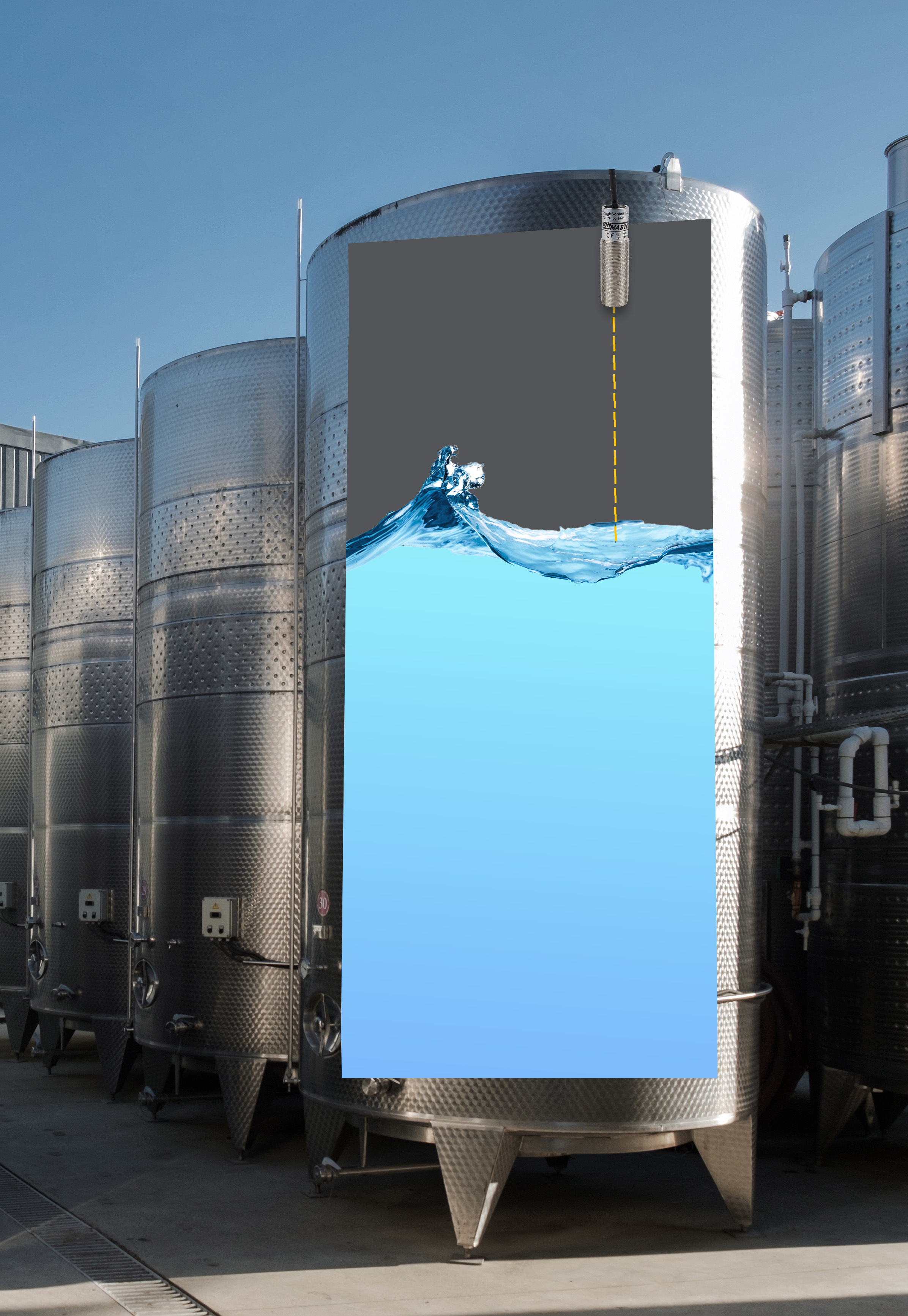
There are also ultrasonic rangefinders that as marketed as sensing water level (see diagram at the bottom of the page)…
I have a golfer’s laser rangefinder. I also live in a high rise overlooking a golf course with many ponds.
My balcony experiments conclude that even at look angles as shallow as ~5 degrees I get reliable returns off smooth pond water as far away as ~450 yards that is reflecting something. IOW what I see when I look at that aimpoint is the reflection of trees or buildings or …
OTOH, even at look angles as steep as 40 degrees (best I can do from home), I get no return at all if the background reflection off the water is blue sky.
Further testing reveals that when I’m aiming at reflections I’m not measuring the distance to the reflections. But rather the two-part distance to the point on the water where the reflection is, then up to whatever is casting that reflection. Tree crown, building etc.
Which demonstrated to me that the water provides an adequate reflective surface to handle 2 bounces round trip and still give a reading. Suggesting that a straight 90 degree look angle into the same water will produce a reliable reflection and therefore a reliable reading.
I’ll be out later today and can take some straight down readings off a drawbridge into water 10 or 20 feet below. But based on my early returns (heh) I expect no problem with the OP using a golf rangefinder for his purpose over the distances that a ship deck might provide above the water.
Now this isn’t the crystal clear transparent water found in tropical travelogues. But neither is it lentil soup.
Cool experiments! I’d love to hear how they go, and if it differs depending on salinity, turbidity, waves, etc.
Well, that was disappointing. I visited the first drawbridge. About 20 feet straight down into salty baywater with light wind & current ripple on it. Visibility in the water was probably 6" or so, maybe a foot. Far from clear, but not lentil soup either.
Result: No laser return.
I tried the sunny & shady sides of the bridge. No return.
Crap.
Disregard my earlier optimism. Later today I will hit a different bridge with clearer water & a bit more range. I think I was beyond the rangefinder’s minimum range, but I’m sure I will be on the other bridge.
Still, we’re doing Science!

Radar versions also exists for tank & hoppers for materials not suitable for sound or light based techniques like grain or airy powders. I recall some consumer grade sonic tape measures before the laser ones were available, I still see some supercheapy ones online.
As an engineering student, we had little ex-Polaroid camera transducers (so we were told) in labs for interrupt timing and arithmetic programming on microcontrollers. They were really impressively accurate on the bench and, as a student, accuracy wasn’t even the objective.
What is that, and how is it different from a radar altimeter?
Still, though, thanks for validating the hypothesis with real-world experiments! I’ll try some too at our local rivers later.
Anyone have a radar or ultrasound one they can try? Or maybe you’ve just had a lot of practice with echolocation?
I was also thinking… for measuring water with laser… you should be able to just have some sort of floating mirror (or white plate of some sort on a rope, almost like a secchi disk) that you can lower onto the water surface to measure its distance.
But then you could easily just get a rope with built-in measurements on it and just use it to measure the distance directly…
It should work just fine from deck to water. laser range finders are tuned to and are very sensitive to a very specific wavelength (that of the laser itself, ovbs). If you can see the laser on the target, more than enough is being returned to the rangefinder for it to calculate the distance.
You are running into Snell’s Law and the critical angle.
At a shallow angle (as you define the angle) the angle of incidence (which is 90 degrees minus your angle) is greater than the critical angle so the water acts as a mirror. From directly overhead (or nearly so) the angle of incidence is less than the critical angle so the light passes into the water, where it is scattered or absorbed before it can make it to the bottom of the pond and back to the surface. So no return.
But doesn’t that depend a lot on the water conditions? If the laser is refracting, reflecting at an angle, or hitting the ground below the water… what are you actually measuring? It doesn’t seem easy to reliably bounce it back off the surface in particular (as in LSLGuy’s experiments).
Edit: Nevermind, ninjaed by @Marvin_the_Martian with a much better explanation.
Just curious. You mean you want to measure straight down, how high the deck is? Which would vary depending on how heavily it was laden? What sort of ship? Don’t many ships have plimsoll lines/depth marks to show that sort of thing?
Sorry if that is a hijack. Or if it is an additional hijack to express the joy of golfing with someone who makes a point of scoping every shot, when you both know he lacks a reproducible swing and has no consistent yardage for any of his clubs? 
Some laser rangefinders (like on Sony cameras) use a Kinect-like point cloud or grid:
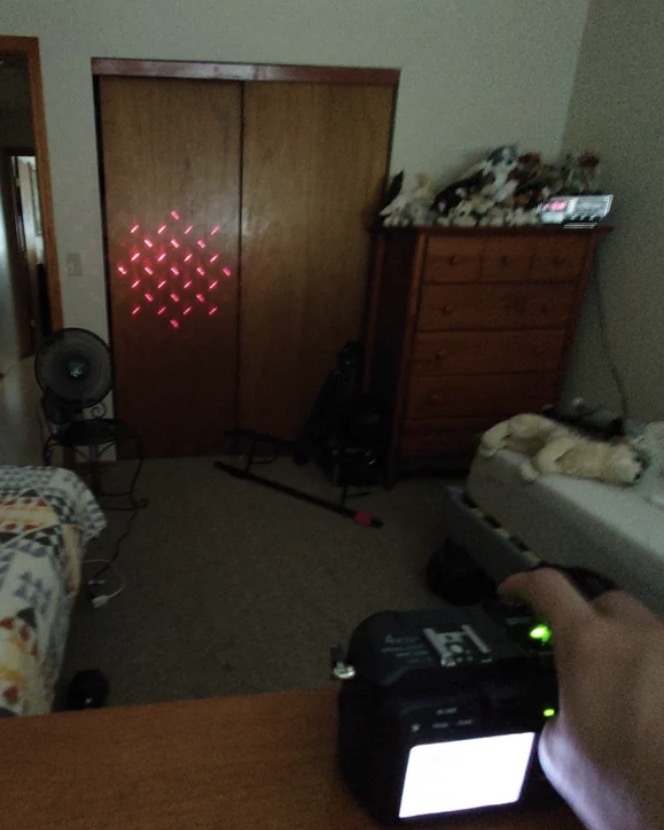
I wonder if that would be better & sufficient for this? Or would even the outermost points still be less than the critical angle?
Could you could use a laser pointer on a stick to bypass the critical angle limitation and then do some trig? Something like:
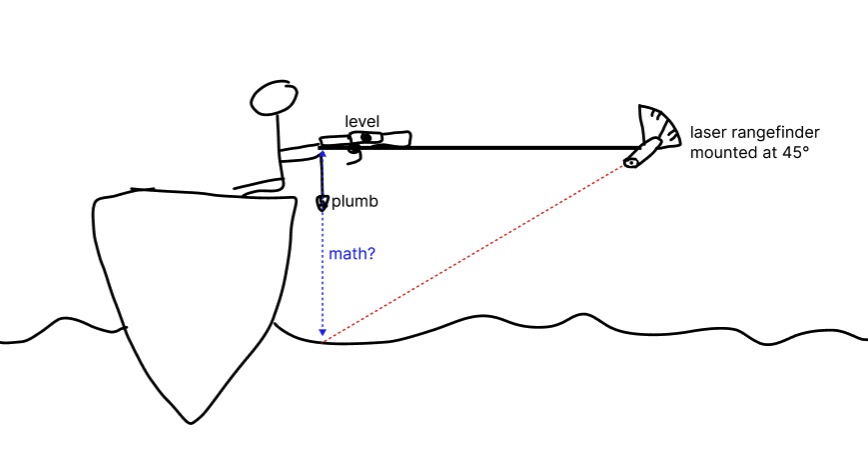
(oops, the pointer angle shouldn’t matter as long as the stick is long enough)
As long as you know the length and angle of the stick and the angle of the rangefinder, sure it should work. Simple Trig.
Maybe @LSLGuy has some sticks lying around…? Golf clubs? Tourist whackers?
Nothing about trig is simple  I can barely remember how to calculate the other sides of a square, much less a triangle…
Golf laser rangefinders are IR. There is no seeing the laser spot.
Darn. But thanks for the explanation. More Science!
I was expecting the 90 degree incidence case to be some combo of specular reflection and penetration / absorption. Net of the undulating surface. But evidently there’s just not enough (or maybe any?) reflection going on to be detected on the way back up to the rangefinder.
Oh well.