Maybe that was the intent, and it succeeded in large part, but it wasn’t a complete standardization. There’s still (at least) the traditional/simplified scripts split, along with regional variations in terminology (such as the different ways to transliterate Arnold, or having different terms for “kindergarten”). Much but not all of it is mutually intelligible.
I mean, with nearly a billion speakers across many countries… how could there not be divergence?
Hmm, that’s a really interesting find. A few sources (like Baidu, the Chinese Wikipedia equivalent) say that it’s an ancient literature term: https://baike.baidu.com/item/解放/33101
AI says it’s an old word, but the modern usage of it as “emancipation” (from capitalism or slavery) came via Japanese scholars studying Western texts and reintroducing it to revolutionary China.
I’m not sure who to trust, but it’s a really interesting (and sadly uncited) find on Wiktionary. Good find!
Edit: And certainly both cultures must’ve had both the concept and the word for “freeing someone or something from captivity” long before then. I wonder how 解放 became dominant.
Aren’t you in Hokkaido these days? Yep, I’m in Hakuba (白马)/ Nagano and heading back to Tokyo tomorrow. Going to see some grad school buddies from the early 1990’s. Since this year’s ski season looks to being pretty spring like, I’m probably heading back towards Seattle in a couple of days unless a Siberian cold front and super snow suddenly shows up in the forecasts. Whetted my appetite though, and prolly heading to Asahikawa and other parts of Hokkaido for the last two weeks of Jan 2027.
That was the point, but, remember, there was only something like a 5% literacy rate before “liberation”. And you have to be trained in classical Chinese to actually read and understand it beyond common characters. So, it was a kind of “common” written language, but only at a very basic level.
I can also tell you that when I travelled extensively in SW China between 1985 and 1989, not many people spoke or even understood Mandarin outside of the big cities. And in the big cities, everyone spoke the local dialect as their first, mother tongue. It was the advent of television, and mass ownership of television that made it so that most of China’s population can understand Mandarin, and maybe 50% (dunno, not more than 75%) can speak Mandarin intelligibly for an extended conversation.
There are still plenty of 60+ year olds that are illiterate. And, in modern China where practically everything is done via smart phone, those folks are basically homebound outside of a village.
It might help to think of China and the local “dialects” as being even more diverse than all of the eastern and western european languages combined. I write “dialect” because maybe a linguist would claim these to be dialects. However, there are dozens if not hundreds of mutually incomprehensible “dialects” spoken. Literally, can go 10-20 miles outside of Shanghai, and native Shanghaiese speakers are unable to understand the local dialect and vice versa. And it is this way across vast swaths of China.
I think there are some Cantonese speakers on this board. Yet Canton / modern day Guangdong province has dozen(s) of mutually incomprehensible dialects.
Cool. Finally! Mao on a pogo stick. I would spend hours looking up words by hand in a dictionary. I am sure I spent about two hours/day for 4 years just looking up characters in a dictionary.
Don’t even get me started on bo po mo fo (zhuyinfuhao) abomination. Taiwanese back in the 1980’s were irritatingly insistent that one needed to know bopomofo to properly pronounce Mandarin. That a western student seeing “si”, “ci”, “xi” was too stupid to understand that “x” was not pronounced like x-ray in pinyin, but that “x” represented a sound that was not the same as English. Bopomofo would have been ok methinks if it was used in print form like the Japanese katakana “alphabet” for foreign words. Nope, bopomofo existed as a type of character to represent a sound. The computer age meant that only sub-segment of the Taiwanese population uses a keyboard with bopomofo on it to create Chinese characters. Pretty much the rest of the world understands it’s a lot easier to type in pinyin on a standard keyboard. D’oh!
Also, back in the 1980’s. Everyone in Taiwan assured me that simplified Chinese characters used on the mainland was too difficult to learn. Fast forward to today, no one in Taiwan that uses electronic communications blinks if they need to read simplified Chinese.
There are actual linguists on the board who will hopefully correct me if I’m wrong, but I think it’s politics, not linguistics, that insists that Mandarin, Cantonese, and all those mutually unintelligible village vernaculars are “dialects” of the same language. Just as it’s politics, not linguistics, that insists that Danish, Swedish, and Norwegian are separate “languages”, even though they can all happily talk to each other without translating, as they did throughout Bron/Broen.
Well, pinyin is just a transliteration of Mandarin into Roman scripts. It records the sounds of Chinese characters when spoken in Mandarin, in a way that’s compatible with the Latin alphabet. That’s all it is; it’s not a separate “language” unto itself… no need to give it any mystic power Many transliteration systems are imperfect because languages are different and complicated, but that’s OK, they just have to be “good enough” to get the point across…
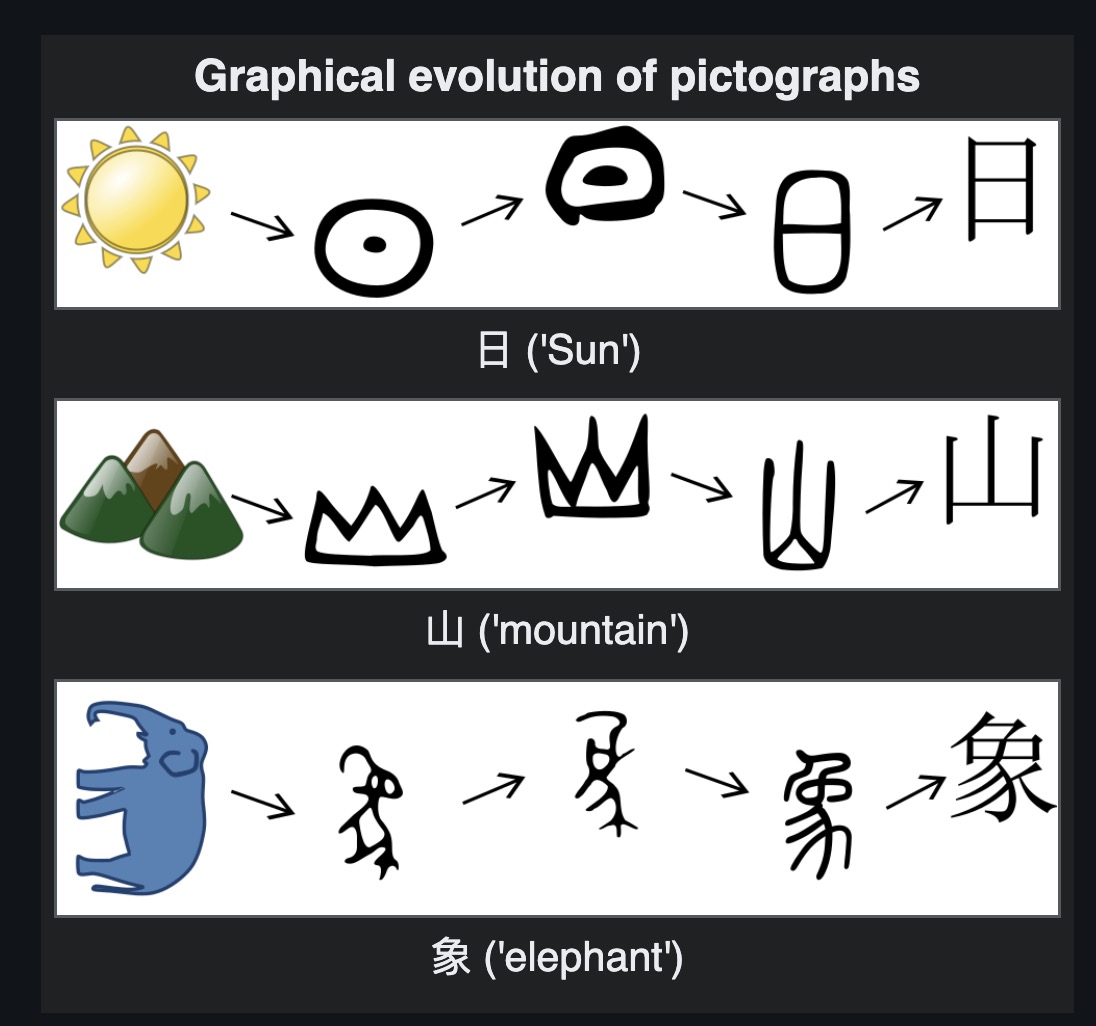
The regular written characters of Chinese are actually more “visual” than pinyin (which is just a phonetic spelling of the way they sound). Some characters are straight-up pictographs:
But thousands of years later, something like “解放军” is not readable to anybody who can’t read Chinese, but Jiefangjun can at least be read and written by anyone who can read the Latin alphabet, even if they might not know what it means. It at least lets them transcribe it and look it up in a dictionary, etc.
Similarly, tsar is more readable for English users than the original царь, or hummus instead of حمص, or karaoke instead of カラオケ, or Hannukah instead of חֲנֻכָּה, etc. Many of those are imperfect in some way, but they get the word and the point across.
Arnold’s transliterated name 阿诺德·施瓦辛格 is similarly flawed, but it’s easier for Mandarin speakers to read and pronounce than “Schwarzenegger”.
They’re just ways for people to write each other’s languages in their own scripts.
The spacing of pinyin is necessarily a subjective thing because the original Chinese script doesn’t use spaces — they have a different set of punctuation altogether, though there’s now quite a bit of overlap due to Western influences. Anyway, the Chinese government can set out the rules they would like people to use, but they cannot coerce all one billion people to suddenly follow those rules correctly overnight. And the rules have changed over time, anyway, even within that government.
You mean 白馬 of course I meant to say that I was in Tokyo for two nights this week, but it looks like we missed each other. I’m back in Hokkaido now but the snow got icy early this year. I may be finished as well.
I don’t know what you mean by this. Pinyin for Chinese and romaji for Japanese are systems for transliterating the languages into roman letters to help nonnatives understand the pronunciation of the written characters.
Transliterating a language makes it no less of a language than speaking it. Is Mandarin less of a language or not a language when it’s spoken?
I know what you mean, but technically it’s also readable to anyone who can read Japanese, although we wouldn’t get the same pronunciation. The simplification of the final character 軍 does take getting used to.
In Japanese, it’s pronounced kaihō-gun, with Google translate wanting to put a hyphen before “army” although the same Google translate doesn’t put a hyphen for 日本軍 Nihongun, Japanese Army.
In Japanese, there are separate words for army when used by themselves or when used as part of another compound. So, the US Army is 米軍 beigun but “army” is 軍隊 guntai in sentences such as “The country has a strong army.”
The question if things count as one or two words seems arbitrary to me. We walk from the bedroom to the living room, and a cowboy may also be a horse trainer.
Some really good examples there, well done. Another such sentence might compare a hedgehog to a guinea pig. Linguists may or may not have a good definition of “word” but if they do, it can’t be by reference to the spaces in written text, since many languages are not written at all, and many languages’ writing systems don’t use spaces, but presumably all languages have words.

 Many transliteration systems are imperfect because languages are different and complicated, but that’s OK, they just have to be “good enough” to get the point across…