I am from the Austin area in Central Texas, so my experience with snow is somewhat limited. However, I am currently visiting my grandchildren in Michigan’s LP, which has lots of snow on the ground right now.
As I was looking at an empty field filled with new-fallen snow, a question occurred to me. Suppose you are a squad of soldiers operating in the area. You know that there is a contingent of enemy soldiers also in the area looking for you. How could you maneuver in the snow while concealing your movements or operations? I can see ways to conceal how many soldiers are in your unit, but I can’t see how you could make the snow look untouched by footsteps, etc. So, how do soldiers operate effectively in this environment (while also not freezing to death!)?
In Band of Brothers the 101st guys dig fortified foxholes with roofs. Then they stay out on the line as long as they can until they rotate to the rear area for a day or so to warm up and eat then rotate back to the front line, They keep several pair of dry socks (inside their helmets?) and keep their feet and toes dry and moving inside their boots to avoid frostbite. I could stand in the woods when properly dressed in 24 degree temps for 6 hours when I was a teen. Could not do that today
As far as leaving tracks, desert dust, beach sand, or dew aren’t significantly different. Fresh snow might reveal terrain features like fresh excavation or perhaps even underground mines or foxholes, bunkers.
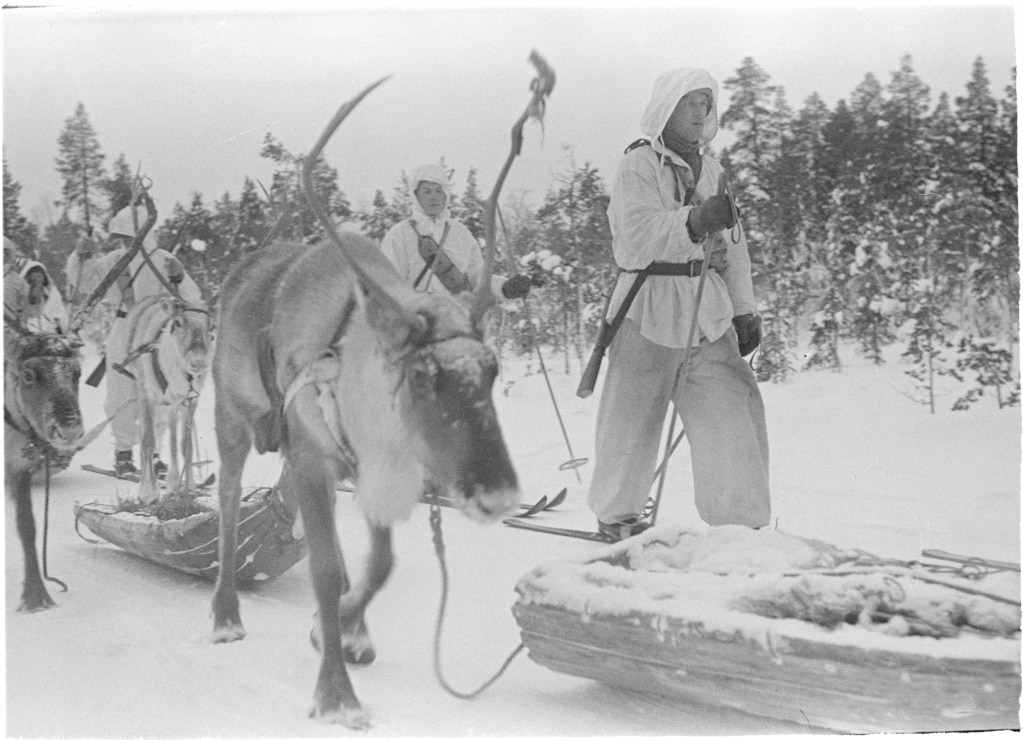
The textbook precedent in military history and strategy about warfare in such conditions is, to my knowledge, the “Winter War” of 1940-1941 between the Soviet Union and Finland. AIUI, the Finns relied extensively on infantry on cross-country skis. Doesn’t hide your tracks, but keeps you much more manoeuvrable in the snow than on foot.
Remember that apart from the Western Allies, supplies during WWII were primarily moved by horses once they reached the railhead. And reindeer are more or less just horses adapted to the cold.
I remember one of my teachers mentioning that he saw the newsreels of the Finns fighting the Russians in theatres when he was young. He said, they cheered on the Finns. Then the Germans invaded Russia, who became our allies, and the Germans were aiding the Finns, and things were complicated.
I saw a YouTube video a few years ago, footage from a Finnish news photographer had surfaced of Hitler discussing the war with some Finnish authorities during a visit - apparently the only footage of Hitler speaking normally rather than making a speech.
The alleged tactic is to drag the pine branch behind you, which covers tracks to some extent by smoothing over the trail. But the same applies with soft dirt, and dusty conditions, and likely long grass too - it’s hard to hide your tracks completely. Snow is complicated - if it gets crusty (top melts in the sunshine and then freezes), snowshoes can go on top and leave no tracks. However, deep snow with a crust too weak to support you - even on snowshoees - can be work. Depth matters too. A foot of fresh snow is serious slogging, even with skis or snowshoes. There’s a reason for the old saying “Eskimos have a hundred words for snow”. (So do avid skiers)
Presumably nowadays snowmobiles would figure into it - but people frequently get stuck up north here if they take their snowmobile into deep soft snow. (“Stay safe! Stay on the packed trails!!”). One of my late friends was late getting to the Korean war because when they were looking for him, he was on an exercise taking tracked vehicles across northern Canada to test out winter maneuvers. Also Jack London has a short story about some guy in the Yukon who falls through the ice and struggles to build a fire. Ice even at -40 can be deceptively thin over running water.
Snow is extremely revealing, which is why tracking game animal movements gets a 1000% boost after a snowfall. Where a layperson could see no trace before the snow, they can now tell at a glance of who went where and how. Burglars get caught, with the footprints in the snow even telling what type of shoe was used by the perp etc.
Like md-2000 above stated, there’s a ton of different snows, though. On the hardest late winter crusts, a relatively light person with appropriately large & soft footwear could travel without making much of a trail. Wind shifts surface snow that’s not hardened to a crust, and new snowfall covers earlier tracks, but generally even small game animal tracks in the snow stay clearly visible and identifiable for weeks and weeks of variable winter weather.
Dragging a conifer bough behind you may make your tracks a little harder to see / identify, but on most snows they don’t make the tracks go away, not by a long stretch. You could still tell a person went this way, dragging a bough behind them.
These days, motion-activated cameras, heat cameras, camera-equipped drones etc. make snow much less important for enemy detection than it used to be.
If you’re in your own foxholes looking out toward the enemy, footprints aren’t going to be the biggest thing you’d see. That would be things like smoke rising up from cookfires, breath fogging, and stuff like that. Snow would actually tend to conceal a lot of stuff like disturbed vegetation, etc…
If we’re talking aerial reconnaissance, footprints and tracks become much more visible, but I imagine that IR becomes more effective as well.
This seems to be more about infantry patrolling out in the “no man’s land” between the enemy forces, and in that case, stuff like covering your tracks, etc… are more important, and I’ll echo that the Finns did it best in 1939.
None of that fools the Indian guides in western films. The scout kneels down and ponders the dirt then proclaims, “Hmm, tracks 4 hours old. 10 horses and one mule. 8 riders are men, 3 are woman. One of them is pregnant. The horses are tired. They won’t get far.”
These days I’d assume the military would be using modern technology & tracks wouldn’t so much matter; except for a scout or sniper, they’d probably be in vehicles of some type. A cop chasing a suspect or a hunter chasing game would be a different story
As long as the operator knows how to use the equipment. A person would be warmer than the background in winter but cooler than the background on a hot summer day; choosing white hot vs black hot view matters in those two scenarios.
That’s what I mean, though. Detecting & imaging heat from warm mammals, structures, & vehicles will work better at freezing temps, even if not optimally configured. A thermal user might even get some benefits from daytime use against tundra & ice floe. Like, you’d think surprise wampa strikes would be less of a problem in Hoth.
Based on videos I’m seeing on social media, Ukrainian drones do pretty well out in snowy territory finding small groups or even individual Russians to blow up.