I assume they kept it. At the time they had a building about the size of an Elks Lodge to host it. I don’t really know what’s happened in the following score of years.
Actually I’ve only read Fables in Slang and More Fables. My library didn’t have any others.
What’s your thoughts on the distaff side: Erma Bombeck, Jean Kerr and Shirley Jackson’s two humorous ventures, Raising Demons and Life Among The Savage?
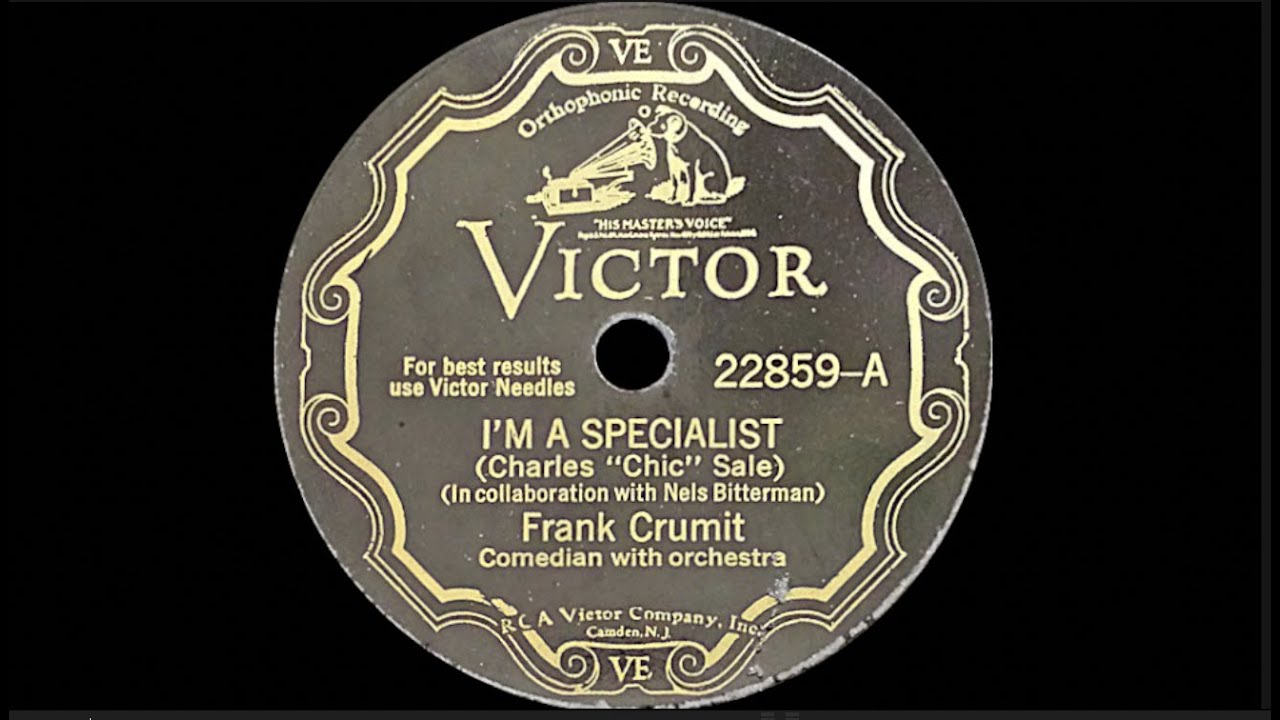
Something you might want to add to your Chic Sale page: He co-wrote a song called “I’m a Specialist” with Nels Bitterman. Frank Crumit recorded it on the Victor label on November 11, 1931:
I have everything by Bombeck and Kerr (I think. I’ve been going through the shelves and checking authors to see if I missed anything.)
Shirley Jackson. I had the idea that her “memoirs” were actually fiction, or fictionalized. Can you school me on them? I’m sure they influenced Bombeck and Kerr. But they probably also looked back to Betty MacDonald who struck it big with The Egg and I in 1945 (with three follow-up books) about her time on a farm.
Funny memoirs aren’t marketed as humor so they’re harder to track down. Cuppy or Armour were allowed to write about any subject and get it marketed as humor. Women were pretty much limited to finding humor in running households or maybe travel. Perelman milked those subjects himself, but his short pieces could be on anything.
I’d love to add more humor by women from the first three-quarters of the century, so tell me more about Jackson and anybody else you’re familiar with. (You as in all of you who are reading this thread.)
Shirley first did her books as short stories that appeared in Good Housekeeping and similar magazines, which she later collected into books. They were fictionalized memoirs of her own family.
Elinor Golding Smith wrote a number of unfunny books (The Great Big Messy Book comes to mind), but one gem: That’s Me, Always Making History, which consisted of one-page monologues spoken by the great and those close to the great (e.g. Einstein’s housekeeper). Hannibal starts off: “I know why I’m here. I know why my soldiers are here. I even know why my officers are here. But why did we bring the elephants?”
Mary Ann Madden was an editor for The New Yorker who ran the letters column and contests (if I remember correctly). She ran a number of literate and literary competitions over the years, and these were collected in three volumes with wonderful titles: Thank You For The Giant Sea Tortoise, Son of Giant Sea Tortoise, and Maybe He’s Dead. This is more editing than writing, but it’s still funny.
The tone is light, but it’s really a cookbook. Good, simple recipes, though, the kind of food I might make.
@Prof.Pepperwinkle
Yeah, that’s probably why I decided long ago not to include Jackson. I’ll take another look and see how far I can tilt them into memoir.
I have some Smith. Do you know she was married to humorist Robert Paul Smith? And looked - in one hairstyle at least - just like Betty MacDonald? But she’s a good candidate for a forgotten author, more than half a dozen books. Thinking about it, who remembers her husband either? He wrote the classic Where Did You Go? Out. What Did You Do? Nothing and co-wrote a Broadway play with Max Shulman, The Tender Trap .
I had a separate couple of shelves for Miscellaneous - that’s where Cecil’s books were kept - and I certainly had those New York competitions. I chucked them a while ago when I needed more space and realized that however much I once enjoyed them I was never going to read them again. Not Cecil’s, though.
Have you read E. Jean Carroll - yes, that E. Jean Carroll. Her essays are sharp and funny.
I think I’ve found a humor book written by her. The Lover’s Baedeker and Guide to Arcady. A Baedeker was a guide book and Arcady was an imaginary country she invented. Not intended to be mistaken for anywhere, it was an extended metaphor about the highs and lows of lovers, profusely illustrated but heavy on poetry.
About a hundred years later, Santo Cilauro, Tom Gleisner & Rob Stich did the Jetlag Travel Series, incredibly detailed, indistinguishable-from-the-real-thing guides to not-quite-real countries. The satire is perfect, but possibly offensive today.
The series comprises ‘Molvanîa: A Land Untouched by Modern Dentistry’, ‘Phaic Tăn: Sunstroke on a Shoestring’ and ‘San Sombrèro: A Land of Carnivals, Cocktails and Coups’
The Rape of the APE* (American Puritan Ethic) by Allan Sherman. I’m remembering it as being mildly biting satire.
Cliff Arquette’s Charley Weaver’s Letters from Mamma.
Avoidism by Roger Price, who also did the Droodles series and co-founder of Mad-Libs. A humorous philosophy that life’s difficulties can be solved by avoiding and ignoring them.
I remember The Rape of the A.P.E., though like you I thought little of it even at the time. I don’t have it, probably because I didn’t think of it as being sufficiently humorous. I might be wrong about that, memory being what it is. Sherman also wrote some shorter humor pieces for Playboy. One is included in The Playboy Book of Humor and Satire, a big fat anthology of prestigious names and lesser work. Playboy was the source of humor after The New Yorker mostly abandoned it after the war. They put out six anthologies - the rest all in paperback - that I know of.
Charley Weaver was part of Jack Paar’s crew of oddballs, something I was too young to ever catch and regret to this day. He did three books, the others being Things Are Fine in Mount Idy and Charley Weaver’s Family Album, which I see I’m lacking a first of, although my third is signed. I’m torn on what to do there. I don’t care much about signed copies but others do.
I have a first of Droodles, but it’s cartoons, so it goes with that collection. Avoidism appears to be the paperback renaming of In One Head and Out the Other, which is rare and annoyingly expensive in hardcover, so I don’t have it. Yet. I’m still trying to figure out whether The Great Roob Revolution is humorous satire or just screed. Have you read it?
Hyman Kaplan is in the pantheon. Do you know that Rosten was so displeased by the way he wrote as a young man that he rewrote the stories line by line a generation later? The differences are subtle but the original had brio. Same with the second volume, The Return of, written in the 1950s. Rosten didn’t see the world with the same eyes and that world was also a dim relic of the past. For carpers - Yes, I know that Hyman Kaplan are short stories of dialect humor. Any humor collection that excludes them excludes me as well.
I have not heard of The Great Roob Revolution, so I can’t help you there.
I didn’t know that about Rosten, so thanks for that info. I agree that that is quintessential American humor.
Let me see…
Grady Nutt (the minister who appeared on Hee Haw) had a couple of safe, religious-themed humorous books, the most successful being The Gospel According To Norton. I remember I smiled when I read it, but no real laughs.
Robert Fulghum had a series of humorous, inspirational collections of essays starting with All I Really Needed To Know I Learned In Kindergarten. Again, the occasion smile, but no laughs.
Tom Bodett’s written a number of humorous books, but the earliest, I see, was published in 1986, which might make him too late for your collection.
Frederick Crews just passed away. His brilliantly savage The Pooh Perplex was just what I needed when I entered college so as not to be gulled into one particular line of thinking about literature or politics. He wrote a sequel, but it wasn’t quite as good.
I remember Jack Douglas and his Japanese wife were on tv talk shows back in the 70’s or 80’s. My husband thought he was such a hoot. I was unmoved. And it really bothered me when they were living in some wilderness and she went into labor. He went outside while she gave birth, and that was all he had to say about that.
Will Rogers and Jean Shepherd are also probably too well known.
The only other names I’ve come up with over the weekend are Art Buchwald and Lewis Grizzard. Madame Pepperwinkle liked Lewis a lot more than I ever did.
Looking over the entry on Armour, I noticed that the designer of the cover for The Happy Bookers made a little inside joke: the title typeface is Bookman italic (with a liberal use of swashes) .
I took a typography course about 50 years ago, mostly to learn I had no eye to distinguish one from another unless I had the complete font in front of me and unlimited time. I’m in awe of anyone who can identify a font that way. The problem is that you linked to ITC Bookman which is not the same as Bookman itself. Bookman’s “e” is quite distinct from the ITC Bookman “e”; ITC’s high bar is used on the cover. Bookman Old Style is actually closer to ITC Bookman than Bookman.
I think the designer (Paulette Nenner) riffed on familiar fonts, but added so many distinctive individual letters that it counts as an invented one-off font.
Anyone who’s an expert can put me in my place if not.
I fooled around with graphic design and typography for most of my career but never had any formal training. So I’m no expert, but there are a few fonts that I can ID right away, and Bookman happens to be one of them, so its use on that cover leapt out at me.
But I could never tell the difference between ITC, Old Style, and standard by eye. I just grabbed an image with one of them to illustrate Mr. Nenner’s joke.
Superb stuff. My go-to for this sort of thing is Parkinson’s Law, very dated of course and with some racist parts, but the rest is still funny and relevant. Probably too famous and too British for your ‘core’.
No Jerome K. Jerome? No Mae West (as a comic playwright)? Clarence Day? I suppose “great” and “forgotten” are pretty subjective, but I’d rank Shirley Jackson’s comic memoirs as definitely “great”.
Lulu Hunt Peters, the inventor of diet humor.
John Keats (no, not that one), the inventor of automotive consumer humor?
Anna Russell. Nancy Mitford.
Betty Comden? Sylvia Fine? Kay Thompson, author of the Eloise books? How about Lois Long, the 1920s New Yorker columnist who pioneered the wry “socialite”-type essay on topics like nightclub life and women’s fashion?
Hard to know how to classify somebody like the immortal Texas Guinan, either.
You don’t want fiction, I think, so no place for Edith Nesbit, basically the inventor of the modern comical children’s novel (as well as the modern low-fantasy children’s novel). And that rules out P. L. Travers of Mary Poppins fame too, along with Stella Gibbons.
And if you’re interested in broader representation, how about some BIPOC humorists? Again, it’s hard to know where you’re drawing your line between “humorist” and “comic performer”, but it seems as though Moms Mabley should belong in there somewhere. Dick Gregory? Someone like Bert Williams, relegated by Jim Crow to “minstrel” roles, is another tough call. Pioneering Black female cartoonist Jackie Ormes?