This isn’t always true. Well, the bit about the risk is true, but must be balanced against other risks.
My relative had her water break prematurely, and they left the baby in almost a week to give its lungs time to develop a little more. She was in the hospital the whole time and keeping everything sterile was the highest priority. If anything looked dicey, I’m sure they would have induced birth or performed a C-section immediately. But things went fine, and the extra week was the difference that meant the baby could breathe on its own.
My first wife’s water broke while we were 2 hours from the hospital. A few days later I came out to my car on a warm day and it smelled nasty on the inside. I tried for a week to clean as much as I could but the smell lingered. Ended up having the passenger seat of my 66 Pontiac Le Mans reupholstered to get rid of the smell.
I was in labor for hours before my water broke. In fact, at about hour 7, the doctor told me to resist the urge to push and walked out the room. The midwife then said to me, I swear, “He’s being a jerk. If this wasn’t a high risk pregnancy (it was twins-- an automatic ‘high risk’) I would have broken your water for you. Next time you feel it-- push real hard.” I did and the first baby head popped right into the birth canal. Never forgot that feeling of “Oh shit! Baby’s coming right now!”
Turns out the doctor wanted to go eat lunch.
How much water are we talking about here? Is the Nile overflowing or are there but a few drops on the chair? Did the bar staff come out and mop up? Did you stay for the rest of the game?
My kids were all delivered by c-section so we never got this far.
One of the things these threads reveal is that a lot of men are shockingly ignorant of the biology of women. For example, many perfectly intelligent men apparently have never even heard of amniotic fluid–or even understand what makes a mammal unique. Given that, there is a real chance some will take the analogy literally. I think it’s a better practice to educate.
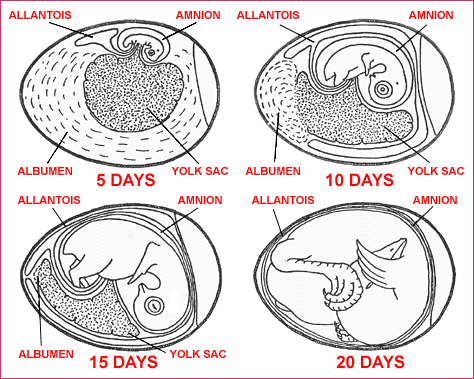
Actually bird eggs do contain an amniotic sac, which contains the embryo like the eggs of all amniotes (including reptiles, birds, and mammals). The sac bursts in the process of hatching. The remaining amniotic fluid is the reason chicks are wet as they emerge from the egg.
In bird’s eggs, other membranes, the allantois and chorion, are involved in gas exchange and the disposal of waste products. In mammals, these become incorporated into the placenta and umbilical cord.
A lot depends on the position of the baby–if the head is down and well engaged against the cervix there won’t be a lot of fluid to come out because the baby’s head is acting like a drain plug. In that case the majority of the amniotic fluid will come out in a gush after the baby is born. The amount of fluid involved in the “water breaking” is roughly analogous to a good pee–it would leave a puddle on the floor like a puppy who didn’t make it out in time and it’ll be enough to soak whatever clothing is in the way.
I lucked out with both kids–had to get up to pee and water broke while still on the terlet so no mess or need to change the sheets. Started labor right after that at 0700 with both of them, daughter was born at 1704 and son at high noon. Women in my family are kinda built for it.
I suspect there’s something either genetic or specific to a woman’s body that influences whether your waters break early or late (or not at all). I had to have the sac purposefully broken three times for all three babies - this seems more than just coincidence given that ‘having your waters break’ is so many people’s default start of labour.
On ‘having your waters break early’ (and the subsequent need to get the baby out) - I don’t think anyone’s mentioned yet how incredibly early NICUs can now care for premie babies. 26-week premies are now more likely to survive with no or few problems, than not and the record-holder so far is an incredible 21 and a half weeks. That makes just having the baby early a lot more feasible than it otherwise would be, though people can also be put on hospital bed rest to give the kid just that little more time to cook.
I don’t know if it is so overwhelmingly common, or if it’s more it just makes for great TV.
ETA: I mean, it certainly happens and it’s not uncommon, but in TV Land, it happens dramatically almost every single time. That doesn’t come anywhere near my own experience or the experience of women I know. Just as many had it broken when labor was stalling. And there’s a whole nother subset of women who had scheduled inductions or C-sections, and so there’s no telling what would have happened first.
When my water broke, it was only a small amount, like a tablespoon’s worth. I was unsure if that was really what happened! Then I started contractions about a minute apart. They had said to get to the hospital when they were 5 minutes apart, so my husband and I pretty much panicked. TWENTY HOURS LATER my little bundle of joy came into the world, via C-section.
Any doctor would ask a pregnant patient about leakage of blood or fluid, contractions, etc. As said, the water breaking means leaking amniotic fluid and the onset of delivery. Of course, like contractions, there can be “false alarms” and the water may turn out to be something else.
What happens is the woman goes to the ER or calls her obstetrician. In either case she goes to an obstetric in unit. A chemical test would verify if it is amniotic fluid (a simpler pH test would probably work). There is an assessment to see if the cervix is dilating, and a device to monitor contraction frequency and intensity is applied.
Even if the water is broken, delivery may take hours or not be imminent. The chance of infection increases a lot if the membranes are “prematurely ruptured” without delivery. In this case, the woman would be admitted to hospital, observed, may be given antibiotics, and may have delivery chemically induced if the baby is close to term and concern for infection or the safety of mother or baby is compromised.
I saw a movie about pregnancy and giving birth in Health-Ed and the giving birth part showed exactly that, the baby popping out into the arms of a gyn* immediately followed by what looked like a huge gusher that arched up and almost reached the rapidly retreating baby. Definitely not prurient even though I was a 15-year-old seeing his first lady-parts.
*After seeing that I never wondered why the slang term is baby-catcher.
My mother in law had a similar birth with my brother in law - but it was longer than a week. It was the mid 1960s in Europe and I suspect that the risks of infection were smaller than the risks of prematurity at that point and place in time.
Now, I suspect its pretty rare not to deliver, since we handle premies so much better.
Mine was quite a bit, but then the head went in like a plug and no more. In fact, by the time we got to the hospital, the nurse was convinced my water hadn’t broken (which caused all sorts of problems), because I was pretty dry.
Part of this was it took a bit to get to the hospital. My contractions weren’t close or painful (they started right away) and the OB on call said I shouldn’t go in until they were closer (less than five minutes apart is the rule of thumb). We had our son at home, so my parents were called to get him, they took half an hour to arrive, and then my husband, in his agitated state (I was in labor and it was the middle of the night), started talking to my dad (and not hearing me say ‘we should go now’) until my dad said “will you take my daughter to the hospital please?”). So it was two or three hours between water breaking and getting to the hospital.
Does anyone want to explain the mucus plug to these guys? Cause that’s weird.
 hmmm!
hmmm!