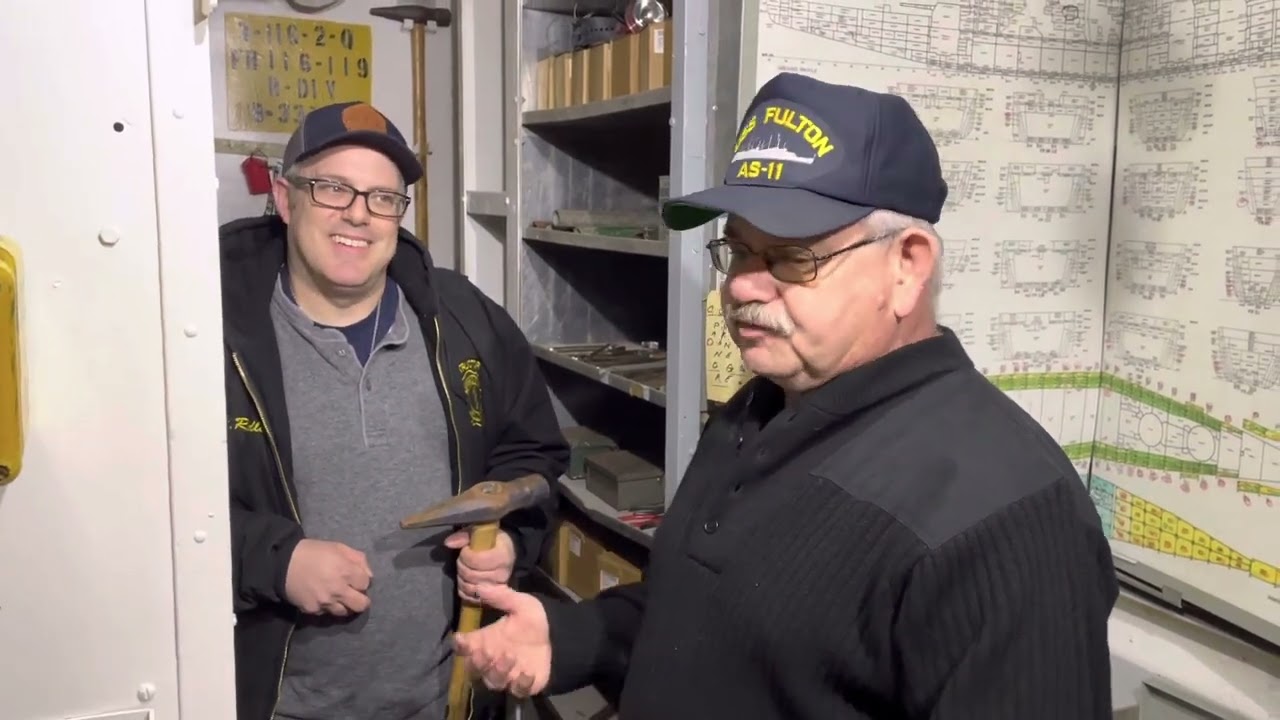
On the submarine: During battlestations, everyone is awake and has a place to be. It may be “stand by this valve and be ready to open it in an emergency”, or “stand here and be a messenger in case it’s needed”, or “stand here in firefighting gear and be ready to fight a fire”, or it may be an actual watch station, like helm or radio or the torpedo room. There’s no resting for anyone during battlestations.
Action stations can’t continue for ever, and people become ineffective without some sort of rest. Lookouts have to be relieved after a comparibly short time as their watchfulness rapidly decreases. In the past, it was thought desirable that they should be as uncomfortable as possible as it would stop them falling asleep.
Combat is why military ships have such a large crew to begin with, so there’s no way they’re going to tolerate idlers. A commercial ship of comparable size to a large warship might have a total crew complement of a half-dozen: That’s enough to handle all of the routine sailing tasks.
This is also why warship crews spend so much time on tasks like swabbing the deck, because you’ve usually (i.e., whenever you’re not in a battle) got a ton of surplus manpower available, and you don’t want idle hands.
Maybe someday there will be androids or robots lying motionless in their bunks until called to action, LOL. …. When my husband was in Marine boot camp decades ago he said they spent an inordinate amount of time cleaning and polishing their boots and doing a lot of make-work to keep them busy. That’s not the same as being on board an aircraft carrier, of course. I have a relative who’s a Naval officer, I should ask him sometime.
There is a lot not quite right about this post.
Idle Hands is not a major issue, there is a lot of work to be done on a Navy Ship.
Swabbing the decks is not done to an excess and only a small part of the crew is generally involved, though most junior enlisted do some swabbing at some point.
As I know it best, I will talk about Electrician Mates. We have to cover repairs, preventive maintenance (mostly inspecting equipment and controllers) and a lot of watch standing. The 8 Switchboards had to be manned in 4 hour shifts 24 hours a day at sea. We also had 2 in DC Central and one in the steering gear room. So it was hard to maintain enough qualified watch standers to limit watches to 1 per day. At sea we tended to have a 12-16 hour work day counting the watches.
To the OP: this is 40 years back now, but all hands report to a station for GQ (general quarters). If you didn’t have a GQ watch station, you were probably in a Damage Control Locker. A pencil pusher would still be expected to man a fire hose and learn how to assist more experience personal in stopping flooding and first aid as examples.
Electricians (EMs) generally were called Sparky and had their tool pouch, 10kv rubber gloves (which should be inspected at the beginning of every GQ) and EMs had to be ready for whatever was needed. Every DC Locker had someone assigned to the sound powered phones in case primary comms failed. This tied every Locker back to DC Central. DC Central was tied to the Bridge, every engineering space, the Bridge and the steering gear machine rooms. Most spaces had redundant comms to more than one station at DC Central.
A very long GQ would give sailors a chance to catch some rest, and to change watch standers. This never came up for us except for a long NBC drill. (Nuclear, Biological or Chemical attack). Box lunches were distributed to all stations. IIRC, I relieved the 7 switchboard watch and he got to take a nap I think. This was a long time ago now and it is a little fuzzy.
Oh, Marines assigned to ship are another story. They do have a lot of cleaning and drilling as opposed to real work. But they are a tiny portion of a ship’s crew. Of course Flight Wings might also be Marines and they worked their asses off during flight operations.
Not a clue, never worked civilian. Though I do understand as hearsay, that they function with redundancies, less systems to start with and accept things not working at > 99%.
Keep in mind a Carrier has 8 generators, 3 emergency generators, AC units for all those sailors. Galleys to support all those sailors, weapons especially defensive, very sophisticated electronics, etc.
Comparing the two is not all that reasonable.
The Gerald Ford class gets by with a significantly smaller crew than the Nimitz class did, but still huge. Nimitz maxed out to about 6000 with Flight Wing and as little as 5000 apparently which is what the USS Ranger had. The Gerald Ford runs 4500-4600 crew.
Just checking, it looks like Oil Tankers only have 3 generators and only one main engine room. Crew support is simple as you mentioned, tiny crews. Etc.
I personally know someone who can attest to how this works. My brother in law was a surface warfare officer aboard the ships launching missiles at ISIS. He thought his shift was the one that the attack would begin on, but it was delayed and the missiles were launched in the next shift when he was asleep in his bunk. He would have stayed up to witness it, seeing as it was a big deal, but there had been rumors it was about to begin for days, so assumed it was a false alarm and went to bed.
Look at it this way. A commercial ship has all the equipment it needs to get from one place to another, stay in communication, and keep the crew alive. A military ship has all that equipment, plus the weapons systems to detect and attack others, and the repair systems you need because someone is trying to kill you (over and above the normal dangers of the sea).
Less than 13 is rare and is really cutting things fine, even on a small oceangoing vessel -
You need three officers of the watch to stand 24 watches (8 hours each) and while the master can stand watches they rarely do. You also need three ordinary seafarers to be lookout/helmsman for the same reason
Similar for the engine room with engineers and motormen.
As stated above a ship at General Quarters (Action Stations for the Royal Navy) has no idlers. Between running the ship, working the weapons, and waiting to repair damage everyone has a job to do. In the movie Greyhound the captain’s steward is seen passing 40mm clips to one of the Bofors mounts still in his white jacket because he’d just brought the captain his breakfast when the alarm was called.
Somewhat in the film, much more strongly in the novel it was based on, was the fact that a fully functional crew is a finite resource. Among the many decisions Captain Krause had to juggle was having a crew instantly responding to an attack that could come at any time vs. being too worn to be effective.
Swabbing the decks is something specific to wooden decks. You need to keep them clean and free of any fresh water. Salt water is good for them. Wooden decks have the useful property of having very good traction wet or dry. But you won’t find one on a modern warship. Expensive pleasure craft and traditional vessels.
In the modern era, naval weaponry is vastly different to the days of battleships and big guns. You don’t have 70 people in a gun turret spread over 5 levels, man handing huge bags of explosive charge, and shells the mass of a small car. It wasn’t a long time ago the US Navy still had the odd battleship useful for land bombardment, and used right up to Desert Storm in 1991 But no more. The last, Missouri, being decommissioned in 1992.
Now you have banks of preloaded guided missiles in cells that require nothing more than the authority to fire and a button press. Guns are close in defence (CIWS), and medium (say 5 inch) that are fully automated. The downside to guided missiles is that once the cells are empty it is a trip to a shore facility for reloading. And the cost is eye watering.
In principle, the entire fray is run from with the combat information centre by operators at consoles. Other than the actual driving and powering of the ship, there just isn’t much to do. The work aboard to make sure the ship and systems are ready and operational leads up to the main game.
Perhaps the difficult question is what the next proper (ie symmetric) naval engagement will look like. Nobody has any real clue. It has been 9 decades since the last one. Guided missiles may make for a very short and very deadly encounter. Submarines make for a nervous time. Hypersonic missiles may make engagements suicidal. Whether a new generation of technology changes things is very open. (Say the UK’s Dragonfire, or someone makes a rail gun that doesn’t self destruct after ten rounds). Unmanned armed vessels are another open question.
Right now navies across the western world have trouble finding enough people. Designs with ever smaller crews appears to be significant trend.
The backbone of the US Fleet at least is still carriers, there is a lot to do on carriers for flight operations. Most of what I described from the 80s is still happening today on the bulk of our carriers. Your posts probably applies to Destroyers and Frigates, but their crews are in theory already shrinking and newer ships join the fleets.
Even the HMS Queen Elizabeth has a crew size of 1600 at sea.
The type 45 Destroyer, like the HMS Daring & The HMS Dauntless D33 in active service currently has a crew of only 190 though it can accommodate up to 245.
The USS Zumwalt DDG-1000 is the latest class of US destroyer and sadly basically a failure. But does manage to run at a Crew size of about 150-175 which is about half of previous Destroyers.
No, but I assume they don’t work 24-7? Obviously there are shifts where some crew are asleep so the ship maintains 24 hours of operation.
I’m also assuming by “battle” the OP means the ship has sounded “general quarters” in response to some immediate threat like an inbound aircraft, missile, or other ship where they lock down all the hatches and everyone has to be prepared for damage control, putting out fires, and whatnot.
Maybe my question is how does a Navy ship distinguish from “general quarters” to just normal combat operations? Like I assume when it’s at war, a carrier and its battlegroup are in a more or less constant state of sending out patrols, monitoring sensors, conducting flight operations, maybe fire support with main batteries or cruise missiles. I guess maybe firing the weapons would precipitate a general quarters alarm for safety reasons?