New Hampshire -- Watch Out For Falling Rocks

First it was The Old Man of the Mountain, which fell 23 years ago from Cannon Mountain in Franconia Notch.

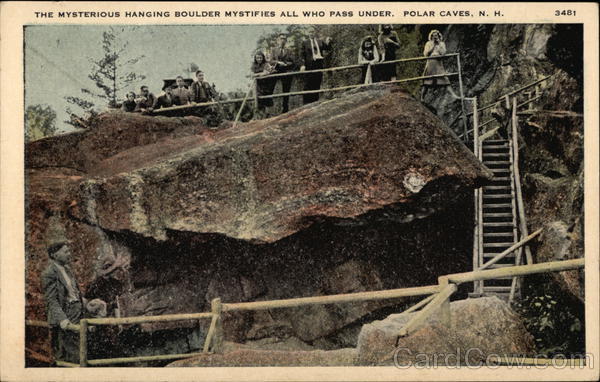
Today it was the “Mysterious Hanging Boulder” at Polar Caves in Rumney. I’ve visited many times and walked underneath this precariously-balanced 80 ton boulder. Nothing mysterious about it now - iut toppled over and crashed through the elaborate wooden walkway that meanders around the tumbled boulders on the site. The attraction had closed for the season last Sunday.

I visited there many times over the past several decades, the last time about a year ago.

An 80-ton rock dubbed the “Mysterious Hanging Boulder” that hung with three-quarters of its weight directly over hiking trails in New Hampshire fell on Sunday.

The incident happened at the Polar Caves in Rumney — located in the White Mountains region of New Hampshire — on the popular, privately owned park’s final day in operation for the 2026 season. No injuries were reported from the rock fall, according to Polar Caves.

A hiker identified only as Nicole was the first person to come across the trail way that was smashed beyond recognition during the day on Sunday, which Polar Caves addressed in a press release at around 1 p.m. on Monday.
The historic “Mysterious Hanging Boulder” was an 80-ton rock that was “cracked all the way through” and rested on three contact points in the back, according to a hand-painted sign on the Polar Caves trail.

It had rested at the Polar Caves — a family-friendly scenic tourist attraction with nine natural granite boulder caves formed by glaciers — in that fashion for at least 104 years, according to a park statement.

About 75% of the weight of the massive “Mysterious Hanging Boulder” was “hanging over your heads,” the sign informed hikers on the trail.
When the rock fell, it appeared to smash straight down through much of the wooden walkway — exactly where Nicole had planned to walk, her video posted on social media showed.

“So … we’re walking along this trail and I’m like, ‘Oh, look, a smashed railing,’” Nicole’s voice could be heard in the video, as she pans the frame over piles of wooden debris near the walkway she was on. She wondered aloud if rocks had fallen.

“And then there’s some ‘Mysterious Hanging Boulder’ sign,” Nicole says, panning to the brown sign.

The camera then pointed to a massive rectangular bolder, sat upright on top of more wooden railing debris.

Falling Rocks was the name of a beloved Native American tribal leader who mysteriously disappeared more than a hundred years ago. My dad never got tired of that joke.

Properly the signs read “Watch Out for Fallen Rocks” – it’s not really likely that you’re going to be hit by rocks that are actively falling. But it’s really easy to accidentally drive into rocks that have already fallen onto the roadbed. I came to appreciate this when driving up Big and Little Cottonwood Canyons outside Salt Lake City in the fog. There were frequent falls of rocks onto the road.

But I like “watch out for Falling Rocks” better – it’s more active, and suggests the possibility of being squished under an 80 pound boulder.

That had never occurred to me before, but I think you are correct.

The problem with “Look Out for Falling Rocks” is that it diverts people’s attention away from the roadway to look nervously sideways at the cliff next to the roadway. And if they do see movement, what are they supposed to do exactly? Stop and possibly get hit? Speed up? Drive into oncoming traffic?

Whereas “Look Out for Fallen Rocks” properly directs people’s attention up forward to the roadway ahead of them so that they are prepared to stop so they don’t run into them at highway speed (and possibly slow down as well when they see the sign).

I don’t think we got the memo in California. It’s almost always “Falling Rocks”.

On every road trip we took as a kid we’d see yellow diamond signs that said “Falling Rock”. And every time we did my father made the same joke as @Elmer_J.Fudd’s father.

Actually, I just checked the current version of the Manual on Uniform Traffic Control Devices (MUTCD) for Streets and Highways (11th edition), put out by the Department of Transportation - Federal Highway Administration. (This is also uniformly adopted nationwide by the states.)

And the current version of the sign is a yellow diamond warning sign with the inscription: “FALLEN ROCKS”.

The change from the earlier “Look out for falling rocks” or “Watch for Falling Rock" officially changed to FALLEN ROCKS in the December 2009 update to the MUTCD.

The change was made for exactly the reasons I surmised above: traffic safety engineers noted that drivers can rarely react to a rock actively in the air. The primary hazard is striking a rock (or rocks) that have already fallen into the road.

Which is not to say that all signs nationwide are immediately updated. They typically get the current wording when the sign in question comes up for replacement.

But that’s for streets and highways. You do still see the older wording for areas where people are on foot, like a trail in a state park.

Actual falling rocks that will intersect your trail at the same time you do are far less likely that fallen rocks that get there before you do and stay there. But I was once hiking in the mountains of Utah and heard the distinct distant ba-Bump Ba-Bump of a large rock rolling down a slope. Somewhere. I didn’t know where and couldn’t locate the source.
Fortunately, it didn’t get any louder, but it’s still disconcerting to hear.

Except that if you’re only walking*, turning a corner and finding a large rock impeding your pathway is less of an immediate danger than if you were driving a car and found the same. And similarly to how a car can rarely react to a falling rock, even if you do see that there’s a boulder in front of you, you can either go around it easily or you can’t.

Plus, looking upward occasionally is less dangerous on foot. So I can see how the safety equation is different for hikers.

*Rather than, say, trail running or bicycling.

UK sign:

It’s accepted by the states, except for California. California uses the basic MUTCD, but edits it. The differences between the versions is shown in blue in the CA MUTCD.

I’ll check for the sign when I get to work. Assuming there aren’t a bunch of emails waiting.

I bet there is a coyote under there.

In the lab next door is a big trundle cart labeled “Acme Dry Ice”. Every now and then I lift the lid to see if there is, as I suspect there should be, a coyote-shaped hole in the ice.

Don’t be silly!

The bump rising on his head would have pushed the rock off and he would have staggered home by now.

I like how the linked article couldn’t have been assed to post a “before” picture.

And the CA sign is, indeed, FALLEN ROCKS (W8-14).

Wow! For such potential disasters, even for formations that have been there for millennia, do they have engineers periodically inspect for cracks, changes in orientation, etc.?

Is that a thing? Is that even possible? Or do we just roll the dice, acknowledging that at some point the inevitable will occur?

I agree with the earlier post, that a coyote is likely beneath it all.

Could’ve been worse

10K views · 65 reactions | A MASSIVE Rock Breaks Off Right Above the Tourists! 😱 | Door to Nature

Balanced Rock in Arches Natural Park in Utah will eventually fall:

It shows up in the opening credits for Indiana Jones and the Last Crusade at just 1:00 in

https://www.youtube.com/watch?v=FPl6RPdJo_g