In additional irony, “zanav” has been rehabilitated as well – as in the “clean” expressions "nishbar li hazanav" or “shavuz” = “shvur zanav” (literally, “my [tail or whatever it stands for…] is broken” – I’m sick and tired.)
I learned “shavuz” in the Israel army in the early 90s. It’s used in-Army mostly (even though most everyone is in-Army, to some degree)? And is a little out of date by now? I’ve also heard that women say it, although I never have, sometimes, hyper cutely pronounced shvuza?
I’d like to note that there’s a subtle difference between “shavuz” and “nishbar li hazayin”, even though the first is an abbreviation of the second. The first means down in the dumps; the second means fed up, and can be said in anger, as in “Nishbar li hazayin with these motherfucking snakes on this motherfucking plane!”
It’s actually–as you know–“shvantz.” It’s also said by a mobster in that Herzog remake of Bad Lieutenant, and is still in use in Yiddish, as a filthy word.
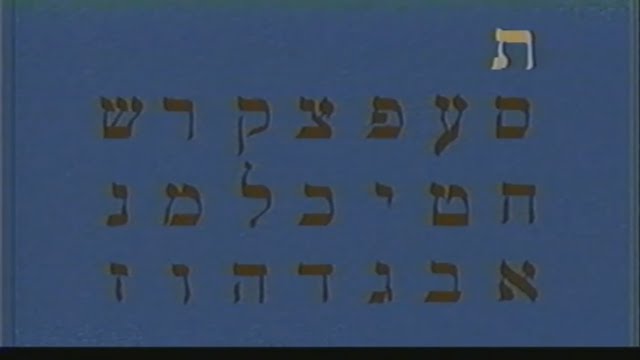
Somewhere upthread the ordering of the letters was questioned and answered nicely. The Jews, unsurprisingly, have loads of Rabbinic stories on just that question (God has reasons for everything), but my on-line (and, more important) Talmud and Midrash chops are history.
The only thing I remember is God took pity on the letter “bet,” who was upset that he didn’t lead off the alphabet, by making him the first letter of the Torah. (“‘B’ reishit”; In the beginning.)
I’ve seen the story–or maybe I made this connection–used the way “the stone the builders rejected becomes the cornerstone.”
But the story in Midrash is an answer to a very clear-cut question: if Hebrew is the language of creation, why does not it begin similarly?
Addendum: The opening “bet” that is in all written Torah scrolls is larger than the following letters, and I believe this is also part of “bet”'s recompense.
It’s funny, there used to be a tradition in Islamic calligraphy that the letter bā’ was written tall with an ascender, like a lām with a dot under it, but only in the opening phrase “Bismillāh al-Raḥmān al-Raḥīm” at the very beginning of a book. Now it becomes apparent where they stole the idea from!
IIRC it also involved some Sufi mysticism in how all the meaning of the Torah, Psalms, Gospel, and Qur’ān was condensed into the Bismillāh, and all of that was condensed into the first letter bā’, which was further condensed into just the dot under the bā’: ب — as though that single point was the singularity of the universe. The Qur’ān commentators said that God first created The Pen to write the decrees of creation, and a drop of ink dropped from The Pen, which made the dot under the letter bā’.
Thanks :D—but my story is probably a bit too violent for little kids. I only made that up because I wanted to know if it was possible and if anyone has come up with a better story!
I read somewhere this: the Torah does not begin with the first letter, because there may or may not have been something before God created the heavens and the earth. It begins with Beth, because Beth is closed in three directions and open only to the left, the direction you read in Hebrew-- meaning that you cannot inquire what might have come before then, you can only read on from there.
I appreciate your easy-to-remember and lively story about the order of the Hebrew alphabets. That is interesting for kids and for new Hebrew learners like me. However, there may be a higher level involving spiritual connotations as presented by the following link:
Hm, those guys have set out to reinvent the Qabbalah from scratch. There was no indication that they would draw upon any of the traditional Qabbalistic lore of the letters.
One quibble: Although the Hebrew words for eight (shemonah) and fat (shemen) are made of the same three root letters, they’re not related. Eight comes from the Proto-Semitic root *θmn, while fat is from the PS root *šmn. In Hebrew, the Proto-Semitic *θ and *š both collapsed into š, allowing for this sort of confusion.