Several times when spending a large bill (my tenant insists on paying me in cash-I feel like a drug dealer) the person at the cash register swipes a marker over the bill. I presume this proves that it is real money. What do they do if it is counterfeit? Press a button under the register and keep me talking until the police show up? Apologize and refuse to take the bill? Run screaming from the counter?
How accurate is that money marker?
They’re iodine markers that detect the presence of starch, which authentic US currency doesn’t contain. If the bill is good, the ink is clear or light brown. If there’s starch, it turns black and the bill is presumably no good.
At my work the policy is to give the bill back to the customer and tell them we can’t accept it because we can’t verify that it’s real.
I would recommend looking for other security measures on modern banknotes, like the color changing ink or the security thread that displays the bill value when held up to light.
Thanks, Smapti. Not that I don’t trust my tenant.
I’ve seen bills checked like that. I’ve never seen one come up as fake. I wonder how often it happens. Must be at least once in a while, or no one would bother checking.
If they call the police they’ll ask you questions about where it came from. Then you lose the bill. No refunds, no take backs. It’s just gone.
Unless they decipher you’re the one printing it I assume you’d be free to go. If you told your tenants name they will probably talk to them as well.
The burden of proof would be on them if they prosecuted you. That’s a tall ladder.
If questioned. Say nothing. “I know noth-kink”
You’ll be fine
If the note ends up at the bank, they confiscate it immediately and ask questions about its provenance to trace it and use a standard Secret Service form to compile the information and later send it off to the gov. If you didn’t notice upon accepting it but deposit it, it would lead to the tenant and then they would have the record. You don’t get compensated for it but would have the copy of the form if the counterfeits are sourced and become a case. You doing so at a bank is not a sign that you are doing anything wrong, but should truthfully answer the questions to the best of your knowledge.
So if someone wants to be difficult, they soak their bills in starch solution? Then deposit them in the bank, which uses less simplistic detection methods, so may recirculate them unawares?
Three articles on counterfeit money detectors that do not bode well:
Why Counterfeit Pens Are Not Reliable - AccuBANKER USA
Why Counterfeit Pens Are Not Reliable – Carnation Bill Money Counting Machines
Why Counterfeit Pens are Not a Reliable Way to Detect Fake Money
Obviously using the pens alone is not enough. Most American banknotes have other security measures that one can look for, like the security thread or the color-changing ink. Plus the paper feels very different from regular copy paper.
But do store clerks actually use these other methods as a whole?
I have seen bill scanners like this one at Target Stores cash registers. No idea if the cashiers use them regularly, as I almost always use a credit card..
Policy at my store is “apologize and refuse to take the bill”. If that leads to issues then you call a manager.
Counterfeit bills are common enough that if you’re an adult you have almost certainly accepted or spent one at some point unaware that you did so.
It’s not just the high-denomination bills - our stack of “funny money” we use for training purposes (they’re authentic fakes we found during the course of business) includes singles and fives as well as hundreds, and the bills in between those.
except that if the bill has been in contact with something with starch for an extended period of time (like in between the pages of a book, or maybe something else) it can absorb sufficient starch to trigger the pen.
That works for newer bills, but we’ve received paper currency as old as printed in 1923 at my store. Higher value bills are more likely to be older because they don’t circulate as much.
Really, it doesn’t hurt to use a combination of techniques to determine if money is genuine or not.
Where I have been working for the past decade we’ll get a fake about one a week during the holidays. Randomly at other times of the year. For a store that sees a couple thousand customers a day.
At my store, yes, YMMV.
Perhaps worth more than face value?
Yes. It’s routine for us to check large bills by holding them up to the light to check for the watermark and thermal strip. We also have a bill scanner in customer service that we can use to alleviate any doubts, and a large bill sorter in bookkeeping that identifies fakes. Older bills have microprinting that can be examined by zooming in on them with your phone camera.
The truth of the matter, though, is that most of the counterfeits we see aren’t highly sophisticated superbills. They’re either printed on shoddy paper which noticeably doesn’t feel right, or, more recently, they’re just motion picture prop bills designed to look good from a distance but are obviously not real if you look at them for even a second, like so;
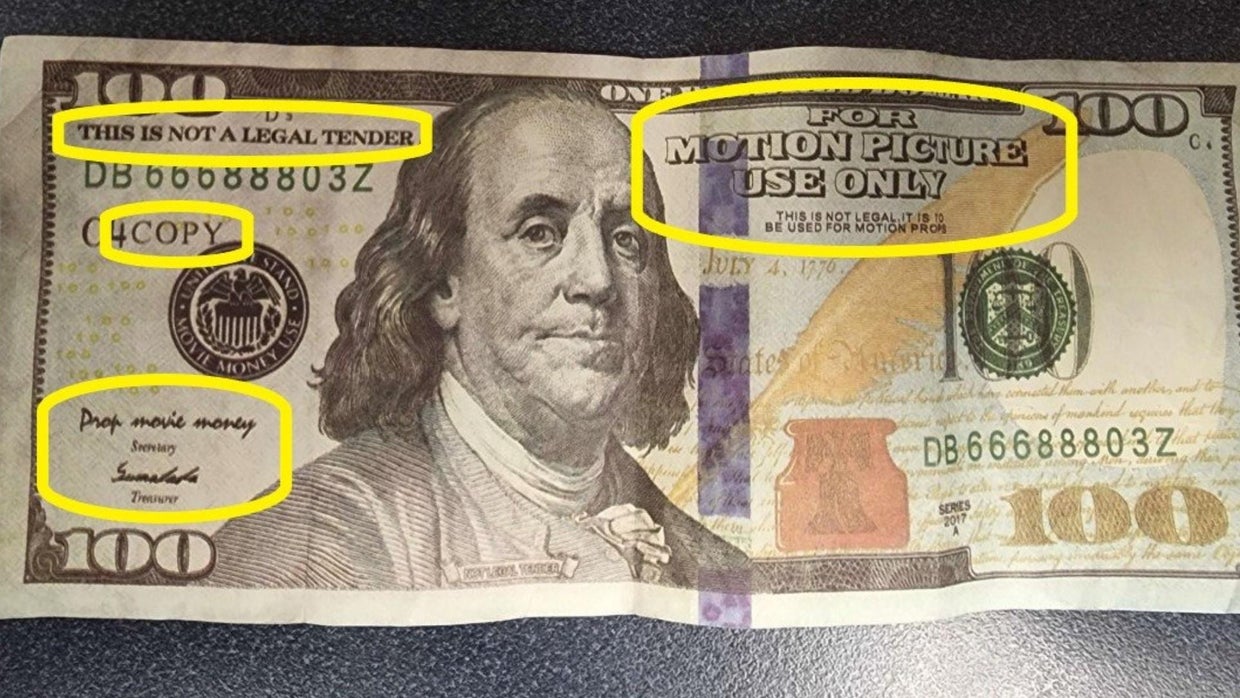
Definitely in some cases.
Nobody is counterfeiting $1 or $5 bills, it is usually $100s. Most of the people trying to use this money were already scamed by someone else and ended up with the fake bill. Almost every place that I am aware of uses the pen on all $100s. People finding out that their 100 is fake, and have it turned into the police can be quite upset because that can be a significant amount of money to lose. They have lost all that money and have no recourse other than being out the money. And the store or business has to turn the money over to the police/FBI. Or they can give it back, but that is probably an illegal transaction too.
My mom came across one of those recently (she wasn’t passed it; I’m not sure precisely how she got it). Aside from the “this is fake” messages on it, it looked basically right, but the feel of it was completely wrong. It just felt like normal paper, not like a real bill.
I’ve heard that some counterfeiters start with genuine $1 bills, bleach them somehow to erase them, and then print higher denominations on them. That’d fool any test that’s based only on the kind of paper.
They tested my $50 at Petco. Frozen fish food is darned expensive.