If you want to understand that, take a look at the money the Ds have spent on messaging in those areas. ($0)
It’s very difficult to obfuscate in Irish. There are no words for “yes” or “no”, you have to repeat back the verbs in the positive or negative. So it makes telling lies a much more stark and intentional process. Mind you, we’ve got a thousand ways to say “maybe.”
I’m surprised to see “redd up” mentioned multiple times here. I always thought that was a Pennsylvania Dutch phrase.
Some of my dad’s hunting lore is that squirrels get “wolves”, tumor-like masses under the skin that appear during the summer. So you don’t hunt squirrels until after the first frost, when the “wolves” go away.
I later learned some things from this:
- “wolves” was a Middle English term for “tumor”, on the folk theory that a tumor is a wolf eating a person from the inside.
- Squirrel “wolves” are infestations of botfly larvae, explaining why they appear in summer and drop in the winter
- It’s better to hunt squirrels in autumn and early winter anyway, because that’s when they’re fattest.
- A lot of Appalachian folklore is bunk.
Different thing, but a century ago, my ancestors who didn’t want to admit they drink beer would winkingly call it “Tennessee Pepsi” in front of the kids (Tennessee being a reference point for things exotic or incomprehensibly distant from Tupelo, MS).
I think my family has some different pronunciations. though It’s more like upper rural midwest than Appalachian. Everyone else in the US says ‘cra-yawn’ yet my parents say ‘cran!’ It sounds like they’re going to talk about Oceanspray but they’re talking instead about the same Crayolas everyone else would grab from a bucket.
Whoa! I haven’t heard that word in a million years. But yeah, I know it.

The famed Ark-La-Tex - Wikipedia.
You might also work on removing “yeet” if you’re serious about that project. 
I’d never seen that Wikipedia link.
Thanks
Oil was key to bringing jobs and easing agricultural poverty in the 1920’s.
Oil Refineries and Chemical plants opened soon. Ammonia AND Bromine is employing people.
I left South Arkansas after college. I haven’t visited any of the S. Ark. small towns since my parents passed.
How is “redd up” pronounced?
Is it slurred together or two words?
Sounds like red up. Two separate words but this area does have a lot of slurring lol!
Don’t have anything to contribute to this topic (beyond “settee” being in common UK usage and “poke” for a bag being very common during my childhood in 1980’s Scotland), but reading some Cormac McCarthy novels set in this region, I came across the phrase “I’d admire me a glass of water”. I took this to mean “I’d be grateful for some water” but it’s an odd turn of phrase and I wondered if it’s a particularly localised usage or even a totally fabricated saying
I did not know yeet was particular to Appalachia! I rarely use it.
Just love the sound of saying Yeet!
I’ve never in my life heard anyone say “woish” but I’ve heard “warsh” plenty. In fact, everyone on my father’s side of the family said ‘warsh’. It grated on my ears to hear it even as a child. One other pronunciation peculiarity my father and grandfather both did was pronounce ‘Tigers’ as ‘Taggers’. Again, nails on chalkboard to my young and discerning ears. I wonder if that’s an Appalachian thing?
My mother used to say chifferobe (but prounouced it ‘chef-robe’). I had always understood the term to refer to a particular type of furniture; a dresser that had drawers AND a little vertical cabinet for hanging clothes in. Four year old me just knew it was the ideal place to hide when playing hide and seek.
Pronounced “ret up” or “red up”. I always heard “ret” but I believe “red” is more common, especially in the Pittsburgh area.
Many younger folks seem to think it actually refers to the color red, but it doesn’t. “Ret”, “red”, and “redd” all seem to be common, and “rid up” seems to have at least some use (according to Google). “Redd” is probably the most correct as that matches the Scotch-Irish version of the word.
Google’s bullshit generator thinks that it is Scotch-Irish, with some popularization from Pennsylvania Dutch. Google claims that the word is heavily used in Pittsburgh but is also common throughout Appalachia, and is also used in Scotland and Northern Ireland.
Google also thinks that the word originates from the middle English word “redd”, meaning to rescue, free or clear.
That’s how we used it too. But pronounced SHIFF-ih-robe.
Rernt=ruined
Rock an row=rock and roll
Also, it took my Baltimore/DC area wife decades to pronounce Appalachia correctly (with a short a in the third syllable).
I have heard that expression and I always though it came from “ready,” as in “get ready.”
Someone said it above… “Redd up the parlor ‘cause we got company comin’,” i.e. “Get the parlor ready for company.”
My parents are both southern and my mom is actually from the southern end of the Appalachians. So I’d heard of terms like 'britches." But I was raised in the DC area and still mostly a Marylander in nature. Even after doing my undergrad and then some in NC, I was unprepared for moving up to Boone for Appalachian State University. Working at Harris-Teeter, old folks would ask where they could find the “Ko-kola” and “Shake Cheese.” I figured out Coca Cola but had to be shown that shake cheese was the Kraft grated parmesan in a can. My mom told me they called a Coco-Cola a “Dope” and the extremely racist term for Brazil nuts.
I’ve heard the converse from the pre-Boomer generation, in which words like ‘gas’ and ‘half’ might be pronounced ‘geiss’ and ‘hyfe’, respectively.
And with respect to the ‘l’ being dropped in some words *(seems like they’re mostly monosyllabic), to my ears, there’s often some compensatory lengthening with the preceding vowel.
*(“Goad” for “gold,” “guff” for “gulf,” “hoe” for “hole,” etc.)
I grew up in rural Ohio between Columbus and Cleveland. (See the map below; I was in the gap.) Lots of family in Ashland county. Me and my sisters figured out in middle school that “woish” was not how it was pronounced on tv. And we consciously trained ourselves to pronounce it “waash”.
I found this useful article.
The map:
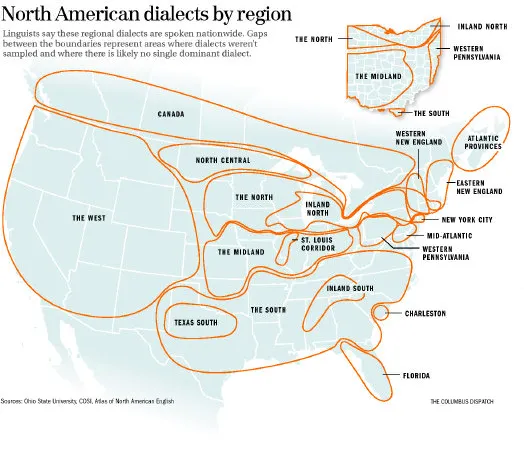
In my experience, that South dialect in Ohio goes a lot farther north, covering most of south eastern Ohio. They speak like West Virginians there.
Phrases like “me and my sisters did something” sounds natural to me. As opposed to “my sisters and I did something”, which sounds stilted. I’ve learned to code switch as most people with minority dialects do.
Other maybe weird pronunciations:
“perfect” said as “perfick”,
“ancient” as “ainchunt”,
“iron” as “eye-urn”.
It’s hard for me to tell what’s standard sometimes.
I grew up in East Tennessee, just past the Virginia border off Interstate 81. I tend to draw out words like gold; it would become “gowld”. I can’t think of any words where I drop the l. I had a girlfriend from Connecticut who couldn’t wrap her head around how I pronounced “butt”. I’m not sure I can figure out how to spell the pronouciation phonetically.