[quote=“nevadaexile, post:159, topic:679855”]
[LIST=1]
[li]It’s a moon, not a planet. Therefore its surface area is far smaller than a planet making it easier to survey. And that would have to be done by satellite, not by a spacecraft, unless they planned on a survey taking years. Also the gravity would be lower than Earth-normal because of its smaller size.[/li][/quote]
False assumption. The fact that it’s a moon doesn’t necessarily mean it’s small–it just means that it would have to be orbiting a very big planet. Its primary is Calpamos, a gas giant, which qualifies. The fact that they’re trying to terraform it means that it has enough gravity to hold an Earth-like atmosphere, and there’s no obvious indication in the films that the gravity is much lower than Earth’s. In essence, practical considerations indicate that the moon has to be pretty big or incredibly dense.
Other secondary canon material on the setting (the Aliens: Colonial Marines Technical Manual) establishes LV-426 as having an average diameter of 12201 km (vs 12742 km for Earth) and a gravity of 0.86g. That doesn’t seem out of line with what we see, though it’s quite big even for a gas giant’s moon. I believe there was some mention in secondary materials that it was a relatively recent capture–it may have actually been a lone planet at one point, and is only called a moon because it’s been captured by the much larger planet.
[quote]
[li]Again…the colonists had no aircraft or spaceships. To get anywhere in a wheeled vehicle (even on a small moon) would take hours or days. The site obviously had to be close or they would have missed it. Or the story would have unfolded over the span of a t least a year, rather than the several months or so that it did.[/li][/quote]
The Jorden’s vehicle allegedly has a top on-road speed of 110 km/hr (~69mph). Modern ATVs generally have top speeds between 40 and 60 mph, so it’s not implausible. Even if it’s restricted to less than half that under off-road conditions, one long day’s drive could put the distance at ~200-300 miles. In the director’s cut, a discussion between the colony ops manager and his assistant mentioned sending them “out past the Ilium range a couple of days ago” when the Jordens call in to report that they’ve found something. So, call it two days travel to reach the Derelict–that puts it maybe 400 to 600 miles away, apparently on the far side of a low mountain range. (Which would account for it surviving the explosion of the processing plant, but that’s another matter.)
So, it was hardly in their backyard, but it wasn’t so far away that the timeline (Russ Jorden getting facehugged and getting back to the colony base before the chestburster popped out) is unreasonable.
[quote]
[li]The satellite dish wasn’t that large. And why would there only be ONE? Is redundancy no longer a valid concept in the future?[/li][/quote]
The dish itself is just a big piece of metal; there’s not much to go wrong with it short of something big hitting it really hard. They probably had or could fabricate spare parts for it, but there was really no reason to have redundant dishes, just spares for the equipment in the feed assembly. Given a two-week communications delay, they weren’t going to get realtime responses from the company, anyway, so a few hours of repair time if it were damaged would not make that much difference.
[quote]
[li] The alien ship (actually the Space Jockey/Engineer’s ship) is shown to be the size of a football arena. Hardly small. And it’s in the open. It’s not hidden.[/li][/quote]
Well, a football field, anyway. It’s settled in what appears to be a crater, or at least a ruggedly rocky area, not entirely in the open, and its curved structure and textured surface give it a superficial resemblance to a kind of odd rock formation. Between that and the perpetually murky, dusty atmosphere, it would be pretty hard to spot.
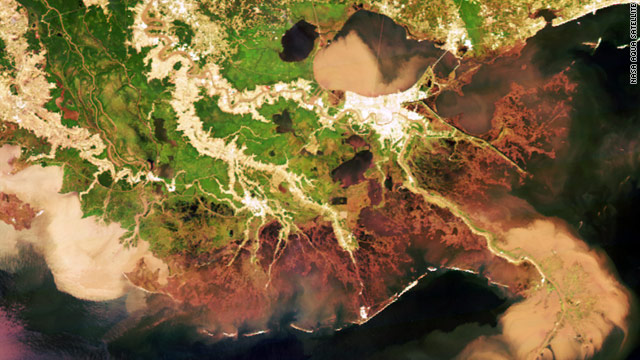
The surface area of LV-426 is ~468 million km[sup]2[/sup]. If we take you literally, and say that the Derelict is the size of the Superdome, we’re looking at it covering an area of ~0.2 km[sup]2[/sup]. Put another way, here’s a pretty good satellite image of South Louisiana. Can you spot the Superdome?
[quote]
[li] You hardly be “saving money” if you attempt to terraform a moon with a supervolcano on it or a large mass of a naturally occurring, but unstable element. How would you find that out? Oh wait…you’d SURVEY THE ENTIRE MOON TO MAKE SURE THAT THERE WASN"T ANYTHING LIKE THAT THERE.[/li][/quote]
They probably did. A supervolcano is pretty noticeable, what with massive heat signatures and the like. Large masses of unstable elements (by which I presume you mean radioactive) would be easily detectable by their emissions (and probably make the W-Y execs drool, not back off). A survey ship could spot those much more easily than a (relatively) small, passive, rock-looking structure in the middle of a rock formation. They probably landed a survey team on the surface, too, but the Derelict’s location doesn’t look like a good landing site, even if they happened to look at it.
The survey team found no life, of course. Apparently not even microbes. No microbes in your survey area is a pretty good indication there’s no native life on the planet–or, as one of the W-Y reps said, “It’s a rock. No indigenous life.”